


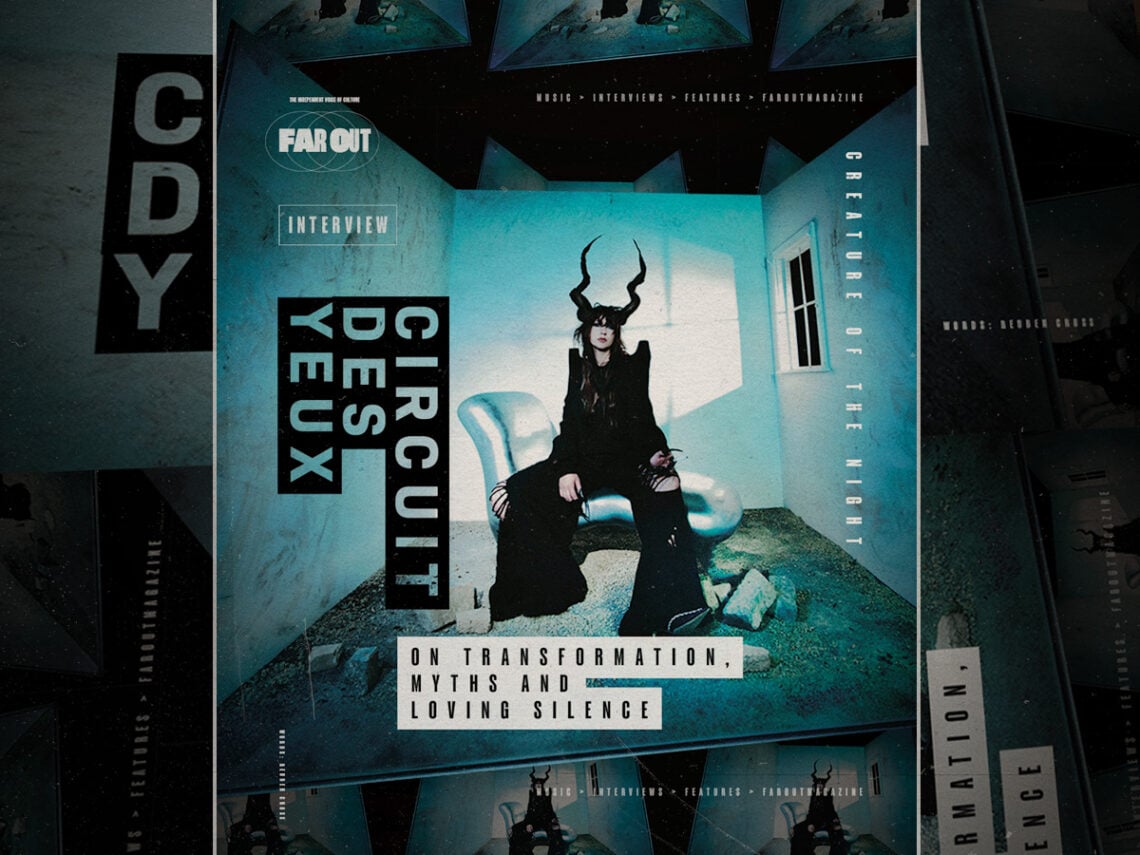
Creature of the night: Circuit des Yeux on transformation, myths and loving silence

Given how 2021’s -io and 2017’s Reaching for Indigo were thematically rooted in traumatic experiences, it’s no wonder that Chicago-based experimental artist Haley Fohr felt a desire to escape her past for her latest album under the Circuit des Yeux moniker. On Halo on the Inside, she is a woman transformed, drifting further away from the grief-stricken worlds she has visited on previous outings and delivering a defiant statement that feels dramatically severed from her old music.
Fohr knew that she couldn’t make the jump from the neo-classical sound of -io to the industrial and almost danceable Halo without providing some forewarning about her artistic shift. So she chose to ease her listeners into these new horizons with a litmus test of a single titled ‘God Dick’. “I know my music is kind of dark,” Fohr admits, “But I didn’t want to freak out all of my long-time followers.” While she may have seen ‘God Dick’ as a reasonable connecting point between her previous work and the new chapter, it’s hardly what you’d call a welcoming invitation.
As fearless as the track and the album might seem, Fohr’s music is still teeming with emotional intensity and doesn’t make for easy listening. The way she has pivoted from the symphonic sound she was “obsessed with” during the making of -io to the electronic-heavy doesn’t forego any of the vigour and bombast of her previous albums; it instead repackages it in a different fashion and relies on a fresh approach to production.
Having parted ways with her previous production collaborator Cooper Crain after ten years of working together, Fohr attests that Halo was “a marriage of ideas between me and the producer, Andrew Broder,” adding that it was imperative to her that she found someone she could be friends with and share a sense of intimacy. After trialling out several candidates where “nothing felt right” in terms of her ambitions for the new record, Broder’s resume was ultimately what sold her on the idea of bringing him on board.
“He worked with this Indigenous singer in America, Joe Rainey, for a record that came out on People Records, and it’s beautiful,” Fohr explained. “It reminds me of Alice Coltrane. They utilised cassette samples with electronics and strings to make something I’ve never really heard before. I was really taken aback by it.”

Removing herself from the comfort zone of recording with someone she already knew and trusted was another significant part of her leap into the unknown and transformation. However, a simple change in sound and producer is not enough to warrant being called what Fohr refers to as a “metamorphosis”. In an attempt to understand what she meant by this and not take it as a literal Kafkaesque shapeshifting act, deeper questioning was needed.
“I’ve been quoted and thought for a long time that life was suffering,” she explains pensively. “That was my big motto, kind of a Buddhist saying, and I don’t think that anymore. I think life is change.” This seismic internal shift is more in line with the metamorphosing process that Fohr has forced herself to undergo. “When I say metamorphosis, I think I don’t think about my entirety breaking down and coming back to life. It was like a small inside thing that came outside, and it feels like the final frontier for me. I’m going in[to] places that I’ve been really embarrassed to go before.”
Fohr elaborates on how the album ended up being a collection of love songs despite, by her own admission, never having written a love song before due to feeling shy about expressing this part of her identity on record. “I didn’t think I was writing a love album, so in that way, I’m facing the cheesy truth.” The internalised conflict surrounding the display of a sense of sexuality and amorousness finally gave way during the process of writing and recording Halo, and Fohr began to embrace it rather than allow it to confuse and cloud the process.
“I think the messaging is internal,” Fohr concludes in a way confirming to herself that the album turned out this way for her own good. “I think I’m singing lullabies to myself, but it was made during a period of dating. Since I’ve been working on it, they’ve kind of jumped meaning, and they take on meanings for other people or other situations, which is interesting.”
Another relationship that Fohr established between recording albums was a friendship with fellow experimental producer Claire Rousay, who created an EP of remixes for -io in 2022. After witnessing the way in which she minimised the grandiose sound of the 16-piece orchestra on the record into equally powerful electronic compositions, Fohr felt that her ambitions for scaling down the sound without sacrificing her aspirations were suddenly a bit more within reach.
“She reminds me of early female pioneers who were doing things with tape machines and oscillators, except she’s doing them on a laptop,” Fohr says in admiration of Rousay’s process. “It was cool to hear what she decided to do with a couple of my songs. I was surprised she was able to double down on the emotion somehow but do it in a more minimalist way.” There were distinctions between their approaches that Fohr recognised began to shift after being exposed to her reworkings. “I feel more of a maximalist than her, and I think that getting to know her and working with her subconsciously helped me lean into the minutia and the more minimal aspect of making songs.”
It wasn’t a straightforward decision to shed the string section, however. Fohr realised there was more than just an infatuation with the grand string sound, but a sociological driving factor behind her desire to work with a larger ensemble. “It’s kind of like a class war thing,” Fohr explains. “I grew up not having access to those types of concerts or instruments because I come from a small pharmaceutical town in Indiana where SUVs are made. With -io, I learned so much, and it brought in my ability to compose for other instruments, but that kind of maximalism is just unsustainable.”
In addition to having the burden of touring with nine of the 16-piece ensemble and also writing individual parts for them, Fohr felt as though the Steve Reich- and Philip Glass-inspired parts she was providing were too rudimentary for the musicians she was working alongside. “I was working with these world-renowned players,” she continued. “I felt like I was caging a bird. My parts weren’t written for someone of that calibre.”
The pharmaceutical town she grew up in was Lafayette, Indiana, situated about three hours southeast of the city of Chicago she now calls home. “I don’t think I went until I was a teenager,” Fohr recalls of her earliest experiences in ‘Windy City’. “I started a punk band called Cro Magnon when I was 17, so I remember going to Chicago where we played shows to not very many people.”
It didn’t take long for her to feel immersed in everything the city had to offer, recalling an early solo show at the Flower Shop on the south side with US Girls. “I remember just thinking, ‘Wow, this city is so big and beautiful, and I want to come back here more’,” Fohr said, only for it to not just become a reality but to find herself living on the same street as the venue ten years later.

As for feeling like a part of the rich heritage of Chicago’s music scene, Fohr realises that while she has only lived there since adulthood, her work is still connected to the former generations. “I moved there in 2012,” she says, “so things like Tortoise were before my time, but the sheer experimentalism and mashing of genres in this sacrilegious way is pretty evident in my music and stuff that’s happening now that’s new.” Citing the existence of notable record labels in the city, such as Thrill Jockey and Drag City, and noting how many of the venues are artist-owned, she does insist that it’s not exactly glamorous. “You can see Sam Prekop play three or four nights a week, but it might only be to 18 people.”
One of the constant features of Circuit des Yeux is the uniqueness of Fohr’s voice—one that explodes with passion on every track. It’s often remarked that she has a four-octave vocal range, but despite its impressiveness, she tries to downplay it by explaining that it took a lot of encouragement to even discover this talent as a timid child. “I had a teacher pull me aside and say, ‘I want you to try to sing this solo’,” she recounts. “I was so scared, but she obviously heard something coming from me in a group of children, and I stayed afterwards and did the national anthem for her. I remember her having to go like further and further down the piano until I was in this boy range, and once I did that little solo, my parents were flabbergasted and put me into voice lessons.”
Taking vocal lessons for around ten years, Fohr was exposed to performing everything from Italian arias to jazz standards, discovering influential artists like Billie Holiday in the process. While now she says she focuses primarily on extended vocal techniques employed by female artists such as Linda Sharrock, Diamanda Galás and Yoko Ono to mimic more unusual sounds, she’s quite relaxed about the way she chooses to maintain her vocal strength. “I’m not Mariah Carey,” she laughs. “I don’t sleep with a humidifier over my head and stuff. I mean, she’s amazing, and it pays off, but I feel like the less neurotic I am about my voice, the better.”
Humidifier or not, sleep is an interesting subject for Fohr, considering how large amounts of the album were made in the dead of night. “I’ve dealt with a lot of shame being a night owl,” she says excitedly, as though she doesn’t get to speak to anyone about her sleeping habits. “I learned while making this album that I very possibly have slight narcolepsy, which makes a lot of sense. It means that my circadian rhythm is not 24 hours.” Unsure of what this means, she delves a little further into the scientific side of this. “My brain wakes up late at night. I sleep late in the day. I didn’t have roommates or a witness, so things just got weird pretty quickly, and I found that the time between maybe 2:00 and 6:00 was the time I was actually relaxed enough and knew that everyone in my life was sound asleep that I could actually get to the heart of something interesting.”
The stillness of the night was a huge inspiration for the more minimalist moments of Halo, and the shared atrium that Fohr’s basement workspace led to was a place of solace for her. “There’s this big tree inside my complex that I would walk around and look up into these like skylights that either showed stars or clouds. I wasn’t outside, I was inside, and it felt more like a womb or an incubator or something.” Being so cut off from the rest of civilisation can be difficult to contend with for some, but Fohr isn’t bothered by that in the slightest. “Chicago is such a loud city, and it’s really tough to find that kind of serene, boringness of silence. I learned that I quite like it.”
In addition to the nighttime, Greek mythology was another major inspiration behind the themes of Halo, and this is another topic that Fohr seemingly relishes discussing. It’s been a fascination of hers since childhood, and finally getting the opportunity to travel there for a holiday during the making of the album significantly changed her personal outlook on life. It would appear that the final part of her personal transformative journey was completed once she encountered a deity that spoke to her on a personal level.
“The Greek myth of Pan came front and centre while I was at the museum and reading up about things. I just identified a lot with it,” Fohr explained. “Pan is debaucherous; they play, and they drink, and he has this flute. Melody and sex are like his main themes, and there was a lot of that in my life at that time: levity through music and sex and being with people.” He might be debaucherous, but his story isn’t all about enjoyment. “I just thought it was so interesting that in the mythology of Pan, he dies, right? I love that. I love the anti-hero.”
Fohr exasperatedly stresses that Pan succumbing to his demise, even as a demi-god, and instead filling his life with the finer things, is where she wishes to find herself. “I am so tired of trying to work myself into this elevated extension of myself, and this idea that we’re always bettering ourselves. This half-god, half-human leans towards the human instead of the God. I really think that there is something to, like, be learned there, that we’re enough and that maybe we’re not born with sin, like many religions teach us.”
This latest album is just her way of expressing her desire to mirror this way of life, and its title is symbolic of how she wants to be viewed despite her flaws. “What if we’re just born pure, and the halo’s on the inside?” she asks introspectively. There’s a lot to consider and still be discovered for Fohr, but she appears to be looking in all the places she feels most comfortable.
