


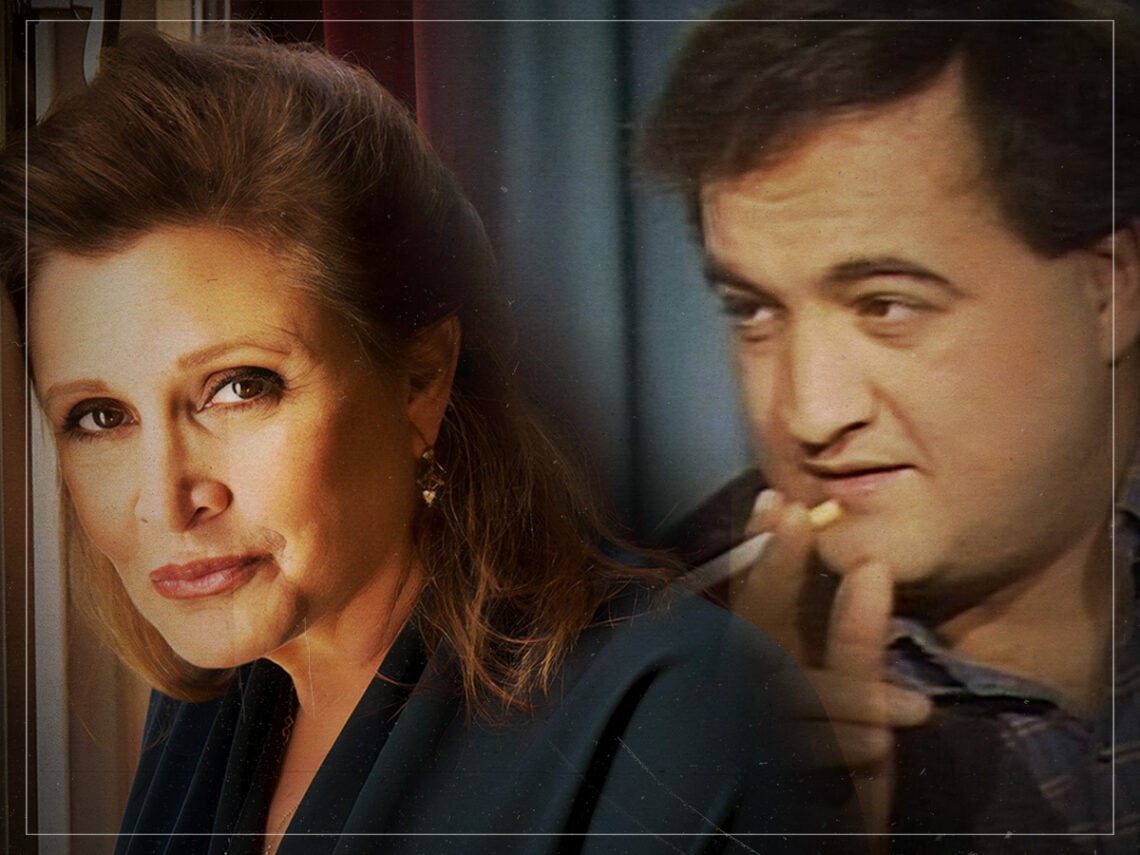
Carrie Fisher’s biggest regret about John Belushi: “He just went straight to death”

The art world has held a lot of tragedy. Layers upon layers of tragedy, in fact, of idols losing friends and then the world losing those idols, of people mourning others and then people mourning them. Carrie Fisher knew it well, and then the world knew it about her too.
We could discuss till we’re blue in the face about why this happens. Some chalk it up to the damaging tortured artist trope, leading people to feel like their pain is what makes them talented, and so they never get adequate help. Others would say that it’s simply down to the type of personality artists tend to have, one that delicately and dangerously balances sensitivity and ego. Or, it could all be down to access.
When a person gets famous and the world is at their feet, how do you keep your head? Especially if things were fragile before?
Fisher was always open about that. She had no qualms sharing her experiences with drug abuse and her struggles living with bipolar disorder. It’s part of what made her so deeply beloved in the public eye, as so many heard Fisher talk or read her writings about mental health and related issues.
She was open about her cocaine addiction. Especially smothered by it in the 1980s, Fisher said, “Slowly, I realised I was doing a bit more drugs than other people and losing my choice in the matter,” eventually suffering a near-fatal overdose in 1985. So Fisher had been around the block. She knew the pains and the risks and the struggles, yet still, that doesn’t mean she could ever save someone else.

From the end of the 1970s, Fisher had fallen in with the SNL crowd, finding herself in a big friendship group of the young and funny stars, including John Belushi. “John and Carrie had become very close right away,” Judy Belushi, John’s wife, said of their friendship. “He didn’t suffer fools. Carrie was very feisty.”
But really, what drew them close was drugs. Every did cocaine, but they were the two addicts and they recognised it in one another. The issue was that Fisher seemed more aware of it, as well as the need to kick it.
“John had offered me some drugs once, and I said, ‘John, should you be doing this?’ and he said, ‘Do you want some or not?!’ And I just thought, ‘You know what? I can’t do this. I am not a cop,’” Fisher recalled. People were growing concerned as she added, “Danny [Aykroyd] was always trying to get him to stop. We all were. But you couldn’t stop him, you couldn’t stop him,” recognising it in herself too as she said, “You couldn’t have stopped me.”
It’s the sort of thing a person could beat themselves up over forever, as Fisher said, “I always think about people who say, ‘We should have blah, blah, blah.’ You can’t. As much as you’d like to think so, you can’t.”
But her major regret about Belushi, or the most distressing part of it all, was the fact that there was no warning or no second chance. “The thing I regretted about John was that he hadn’t had a scare, he hadn’t had some sort of overdose, or hospitalisation or something, some warning,” Fisher said, adding devastatingly, “He just went straight to death.”
With no chances to step in even more, or no instances to truly scare Belushi into recovery, he was simply here one day and gone the next as he died tragically at the age of 33.
