


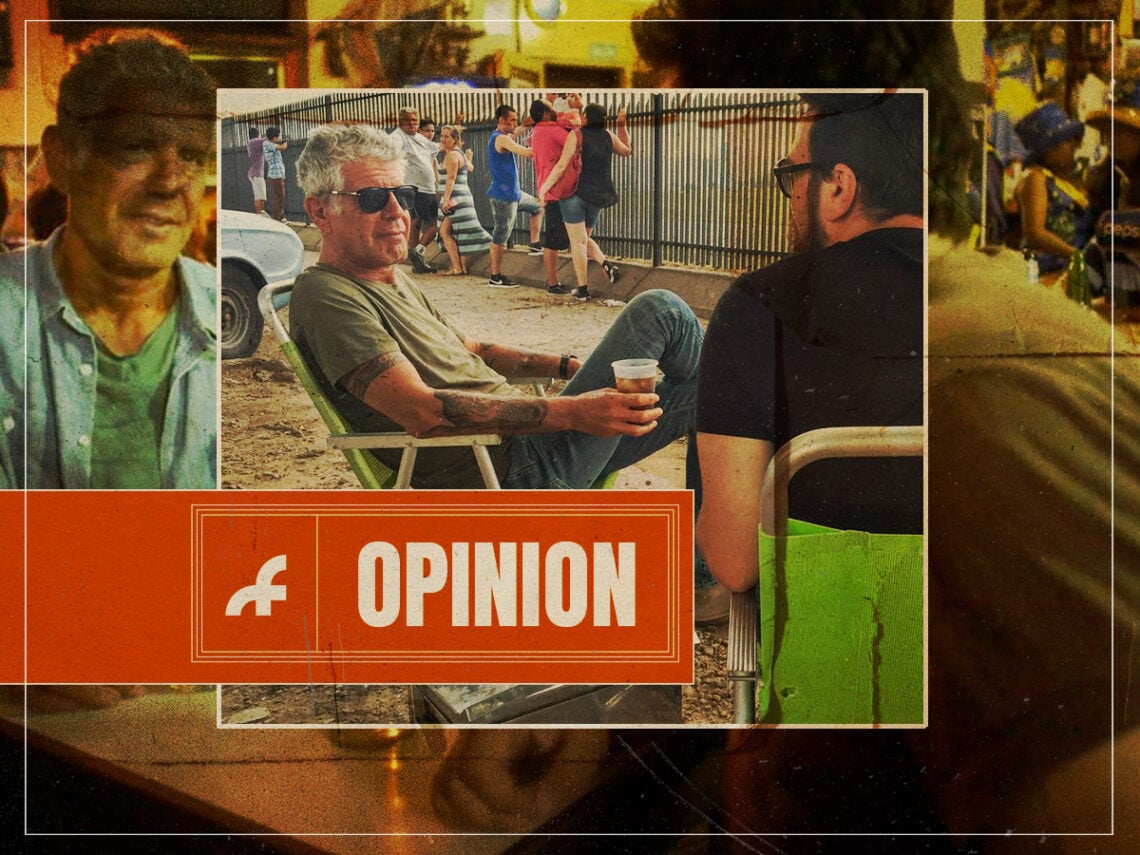
Buenos Aires in ‘Parts Unknown’: Anthony Bourdain’s finest moment

Throughout his time, Anthony Bourdain carved out a space for himself in travel documentaries. Delving headfirst into cultures and cuisines, he led Western audiences on voyages deep into the expansive world outside the comfort of consumerism, showing that there are untold experiences on offer of life-affirming and truly startling varieties.
An accomplished chef by trade, his existence was one lived outside of expectation and the nine-to-five. From the night-time trappings of the kitchen to using drugs—including heroin and cocaine—it seemed that from early on, he was destined to become a traveller on a strange path that only few venture down. The perception gained from such fraught experiences and already enquiring nature underpinned a figure whose sincere way with words would fuel some of the most affecting moments the travel documentary has ever seen.
While Bourdain helmed several acclaimed shows, each with its highlights, episode nine of the 2016 seventh season of CNN’s Parts Unknown is arguably his finest moment. Filmed in the cultural melting pot of Buenos Aires, Argentina, Bourdain opened up in the most candid way he ever would on screen. In light of his 2018 suicide, this already profound episode becomes even more affecting.
In the episode, Bourdain finds himself in Buenos Aires in the middle of January, at the peak of summer. It and the following month are the peak of summer in Argentina, meaning that most denizens—known as porteños —are on holiday in cooler climes. This gives the city an almost deserted, motionless feel, heightened by the striking blend of architecture.
This is the perfect backdrop for one of the show’s most meditative episodes, with the cinematography and editing augmented by Bourdain’s commentary and exploration of the city’s culture. At the onset, the New Yorker says of the sprawling hub: “It’s got sort of a mournful, sad, sleep quality that I like. Fits with the architecture.”

Although Bourdain’s discussions with locals about the socio-economic status of workers who had stayed behind during the holidays were vital, what makes the episode particularly significant is that these conversations are interspersed with his visit to a psychiatrist. This might seem random at first, but it is not; Argentina has more psychotherapists per capita than anywhere else in the world.
At one point during the early stages of the episode, Bourdain inquires about the country’s obsession with psychotherapy with celebrity chef Francis Mallmann and confides, “I need somebody to talk to”. The warm surroundings of the restaurant they are dining in then cut to a monochrome shot from above, showing Bourdain lying on a black couch in a psychiatrist’s office.
He reveals that as part of a deal with his parents when he was caught with drugs as a teenager, he agreed to see a psychiatrist for a short while. As the colour returns to the shot, Bourdain offers more insight into his complex being and honest view of his work.
Asked what brought him to her couch, Bourdain explains that a lousy airport hamburger, an admittedly “insignificant thing”, would send him into “a spiral of depression that can last for days”, an issue he discussed many times throughout his life.
However, he opened this point up to something more philosophical, thanks to another road-weary, albeit surprising, traveller, George Orwell. He explained: “George Orwell said something that really upset me because he talked about human beings are essentially tubes into which we shove food, and this is my job; I travel around the world with these people, and they turn on the cameras and then for a certain period of time my job is to shove food into my face.”
What’s wrong with that? He is questioned, before it cuts back to the restaurant, and Malmann says you have to eat. Nevertheless, there is something much more significant to what Bourdain is saying, which is revealed in further scenes with the psychiatrist throughout the episode.

To most of the world, Bourdain’s job seemed like the perfect mix of work, travel, and leisure. To him, though, it clearly wasn’t. In these later scenes on the black couch, he opens up about what it’s really like, the internal dissonance an isolated life spent travelling creates, and misgivings about his personality. He says: “I feel kind of like a freak, and I feel very isolated. I communicate for a living, but I’m terrible at communicating with people I care about. I’m good with my daughter. An eight-year-old is about my level of communication skills, so that works out.”
At the end of the episode, as was customary for the editing style of Parts Unknown, the psychiatrist loops back to her original question of what really brought Bourdain to her couch. His response was hitting at the time of airing and, in retrospect, given everything that would ensue, is now exceptionally so, adding another dose of immense sadness to an episode already tinged with it.
Bourdain concedes: “I’d like to be happy. I’d like to be happier. I should be happy; I have, you know, incredible luck. I’d like to be able to, you know, look out the window and say, ‘Hey, life is good’.”
Bourdain knew he wouldn’t get much sympathy from audiences, as frankly, he had the best job in the world, but bringing his profession into question once more, Bourdain glanced at a man grilling sausages as an example of actual work. Offering one last insight into his ideation, the late documentarian revealed that just as bad cheeseburgers set him off, so did the good parts of life. “I have a couple of happy minutes there, where I’m thinking, ‘Ah, life is pretty good.'”
As Bourdain asks, “Is there any hope for me?” in the closing seconds, this question becomes eerily consequential as we contemplate the tragedy of one of popular culture’s best-loved figures and how much he brought to the world. For this reason, Buenos Aires remains his finest moment; he opened up more than anywhere else in the public eye. Seldom do we see someone so prominent offer such a peek into their personality.
