


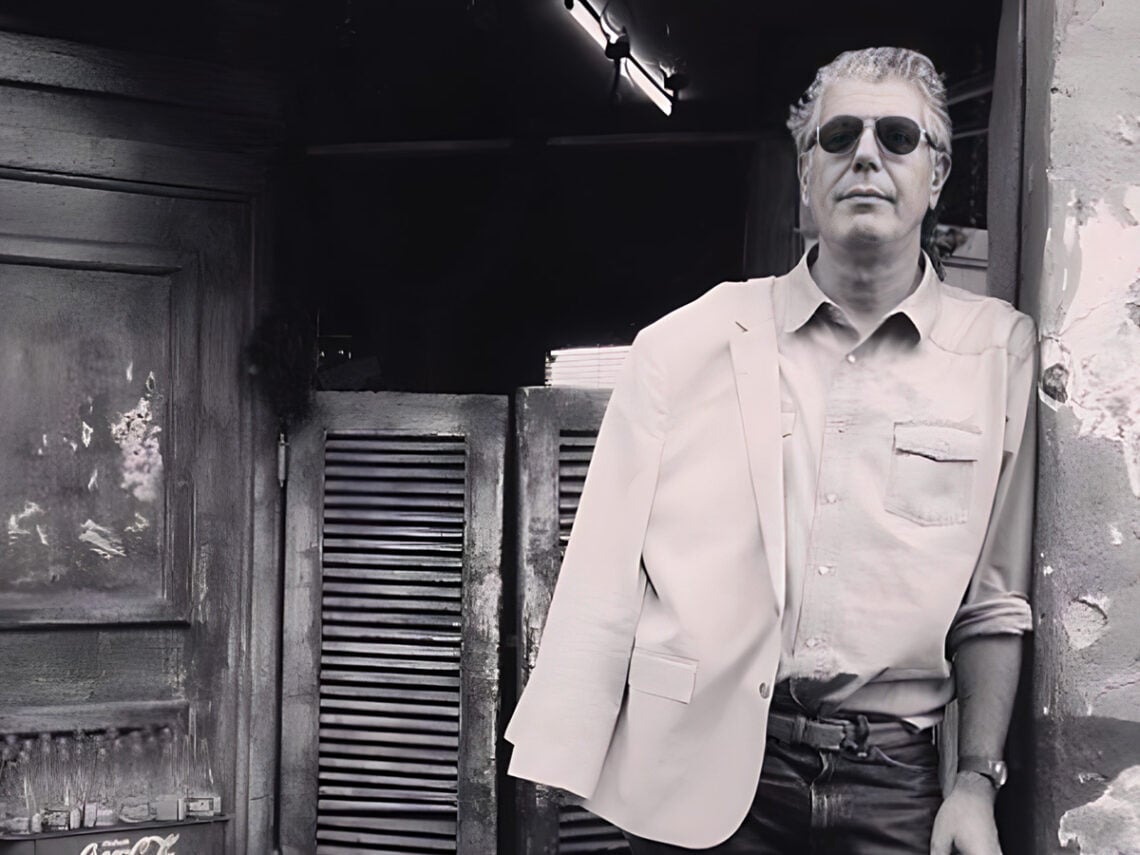
The ultimate punk spirit of Anthony Bourdain

The late Anthony Bourdain was likely one of the only high-profile chefs on the planet who qualified as an honourary punk rocker. The culinary world has always been about perfection, Michelin stars and flawless plates, but Bourdain’s approach was non-conformist in the purest punk sense. He wanted people to go back to basics, bored with the bland climate of celebrity chefs. While he was one himself, Bourdain reinvented what the role could be – laying the crucial groundwork for figures like Action Bronson and Matty Matheson to bring their own personalities and musical crossovers to food television.
Audiences fell in love with his dry humour, and his no-frills approach to good food made him beloved. Everything you’d expect from a chef, he seemed to invert. He went to beautiful locations around the globe but was always drawn to the underbelly of whatever city he found himself in. He pushed people outside their comfort zone, advising: “You’re never going to find a perfect city travel experience or the perfect meal without a constant willingness to experience a bad one.”
“I’m a big believer in winging it,” Bourdain added. “I’m a big believer that you’re never going to find a perfect city travel experience or the perfect meal without a constant willingness to experience a bad one. Letting the happy accident happen is what a lot of vacation itineraries miss, I think, and I’m always trying to push people to allow those things to happen rather than stick to some rigid itinerary.”
Bourdain was always drawn to New York. To him, it was the richest cultural hub in the world – not least because he launched his career at Brasserie Les Halles there. He dutifully made guides of its many great restaurants and penned essays on being a part of its burgeoning punk scene.
In his infamous Eat to the Beat essay, in true Bourdain fashion, he managed to wrap up his love for its music with a frank appraisal. “Don’t let anybody tell you different: 1977 was not a good year,” he reflected. “Not a good decade, not a good time for New York City. Remembering now, it’s easy to wax rhapsodic–the year gave us, after all, the first important explosion of punk rock and hip-hop.”
He was able to look past the abject horror of the disco explosion, adding: “Every douche bag in America who could buy a white suit or some heavily adulterated cocaine was suddenly empowered to show you his back fat and chest hair”, while also remembering its best musical exports more fondly. Richard Hell and the Voidoids get a warm mention, as do the likes of the Ramones.
Bourdain continually brought punk sensibilities to his life, food, and outlook. His fierce passion for good food echoed punks love of non-conformity – something Bourdain adopted with equal gusto.
