


Six definitive films: A beginner’s guide to Bruce Willis

“I’ve always had confidence. Before I was famous, that confidence got me into trouble. After I got famous, it just got me into more trouble.” – Bruce Willis
Maverick action-man and hard-headed hero, Bruce Willis, has long been an established Hollywood staple and has come a long way from his days as John McLaine. With five Die Hard films under his belt (and a sixth on the way) spanning across 33 years of filmmaking, he may be well known for his role as the death-defying police-officer, though recent years have shown he has much more to offer.
While his role as an action hero may continue in mainstream filmmaking, films such as Between Two Ferns: The Movie, The LEGO Movie 2, and even M. Night Shyamalan’s Glass have shown that he is capable of versatility, with strong comedy chops as well as the ability to sink into darker, more dense roles. This is self-evident looking back across a vast career of terrifically diverse characters and roles, working with directors such as Quentin Tarantino, Terry Gilliam and Wes Anderson.
Let’s take it back to the ’80s as we look into his most defining films.
Bruce Willis’ six definitive films:
Die Hard (John McTiernan – 1988)
Stood beside Arnold Schwarzenegger’s Terminator and Sylvester Stallone’s Rambo as one of cinema’s greatest ever action hero’s, Bruce Willis’ John McLaine is your everyday average Joe, which is why he is so memorable.
Willis had entered the role from almost total obscurity after multiple roles as an extra and a breakout role on television’s Moonlighting, where he established himself as a comedic actor, winning a Golden Globe Award for Best Actor – Television Series Musical or Comedy. His first film role wasn’t until 1987, alongside Kim Basinger in Blind Date, before he stumbled through 1988’s Sunset and onto the set of 1988’s Die Hard and a new dawn for his career.
Instantly establishing Willis as an action star, the actor perfectly embodied the role of John McLaine, an unlikely hero with a sharp tongue and dogged determination. Based on Roderick Thorp’s 1979 novel Nothing Lasts Forever, the film itself follows McLaine, an NYPD officer who attempts to save his wife and several other hostages from a towering office block during a Christmas party. It’s a colourfully lavish action film, bubbling over with grit and intensity that would spawn many imitators, none of which would glimpse its success.
Pulp Fiction (Quentin Tarantino – 1994)
To no surprise, the success of Die Hard prompted a sequel just two years later in 1990, whilst Willis juggled job offers to reprise his action-hero role in similar – though less prestigious roles – in Hudson Hawk and The Last Boy Scout. He suffered a minor career slump, lost in the landscape of cinema following his breakout role.
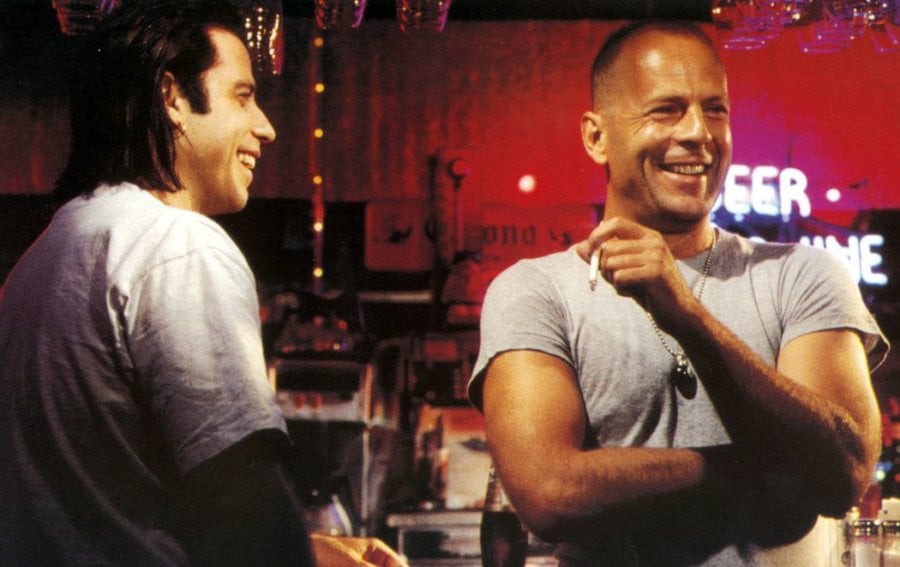
Quentin Tarantino’s follow-up to his cult independent film Reservoir Dogs would see Willis established once again, though now as something more than a ragged action man. In Pulp Fiction, he was a boxer, a crook, and a punk. The director’s most acclaimed work, Pulp Fiction told the story of four separate sets of outlaws as their lives mingled, mashed, and entwined on the sleazy streets of L.A. Blood-soaked and brutal, Willis’ Butch Coolidge shines as a criminal with cool guile in a role which illustrated the actors increasing depth and range, skills he would build upon through the 1990s.
12 Monkeys (Terry Gilliam – 1995)
Following his leap into Tarrantino’s own brand of art cinema, Willis quickly slipped back into a host of average Hollywood roles in Color of Night, Nobody’s Fool, as well as the third instalment of the Die Hard franchise in 1995’s Die Hard: With a Vengeance. Though for Bruce Willis, his career would take an altogether more otherworldly transition in the late 1990s.
Inspired by Chris Marker’s experimental film La Jetée, and directed by filmmaking eccentric Terry Gilliam, 12 Monkeys sees Bruce Willis star in the leading role as a prisoner sent back in time by scientists to allocate the outbreak of a virus and study its origins in the hope of devising a cure in the future. Particularly pertinent in a post-2020 world, Gilliam’s futuristic thriller was a success with alternative audiences, even earning supporting actor Brad Pitt an award for his energetic performance. Though it was Bruce Willis’ role as prisoner James Cole that really accelerated the action of the film onwards. A vibrant performance that perfectly danced on the edge of madness, Willis perfectly portrayed Cole’s psychotic desperation submerging himself into the identity of his character and the world around him.
The Fifth Element (Luc Besson – 1997)
With continued success following 12 Monkeys, Willis would re–channel his comedy roots in Mike Judge’s 1996 animated film Beavis and Butt-head Do America before he quickly returned to his typecast role, albeit with slightly more zest.
The actor’s transition into sci-fi had come apparently by mistake, though followed the popular zeitgeist of the new millennium. Luc Besson’s The Fifth Element was a pulpy sci-fi action thriller, part-written by the director when he was just 16-years-old, following a cab driver in pursuit of a cosmic weapon to help stop evil and destruction across the futuristic 23rd century.
Willis plays the taxi-driver caught in the centre of the story, a stylishly colourful maverick who likely ‘has better things to be doing’. Despite constant distractions, from Gary Oldman’s eccentric villain ‘Zorg’, to Chris Tucker’s wondrously annoying Ruby Rhod, Bruce Willis is the glue that holds the film together and grounds it in reality. Channelling the style of Die Hard’s John McLaine, but with added visual and personal pizzazz, The Fifth Element nicely assembled each string in Willis’ metaphorical bow, giving him a role he could morph into his own, with flair, grace and a sharp sense of humour.
The Sixth Sense (M. Night Shyamalan – 1999)
“I see dead people”
Unsure of where he now stood in the landscape of Hollywood, after several roles in action, sci-fi and comedy, Willis dipped into TV, appearing in Mad About You in 1997, as well as the ongoing Bruno the Kid. Armageddon briefly put Willis back into familiar territory as a maverick ‘deep-core driller’ who is sent to stop an asteroid from hitting earth, but it was M. Night Shyamalan would catapult his career into the 2000s, with the critically and commercially successful, The Sixth Sense.
Far from his role as John McLaine or James Cole, Bruce Willis’ performance as child psychologist Malcolm Crowe in Shyamalan’s film is perfectly gentle, yet dramatically weighty, particularly at the film’s surprising conclusion. Following the psychologist’s relationship with a boy who communicates with spirits, Willis’ authentic performance heightens the credibility of The Sixth Sense whilst elevating the terrific performance of child actor Haley Joel Osment. Similar to how Pulp Fiction demonstrated Bruce Willis’ dramatic range, here he is flexing totally different acting techniques in order to sell the difficult sell that is the film’s final twist.
Moonrise Kingdom (Wes Anderson – 2012)
Bruce Willis’ tumultuous journey through the start of the 21st century saw him in a range of TV highlights, classic role-reprisals, with a sprinkling of flimsy roles in family films. He would win an Emmy for Outstanding Guest Actor in a Comedy Series for his work on Friends, collaborate once more with Shyamalan in Unbreakable, appear in Robert Rodriguez’s monochrome Sin City and reprise his role as John McClaine in 2007’s Die Hard 4.0, all before his comedy role in Wes Anderson’s Moonrise Kingdom.
Despite a late-career of several highlights, Bruce Willis’ role in the excellent Moonrise Kingdom nicely encapsulates why the actor is so loved, as he plays off his own direct, frank, and deadpan humour. Playing police Captain Sharp who is tasked with tracking down a pair of child runaways in Wes Anderson’s modern classic, and does so with sharp determination and wit.
“Even smart kids stick their fingers in electrical sockets sometimes,” he softly says to the young runaway over the table. His role speaks to the range of Bruce Willis as an actor, effortlessly morphing into a firm but softly-spoken authoritative figure with genuine heart and subtlety. Despite being made famous for his gun-slinging, action-hero roles, he is an actor capable of so much more, illustrated by his illustrious career with much more to come.

Never Miss A Take
The Far Out Quentin Tarantino Newsletter
All the latest Quentin Tarantino content from the independent voice of culture.
Straight to your inbox.