


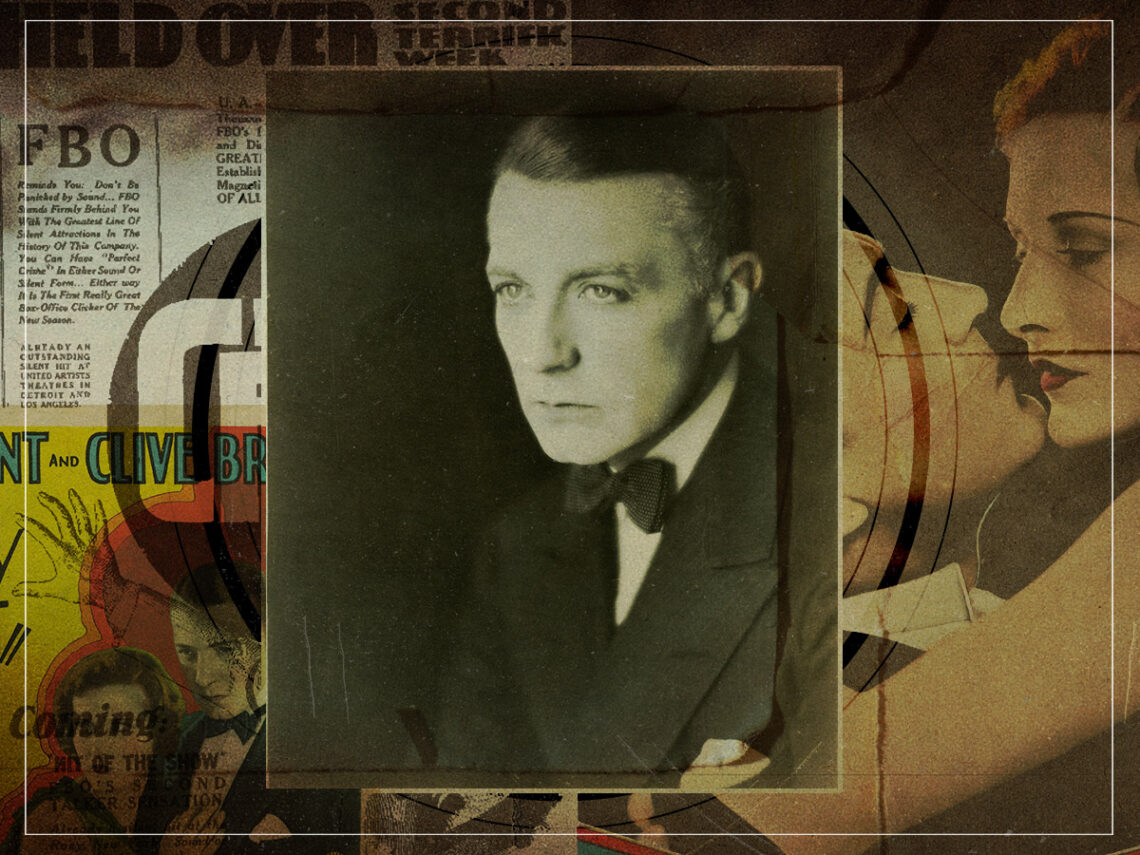
Clive Brook: one of British cinema’s first Hollywood stars

Cinema’s transition from the silent age into the era of the talkies curtailed plenty of careers and flat-out ended many more, but Clive Brook emerged unscathed from a seismic shift in the industry to underline his credentials as one of the British industry’s earliest and most successful international exports.
Having succeeded in the United Kingdom and the United States both during and after silent film rose and fell in popularity, Brook weathered changes in scenery and drastic overhauls of his chosen profession to maintain a steady career that brought him into close contact with past, present, and future icons both real and entirely fictional.
After making his screen debut in 1920, Brook spent his formative years in front of the camera, becoming one of the leading lights in British silent cinema, and it was only a matter of time before Hollywood came calling. With his handsome visage and imposing frame, the World War I veteran was tailor-made for the silver screen regardless of which side of the Atlantic he found himself.
During his years on home soil, he regularly came into the orbit of an up-and-comer called Alfred Hitchcock, who served as a writer, art director, and assistant director on Brook-starring trio Woman to Woman, The Passionate Adventure, and The White Shadow. The latter two were each released in 1924, the same year the actor opted to take his talents to Hollywood.
Quickly establishing himself as one of Paramount’s most important contract players, the legendary Josef von Sternberg immediately took a liking to Brook and cast him not only in 1927’s crime thriller Underworld, where he took top billing, but hand-picked him to play the male lead, opposite his muse Marlene Dietrich in the ‘Best Picture’ and ‘Best Director’-nominated classic Shanghai Express.
Those two titles came on either side of the evolution from silent into sound, which spoke volumes about not only Brook’s talent but also his staying power. Plenty of his peers found themselves cast out when their limitations were exposed and subsequently obliterated by the talkies, whereas he continued to go from strength to strength. He even played the world’s most famous detective three times before Basil Rathbone had so much as donned the deerstalker for the first time, with Brook heading up The Return of Sherlock Holmes, Sherlock Holmes, and a segment of studio-approved anthology Paramount on Parade as the titular sleuth between 1929 and 1932.
Brook didn’t stay Stateside for very long, though, returning to native shores by the mid-1930s, where he spent the remainder of his career. That might explain why he’s not remembered as well as many of the other stars of his era who upped sticks and made America their permanent residence, both personally and professionally, but he was nonetheless one of the first of his kind.
