


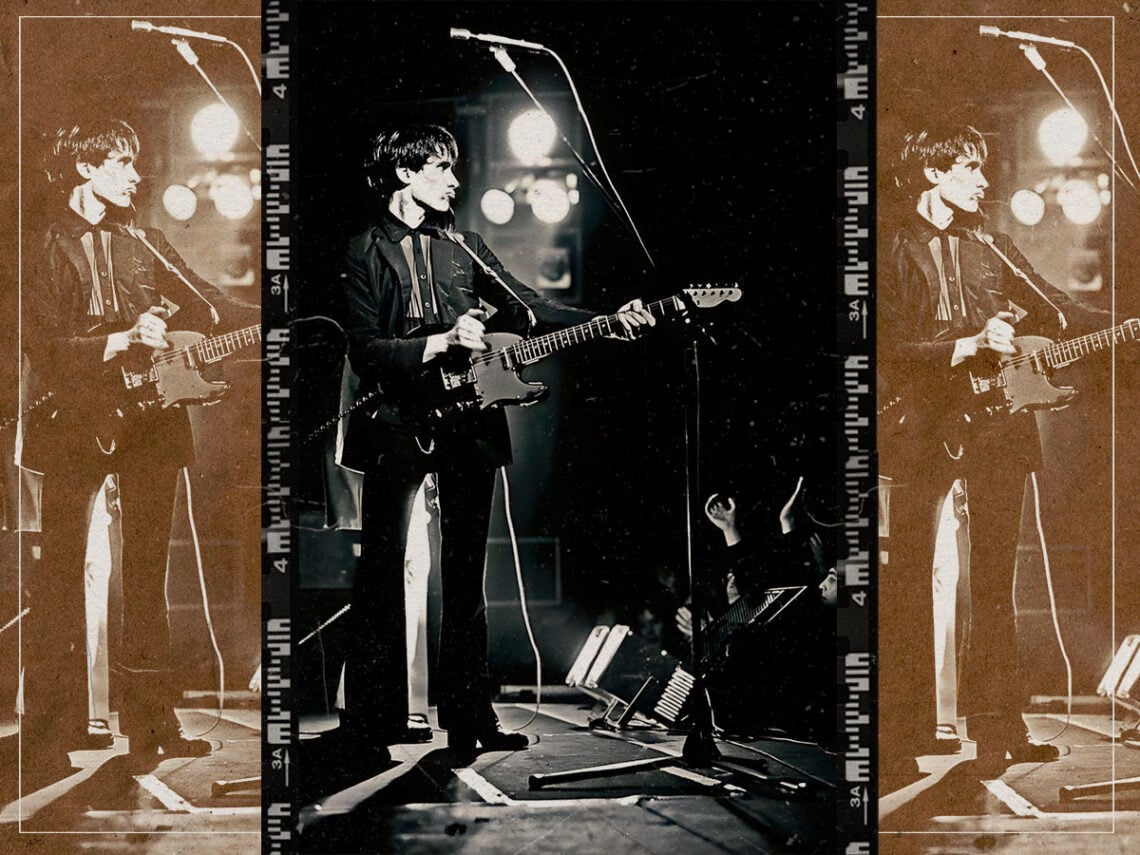
Understanding the brilliance of Wilko Johnson’s guitar playing

The advent of punk rock in the mid-1970s saw the complexities of guitar playing reduced to simplistic barre chords, minimal solos, and a reliance on distorted tones. However, in between the self-aggrandising solos of classic rock and the raw power of punk’s buzzsaw guitars, there was an intervening period born out of the dark and dingy pubs of the United Kingdom.
Within this scene, which incorporated blues and roots rock, no band was bigger than Dr Feelgood. Hailing from Canvey Island, the group formed as a reaction against the complacency and excess of the progressive rock and glam scene of the early 1970s. Releasing their seminal debut album Down by the Jetty in 1974, they forged their own distinctive British R&B sound, influenced heavily by early American rock ‘n’ roll artists but with a certain sense of Essex swagger.
The backbone of Dr Feelgood’s pioneering sound was undoubtedly the songwriter and guitar talents of Wilko Johnson. Back in 1965, six years before the foundations of Dr Feelgood were laid, Johnson strolled into a music shop in Southend and walked out again with a £90 Fender Telecaster. It was that purchase that led to the creation of Dr Feelgood’s signature sound, which would go on to play a huge influence on the punk movement.
There was no shortage of skilled guitarists in the 1970s; the likes of Jimi Hendrix and Eric Clapton had upped the stakes in the latter part of the 1960s, and rock musicians everywhere were quick to try and catch up. But alas, it was not technical ability which gave Johnson his iconic sound. The Dr Feelgood guitarist pioneered his own specific playing style, which set him apart from virtually every other guitarist on the rock scene during the 1970s.
Johnson was famously confrontational on stage, with his jet-black outfits and aggressive persona. The guitarist would often hold his trademark Telecaster as though it were a gun, massacring the audience with his machine-gun-like strumming style. Despite his innovative brilliance, Johnson’s wild attitude and stage persona often overshadowed his guitar playing. Known for his Chuck Berry-esque ‘duck walk’, contorted facial expressions and signature bowl cut, the image of Johnson was as impactful as his guitar playing itself.
Characterised by a unique fingerstyle strumming, rather than utilising a guitar pick, Johnson’s style allowed him to play at a much quicker pace than many artists. The angular sound of the guitarist set Dr Feelgood apart from the other fleeting groups on the pub rock scene. Despite this, Wilko remained fairly humble about his guitar-playing ability, once saying in an interview with QA Live, “You got five minutes? I’ll tell you everything I know.”
That attitude was indicative of the proto-punk scene that Dr Feelgood defined. Before Malcolm McLaren got it together to form his own personal boyband, the Sex Pistols, Wilko Johnson and his outfit were destroying the conventions of British rock. Reportedly, the guitarist took inspiration from another individualistic rock outfit, once saying, “I tried and tried to copy Mick Green, but I didn’t get it right.” Green was noted as the guitarist for Johnny Kidd and the Pirates, who were a huge inspiration to the whole of Canvey Island’s finest.
Although he was quick to downplay his technical abilities, the genius of Johnson’s technique came predominantly from how unusual it was. Wilko had a unique way of playing barre chords; rather than pressing his index finger across an entire fret, he would hook his thumb around the neck onto the sixth string, keeping the other unused strings open. In addition to that, he would take the pressure on and off the frets in order to make the chords short and sharp. With this unusual chord style and his constantly moving right hand, Johnson created an incredibly percussive sound.
Although his own brand of barre chords provided the main part of Wilko’s sound, the constant tempo of his strumming allowed the guitarist to improvise various riffs and guitar licks in between the chords without disrupting the flow of the track. In that sense, Wilko’s style was something more akin to jazz music than anything rock ‘n’ roll – it was driven by experimentation and improvisation.
“That’s more or less it,” Wilko said of his strumming style and unique chord shapes. The rest of his sound arose from moving those techniques around the fretboard and applying them to different rhythms. There is no doubt that Wilko’s guitar style formed the basis of Dr Feelgood’s sound, as signified by the fact that the band’s material witnessed a steep decline in quality once the guitarist left the group in the late 1970s.
In terms of hardware, Johnson always favoured the Telecaster. Such was his appreciation for the Fender classic that the guitar brand gave Wilko his own signature model back in 2013. In distinct contrast to the image of Nigel’s guitar room in This is Spinal Tap, Wilko was famously frugal when it came to his axe collection. “I’ve only ever owned six guitars, and I’ve still got four of them!” he once explained, “Two old Teles, the signature model, and an old Strat[ocaster]. I love Strats and the way they look, but for what I do, the Telecaster is perfect.”
The Telecaster is often noted for its use in blues and R&B music, making it an obvious choice for the blues rock-inspired sound of Dr Feelgood. Moreover, the guitar is said to be well-balanced; Wilko, who mainly played close to the neck pickup, was able to create some great tones as a result. While it is not particularly great for heavier styles of music, that makes the Telecaster an obvious choice for a clear and bright sound. Although it might be a stretch to consider the confrontational sound of Wilko and Dr Feelgood ‘bright’, these open tones hark back to their influences of Johnny Kidd and other early rock groups.
Dr Feelgood and the wider pub rock scene paved the way for the punk rock explosion of 1976. However, Wilko’s influence prevailed more than most. As Dr Feelgood’s disciple, Paul Weller, explained to Uncut, “Wilko may not be as famous as some other guitarists, but he’s right up there. And there are a lot of people who’ll say the same. I can hear Wilko in lots of places. It’s some legacy.”
As is the case with many guitarists from the proto-punk and subsequent new wave scene, half of the sound is derived from attitude. You could amass all the same hardware, incorporate the same influences, and even master the difficult fingerstyle of strumming, but unless you manage to recreate the fearless attitude of Wilko Johnson, you won’t get closer to capturing his sound. A tall order, given the individualistic nature of the man – they certainly don’t make them like him anymore.
