


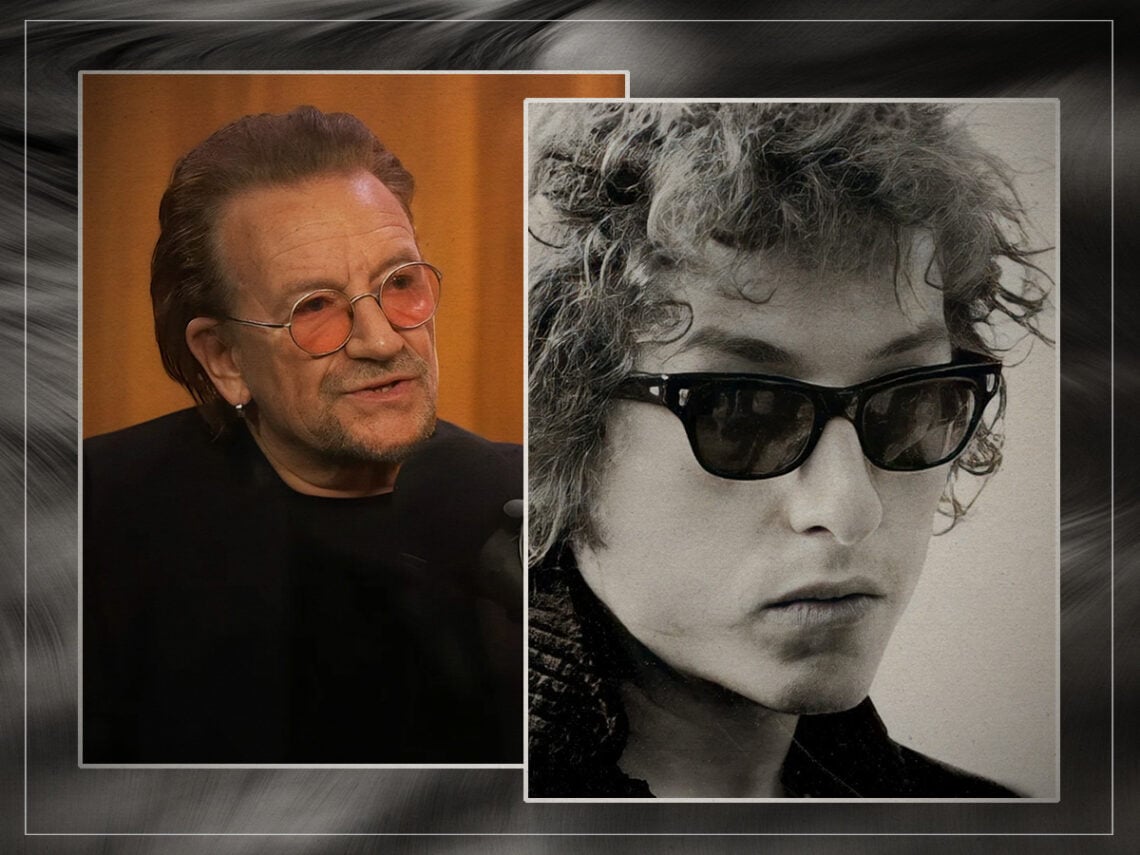
The Bob Dylan song Bono says changed the world: “The reason I’m in a band”

Although they each hail from entirely different eras and walks of life, there’s something of a kindred sonic spirit between Bob Dylan and Bono that makes them two of music’s most prolific wordsmiths. With one paving their way through the Big Apple and the other through the mean streets of Dublin, at face value, it seems that Dylan and Bono are worlds apart – but as the latter pointed out, the language of revolution is universal.
Both singers share not only a blazing vocal talent but also a way with words that invariably stops any listener in their tracks and invites them further and further into their musical microcosms. But this is no exclusive, insular club—what the two ultimately also both have the knack for is expanding their songs out as a beacon to the world, defining eras and anthems in their wake.
In that sense, with Dylan having paved the way for so many aspiring writers before him, it’s only natural that Bono has come to revere the warbling wordsmith for not only his musical prowess but his lyrical eloquence, which has proved a significant influence in shaping the way in which he put his own pen to the page.
To that end, when previously asked which songs changed the world, Bono came up with a litany of examples from the Dylan songbook that fulfil the order, from the likes of classic albums including Highway 61 Revisited and Bringing It All Back Home. But from within these depths, one song in particular stands out above the rest for not only providing Bono a sonic muse but also redefining the axis on which the musical Earth spanned from that point forward.
In Bono’s eyes, there’s nothing that compares to ‘Like a Rolling Stone’, and in 2011, he waxed lyrical on the fruits of the song by explaining that it is a song that “turns the wine to vinegar”. Displaying his own linguistic mind, he continued: “The verbal pugilism on display here cracks open songwriting for a generation and leaves the listener on the canvas”.
Yet more than the sheer power of the words themselves, for the U2 frontman, it also represented a shift in the direction of Dylan’s career as his protesting spirit evolved into a more universal front. “The ‘us’ and ‘them’ are not so clearly defined as earlier albums,” he noted. “Here he bares his teeth at the hipsters, the vanity of that time, the idea that you had a better value system if you were wearing the right pair of boots.”
As such, ‘Like A Rolling Stone’ simultaneously proved to be pivotal for Dylan but also a lightning bolt moment for the future rocker, whose path was defined on the basis of the song’s “caustic” social commentary that “chang[ed] everything” and is the “reason I’m in a band”. As a whole, there is no stronger testimony to the power of music than that – the fact that one single song can alter the universe, and in turn lead to new protest anthems being later blazed from across the Atlantic, as Bono lit the fire of rebellion from his own little corner of the world.

Never Miss A Tale
The Far Out Bob Dylan Newsletter
All the latest stories about Bob Dylan from the independent voice of culture.
Straight to your inbox.