


Bob Dylan and Grateful Dead: A musical match made in heaven

Despite being one of the most forward-thinking and socially liberal artists of all time, I can’t help but look at Bob Dylan as a cantankerous representation of a disgruntled former generation. Perennially unimpressed and notoriously difficult to please, it’s hard to picture him enjoying the irreverent forms of modern art, despite being the pioneer of it.
It’s an outlook largely informed by his history as a cutting observationalist. Whether it’s lambasting Mick Jagger’s wild on-stage antics or describing The Beatles’ ‘Yesterday’ as a song being written in “Tin Pan Alley”, he’s never pulled any punches on the royalty of music’s innovative elite. The salt-of-the-earth folk star seemingly reserves respect for those musicians who approach art with seriousness and earnestness.
But as the true contrarian he is, Dylan’s industry critique refuses to follow those expected norms, and so every now and then, a band so certainly designed to exist in the crosshairs of his criticism comes along and flips all expectations on their head. One such band is the Grateful Dead.
While Dylan may have left the tie-dye T-shirts at home, there was no mistake that he was as passionate a Dead head as anyone. But what he loved about the band existed beneath the kaleidoscopic colour of their profile and instead the virtuosic ability of their guitar players, and the profundity of their lyricism. Once you stepped through the vortex of their psychedelia, a humble offering of life’s artistic reflection awaited.
“Bob Weir, a very unorthodox rhythm player,” Dylan once said. Adding he “has his own style, not unlike Joni Mitchell, but from a different place. Plays strange, augmented chords and half chords at unpredictable intervals that somehow match up with Jerry Garcia, who plays like Charlie Christian and Doc Watson at the same time. All that and an in-house writer-poet, Robert Hunter, with a wide range of influences-everyone from Kerouac to Rilke-and steeped in the songs of Stephen Foster. This creates a wide range of opportunities for the Dead to play almost any kind of music and make it their own.”
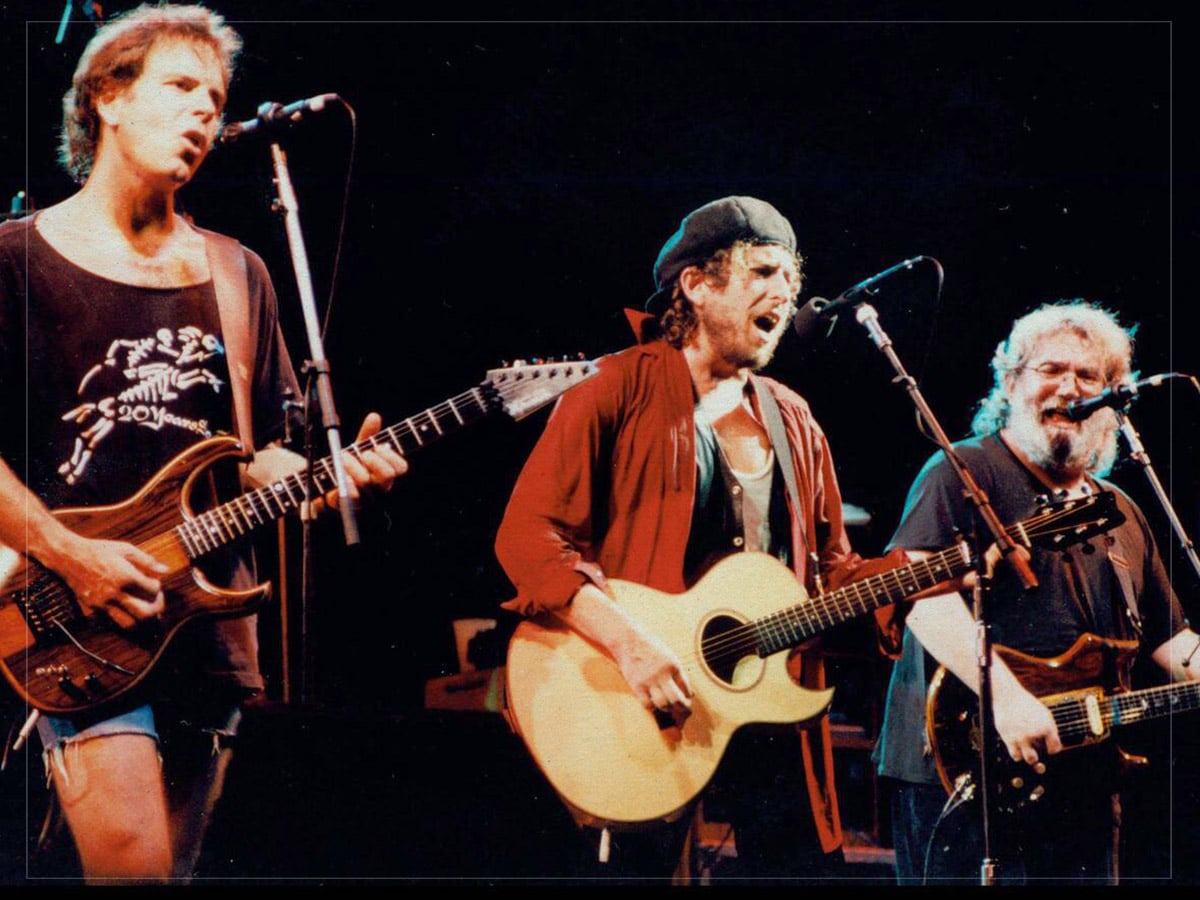
This love for the Grateful Dead ultimately pulled Dylan out of something of a career slump. Towards the tail end of the 1980s, the folk icon was somewhat disillusioned with the direction of his own music and so began trying to regain it through his fandom for the band. To him, they represented a clear exit door for this growing world of artistic commercialism, which began to subtly taint his work in the latter part of the decade.
Both intrigued and fearful of this necessary change, Dylan decided to join the band on tour in 1987 as a third guitarist before putting his name to an immortal project with the band. That spirit of live show magic that had clearly struck a rod of lightning in Dylan’s career was captured on their 1989 live album Dylan & The Dead.
Rattling through a string of Dylan hits, the album showcases the unlikely synergy between these two artists. Unshackled by the expectations of artistic commercialism, they indulge themselves as they descend into spiralling renditions of ‘All Along The Watchtower’ and ‘Slow Train’.
It’s the sound of an artist returning to his stride and shaking loose the cobwebs of an antiquated vision by immersing himself in the freedom of a jam. A clear, unspoken agreement existed between both Dylan and The Dead on this record that ensured the songs they played would be nothing more than loose blueprints for a plan of musical spontaneity.
But while the Grateful Dead might have, on paper at least, seemed like a rather bizarre and esoteric choice to return Dylan to a state of glory, there is a transcendental crossover that exists between the two artists and is showcased on this album, particularly.
Lenny Kaye once remarked that the Grateful Dead were the masters of “tying together different song threads, letting them pass naturally into one another, almost as if they had been especially designed for such a move.” While Leonard Cohen remembered a Dylan show as “some kind of symbolic unfolding of the event, “where the music doesn’t have to be the songs. All it has to be is: remember that song and what it did to you. It’s a very strange event.”
Somewhere in the middle of that magical Venn diagram was Dylan & The Dead, which jammed its way through moments of unrepeated yet deeply symbolic greatness. It was, as Cohen might say, a very strange happening, yet in some even more bizarre way, one that made perfect sense.

Never Miss A Tale
The Far Out Bob Dylan Newsletter
All the latest stories about Bob Dylan from the independent voice of culture.
Straight to your inbox.