


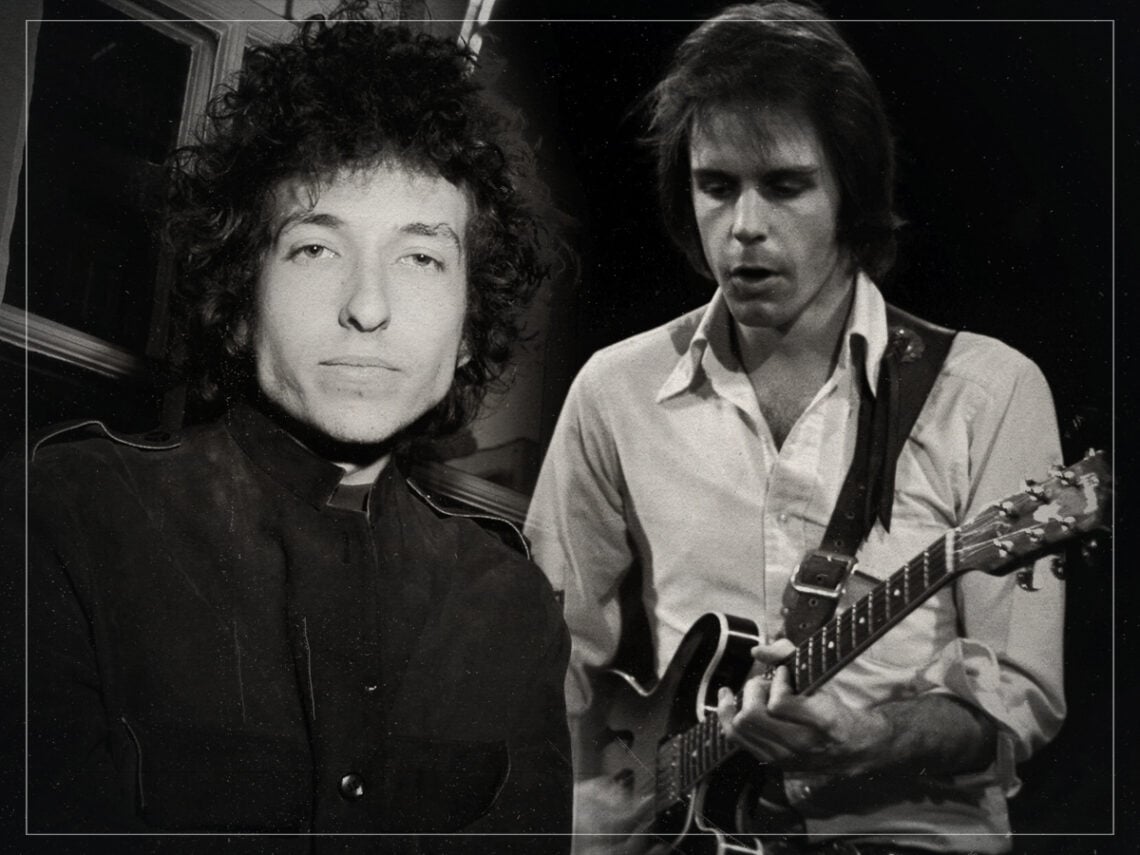
Bob Dylan explains why Bob Weir was Grateful Dead’s most important member: “Has his own style”

If you were to give musicians the option of scoring a number one hit, winning a Grammy or receiving genuine praise from Bob Dylan, I would expect most would choose the latter.
The mercurial songwriter was rarely seen doting over his musical contemporaries. In fact, a swift lift of your head above the parapet was more likely to put you in the crosshairs of Dylan’s criticism than praise and so it was largely best to stay clear of his attention altogether. Especially in the 1960s, when the adolescent folk star was disgruntled with anything that represented extravagance.
But then, come the 1980s, a dip in Dylan’s career saw a sharp U-turn in outlook, which led to him not only unleashing a swathe of praise onto psychedelic legends Grateful Dead, but joining them on stage in a chapter of career revolution.
In his autobiography, he recalled: “Everything was smashed. My own songs had become strangers to me, I didn’t have the skill to touch the right nerves, couldn’t penetrate the surfaces. It wasn’t my moment of history anymore.”
Something in the ever-changing world of the Grateful Dead revitalised Dylan, in a period of desperate confusion. To him, they represented a more intellectual approach to rock and roll that had become lost in the rapid commercialisation of art in the decade. Counterculture had been stamped out by homogenised capitalism, and Dylan viewed the glossy bands of the era as growing contributors to this disillusionment.
With the Dead punctuating that air of boredom, it was only right that Dylan join the band on stage for a special performance at San Rafael in California, where he watched in close quarters the unique connection that existed between the band’s guitarists Bob Weir and Jerry Garcia.
While Garcia stood centre stage, delivering hypnotic riffs for the tripped out crowds, Weir anchored it with the technical sensibilities Dylan simply never had with the guitar. While Dylan was still the premier songwriter, even then, in the confused 1980s, Weir was tapping into something relatively uncharted with the guitar, playing it in such a nuanced way that even his chord progressions felt like solos.
“Then there’s Bob Weir, a very unorthodox rhythm player,” Dylan said. Adding he “has his own style, not unlike Joni Mitchell but from a different place. Plays strange, augmented chords and half chords at unpredictable intervals that somehow match up with Jerry Garcia —who plays like Charlie Christian and Doc Wat- son at the same time. All that and an in-house writer-poet, Robert Hunter, with a wide range of influences-everyone from Kerouac to Rilke-and steeped in the songs of Stephen Foster. This creates a wide range of opportunities for the Dead to play almost any kind of music and make it their own.”
It was rumoured that in 1995, after the death of Garcia, Dylan pitched himself to the band in the hopes of securing a role as the band’s rhythm guitarist alongside his beloved Weir. Luckily, better judgment prevailed within the band, for they swiftly realised that while both Bobs shared a mutual respect, their strengths as musicians existed in completely different areas, with Weir the modest team player and Dylan the mercurial lyricist, destined to forever be a front man.

Never Miss A Tale
The Far Out Bob Dylan Newsletter
All the latest stories about Bob Dylan from the independent voice of culture.
Straight to your inbox.