


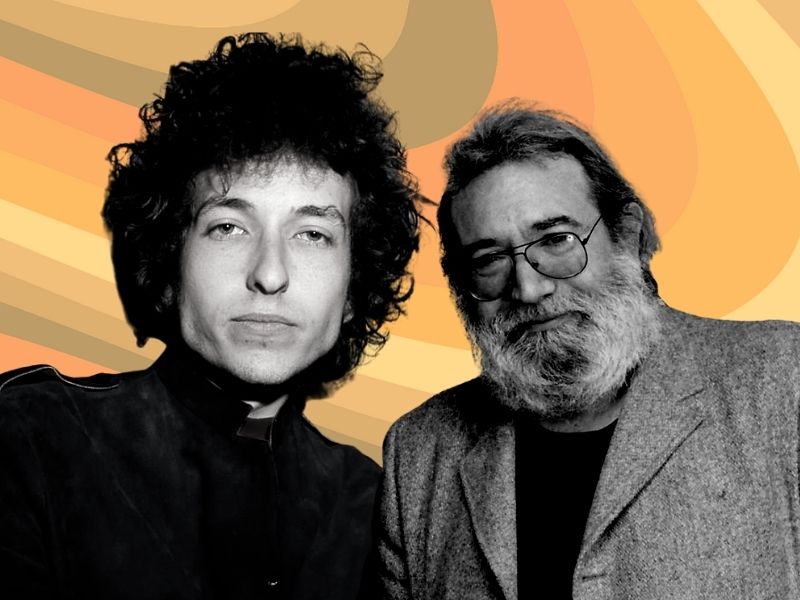
What Bob Dylan really thinks of the Grateful Dead

There are quite a few interesting parts of the new Bob Dylan book The Philosophy of Modern Song. Dylan gives his expert take on everyone from Warren Zevon to The Who to Cher. If you got a version with a fake Bob Dylan signature, I can’t help you, but if you got a regular-old version, there’s a lot to enjoy throughout the various pages.
One of the songs that Dylan decided to cover was ‘Truckin’, the classic cut from jam band gods the Grateful Dead. Originally appearing as the closing track from 1970’s American Beauty, ‘Truckin’ was a nearly-autobiographical account of the Dead’s hectic life on the road, one that included their infamous drug bust in New Orleans earlier that year.
Of course, Dylan has some known history with the Dead. Jerry Garcia, Bob Weir, and Phil Lesh all covered their fair share of Dylan songs over the years. During the same month that the Dead released their biggest-selling studio album, 1987’s In the Dark, the band toured with Dylan and acted as his backing band during a string of stadium shows across America.
In his analysis of ‘Truckin’, Dylan diverges from talking about the song and seems more interested in discussing the Dead themselves. “The Grateful Dead are not your usual rock and roll band,” Dylan writes. “They’re essentially a dance band. They have more in common with Artie Shaw and bebop than they do with the Byrds or the Stones. Whirling dervish dancers are as much a part of their music as anything else.”
Dylan certainly had a unique view of Deadheads from the stage, and he takes some time in his book to analyse the differences in crowds between them and a band like The Rolling Stones. “There is a big difference in the types of women that you see from the stage when you are with the Stones compared to the Dead,” Dylan says. “With the Stones, it’s like being at a porno convention. With the Dead, it’s more like the women you see by the river in the movie O Brother, Where Art Thou? Free-floating, snaky and slithering like in a typical daydream. Thousands of them.”
Dylan also lauds the Dead’s interactions with their audience, something that Dylan feels is unmatched in music. “With most bands, the audience participates like in a spectator sport,” he concludes. “They just stand there and watch. They keep a distance. With the Dead, the audience is part of the band-they might as well be on the stage.”
Ultimately, Dylan is undeniably on board with the Dead and their alternative corner of the music universe. Dylan attended Garcia’s funeral in 1995, and after his touring run, it’s rumoured that he even asked to join the band as a second rhythm guitarist. Evidently, there was only room for one rhythm guitarist named Bob in the Dead.

Never Miss A Tale
The Far Out Classic Rock Newsletter
All the latest Classic Rock content from the independent voice of culture.
Straight to your inbox.