


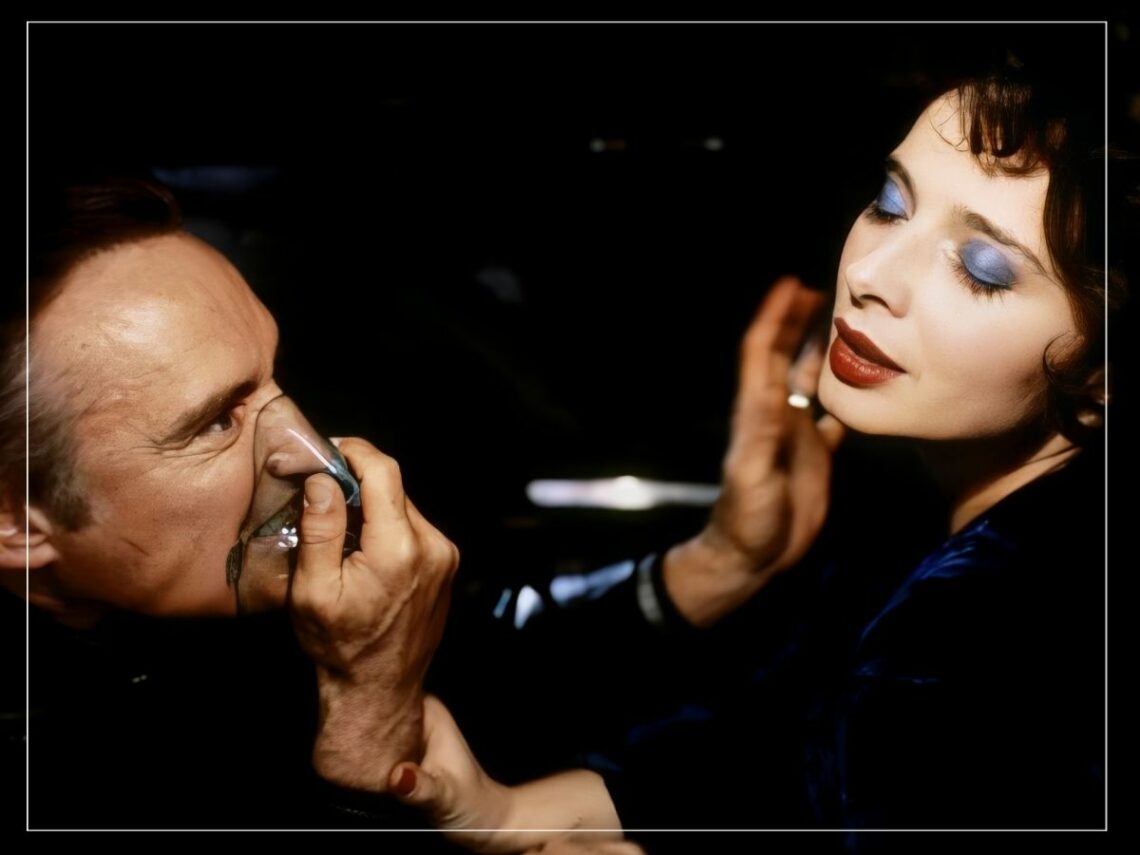
The ‘Blue Velvet’ motif: David Lynch’s perfect metaphor for the seedy underbelly of small towns

A master of curiosity, constantly urging audiences to think non-linearly and question the narratives presented by those in power, David Lynch will forever be remembered as one of culture’s most transformative creatives. The late filmmaker was a true auteur, a boundary-pushing force who achieved widespread acclaim for his willingness to experiment, stray from convention, and challenge established norms. Among his many iconic works, Blue Velvet stands out as one of the most significant milestones of his career.
The late 1986 film is best remembered for the deeply unsettling performance of Dennis Hopper as the Freudian psychopath Frank Booth and a young Kyle MacLachlan and Laura Dern displaying their dramatic prowess. However, one of the key successes of the neo-noir mystery is how Lynch questions the presentation and substance of something known to many: small towns. It’s often overlooked, but it’s safe to say that this triumph emboldened him to plunge much deeper into this issue with Twin Peaks.
Twin Peaks is often regarded as Lynch’s magnum opus due to its intricate themes, eclectic mix of styles, stellar cast, compelling story, and the expansive possibilities offered by the television format. However, it is also one of his most demanding and perplexing works—a vivid encapsulation of his artistic philosophy and distinctive style. Its enigmatic nature and layered complexity make it an undeniably challenging piece to fully grasp.
Blue Velvet, though, diverges from this complexity. In the wake of the critical and commercial disappointment of 1984’s Dune, Lynch aimed to create a more “personal story” that retained some of the bizarre and unsettling qualities of his 1977 surrealist masterpiece, Eraserhead, but with broader audience appeal. The result was a film that balanced Lynch’s trademark eccentricities with a narrative accessible enough to captivate mainstream viewers.
Although divisive upon release, Lynch succeeded in forming what is a much more linear narrative. However, this was David Lynch, and it contains moments that are somewhat incomprehensible to consumers who are into big-budget blockbusters. Furthermore, in true Lynch style, they also actually have significant meaning.
The movie follows MacLachlan’s Jeffrey Beaumont, who returns from college to his small hometown of Lumberton, North Carolina, after his father, Tom, has a near-fatal heart attack. However, the discovery of a severed human ear in a field leads him to uncover a dark criminal conspiracy that’s centred in the seemingly quiet, utopian town.
The film’s throughline is that small towns are not what they seem. This is affirmed through Lynch’s insect motif, introduced at the end of the opening sequence. This scene features sunny, blissful shots of Lumberton and is afforded a truly dream-like essence not only by the camera work and the 1950 and 1960s-evoking aesthetic but, crucially, by the use of Bobby Vinton’s drifting 1951 hit ‘Blue Velvet’, from which the movie takes its name.
For a couple of minutes, the viewer is led to believe that wherever this is is a form of paradise, but then Lynch does Lynch and takes a sledgehammer to the delicate glass of the equilibrium. Suddenly, the man we see hosing his grass falls to the ground in immense pain, leading to a dog barking. The camera then moves past him, zooms in on his pristine front lawn, and goes deeper underground to show a dark, unsettling nest of bugs.
The motif recurs periodically throughout the film, reinforcing this sense of underlying decay—most memorably in the image of the severed ear, teeming with black ants. Ultimately, this motif serves as a metaphor for the hidden rot that lies beneath the surface of small-town life, no matter the location. It’s a brilliant narrative device, seamlessly tied to the plot while evoking the darker realities of such communities: sordid affairs, secret addictions, bigotry, violence, and the Stepford Wives-like veneer of perfection. Anyone who has lived in a small town knows that beneath the polished exterior, these truths often linger.
