


‘Blood Mirror’: the powerful piece at the intersection of art, science, and homophobia

When he was in his early 20s, American artist Jordan Eagles was rejected from a blood donation centre for being a gay man, and the anger never left him. Restrictions on donors date back to the AIDS crisis when the FDA slapped a lifetime donation ban on gay and bisexual men. Even during the health crisis presented by the pandemic in 2020, which was coupled with a significant blood shortage, gay and bisexual men wanting to donate were required to be celibate for three months.
As Eagles points out, there is no celibacy of any length asked of heterosexual individuals, regardless of their risk of contracting HIV. Eagles’ anger was fuelled by the basic and obvious fact that more blood meant more lives saved. In 2014, it was estimated that lifting the ban completely could save a million lives a year. “I, like so many others,” he told OUT, “Am continuously fed up with the constant violence and discrimination that we are seeing almost daily in our society.”
So came Blood Mirror. Eagles was intent on tackling the stigma attached to gay men living with HIV/AIDS and worked on the project in two phases. Initially, he had found a group of nine people, each reflective of society’s broad spectrum. There was an army captain, an identical twin (the implicit point being his straight brother could donate blood), a former board director of the American Academy of HIV Medication, and a priest, all of whom donated blood.
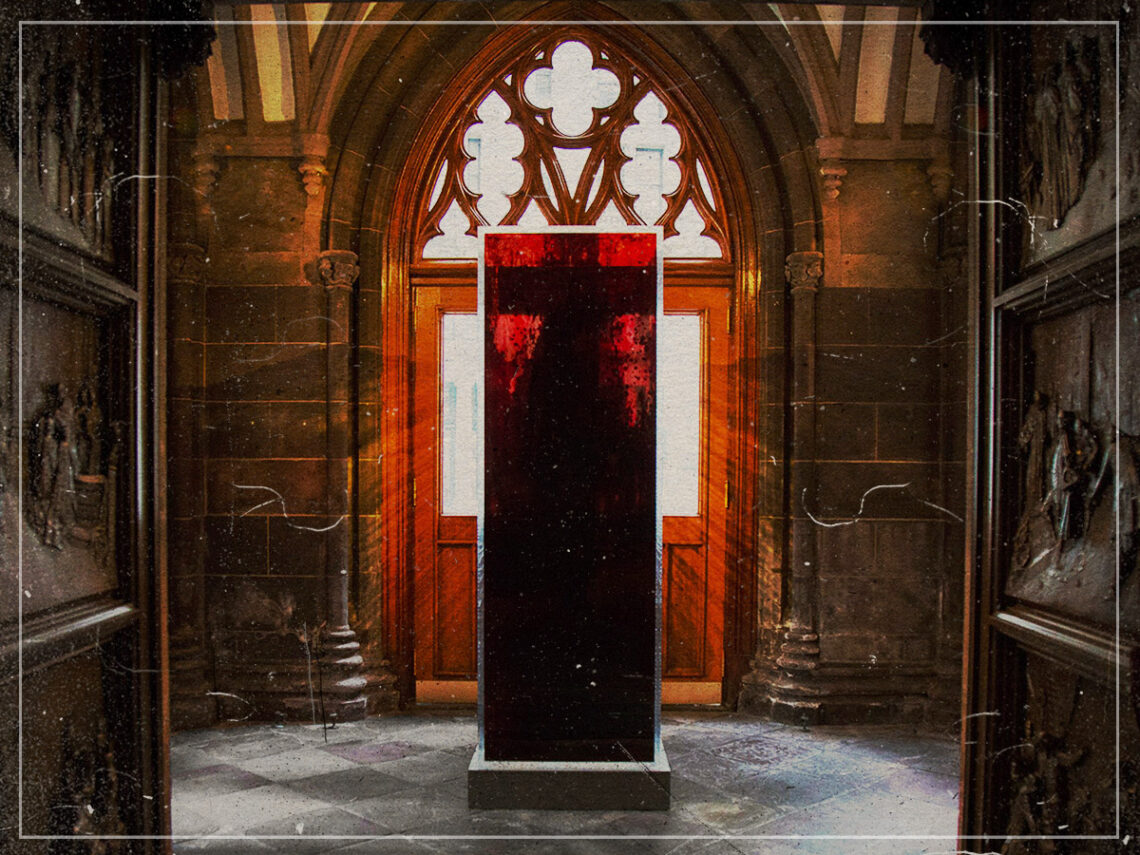
The second phase involved blood donations from 50 PreP advocates. PreP (pre-exposure prophylaxis) is a highly effective tool for preventing HIV. Eagles collected a single tube of blood from each. The 50 tubes made a full pint when combined, the standard amount given in a routine blood donation. He encased all the blood he had collected in a seven-foot column, which functioned almost like a mirror in the right light.
Activist and filmmaker Leo Herrera made a film, Blood Mirror: Raw Footage, to accompany the work. Commenting on what he saw, Herrera said: “[It] represents homophobia so deep that it infected science itself and spawned a fear of our most precious fluids.”
Fully encased in resin, the blood from Eagles’ donors won’t ever change or deteriorate. It stays resolute, suspended in Blood Mirror, as a powerful visual reminder of the discrimination countless donors have faced. Stood in front of it, people will initially focus on the blood and how the specific shade of red in front of them looked. Then their eyes will glaze, and they will see only themselves reflected.
That is precisely what Eagles engineered his sculpture to evoke. Stood in front of it, viewers can see how easily it could’ve been used for a better purpose: to save lives. Some will even stare at their reflection, knowing their blood would be disregarded for the same reason.
