

8 classic books that need to be adapted into movies
Read More


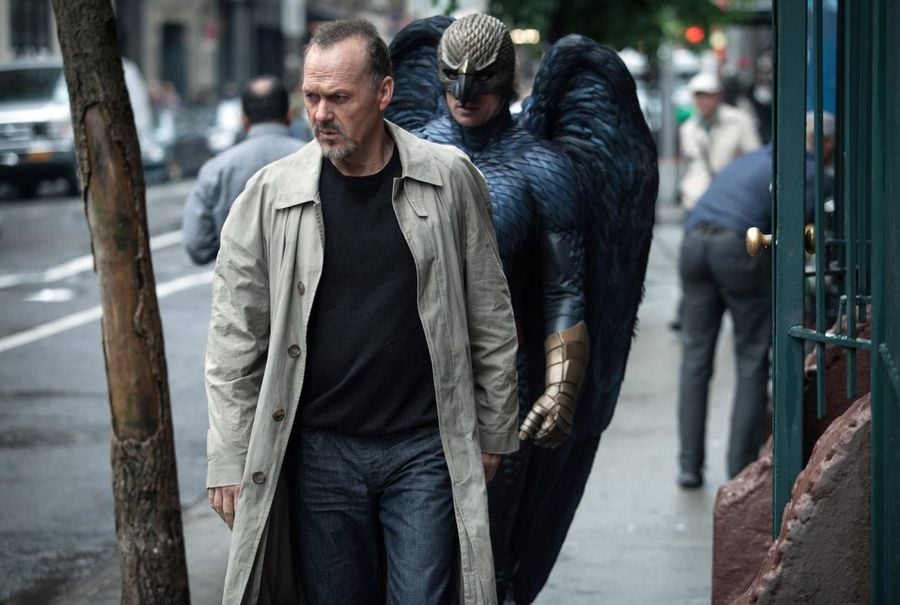
In Alejandro Iñárritu’s 2014 black comedy-drama film Birdman or (The Unexpected Virtue of Ignorance), Riggan Thompson – played by Michael Keaton – attempts to adapt the Raymond Carver short story ‘What We Talk About When We Talk About Love’ for the Broadway stage.
Thompson is a former Hollywood star in decline who once found fame for his role in the fictional superhero movie franchise ‘Birdman’. In a desperate attempt to regain critical recognition and depart from his reputation as a simple-minded mainstream actor, he believes adapting Carver’s collection will earn him several highbrow nods from the theatrical press.
However, Thompson is also suffered from paranoia, hallucinations, self-doubt and severe mental unwellness. His mind is frequently invaded by the thoughts of the superhero he used to portray, who criticises Thompson’s feeble, vain and self-interested attempt to earn the recognition he craves, suggesting that he should instead make an unnecessary fourth ‘Birdman’ film.
The first previews for the play go terribly wrong, with Mike Shiner, an acclaimed but self-obsessed actor – played by Edward Norton – becoming enraged by the fact that Thompson has replaced his on-stage gin with water and drastically breaking the fourth wall, ending any hopes of it going remotely well.
Several personal battles between the cast ensue. When Thompson reveals to Shiner that he wanted to adapt Carver’s short story because he came to see him perform in a play when he was a child, leaving him a congratulatory note on a napkin, Shiner tells him that Carver was most likely drunk.
Eventually, during the opening night of the play, for real, all the pressures of Thompson’s life become insurmountable. In the performance, he picks up a real gun for the scene in which his character kills himself and shoots himself in the head in his own suicide attempt. The performance receives a standing ovation. When Thompson wakes up in the hospital the following morning, he has only shot his nose off his face and finds that the newspaper reviews have lauded him with the critical acclaim he so desired.
As for Carver’s short story itself, it tells of two couples sitting around a dinner table drinking gin. Mel is married to Terri, and they live in Albuquerque, New Mexico, while Nick – the narrator – is wedded to Laura. The two couples sit around drinking when the discussion soon turns to the nature of love.
Terri has had a previous abusive relationship, though she argues that her former husband performed the abuse because he loved her so much. However, Mel outrightly disagrees that Ed loved Terri and claims that he once bought a gun to protect himself and Terri from him. Ed eventually killed himself.
The conversation soon switches to other facets of love, such as an elderly couple in the hospital that Mel witnessed expressing their love for one another and Mel explaining his hatred for his ex-wife. Mel ultimately claims that when something terrible happens to someone’s partner, they are still capable of loving again. What we learn through Nick’s narration of Mel’s talk is that, essentially, Mel is jealous of the fact that even though Terri’s former husband abused her, she still felt feelings of love for him, as she was by his side in the hospital when he died of a self-inflicted gunshot wound.
Iñárritu once opened up on his love for Carver and the very notion of trying to adapt Carver for the stage. He said, “It was a terrible idea. I’ve loved Carver since I was very young. He’s one of my favourite writers. But I think to try to adapt a short story of Carver’s was suicidal. It’s exactly related to your first question: If you don’t know what you are dealing with, it’s an easy and good-bad idea to adapt Carver for Broadway. The film starts with an excerpt from this beautiful poem that Carver wrote just before he died, about what we are looking for in our life”.
“He died when he was 50 years old, and the only thing he was looking for was to feel loved,” he added. “I think that’s exactly the same for me. And the short story is about people lost and confused and looking for love. So in a way, thematically, the short story and the quest of Riggan Thomson are completely attached. I wanted the play itself to become a projection of him, and little by little, he would become one of the characters of that play. It’s a mirror of his own life”.
Whilst in the film’s world, the Broadway adaptation was a success, earning rave reviews, this was primarily owed to the fact that Thompson attempted to commit suicide on stage. Prior to that, the previews of the production were mainly miserable, with the only modicum of respect coming from Mike Shiner’s exemplary performances as an actor.
Evidently, there is something missing when trying to adapt a short story for the stage, and perhaps that is to do with perspective. We learn of Mel’s jealousy from the narration and perspective of Nick, who has his own set of love-based concerns to deal with but is primarily overshadowed by Mel’s incessant chatter. In fact, the story opens up with a line that perfectly sums up the story as a whole, “My friend Mel McGinnis was talking”.
The very title of the story also holds great irony, ‘What We Talk About When We Talk About Love’. But ‘we’ – from the perspective of Nick – do not manage to talk about anything because Mel is so preoccupied with his own self-doubt and jealousy. Unfortunately, in a stage version of a written story, we are not allowed to understand the characters’ inner workings. Not Nick wandering off mentally as Mel rambles on, nor his description of the scene or his apparent boredom with the whole scenario. Instead, the characters other than Mel would appear as mere cardboard cutouts on the stage.
We don’t see much of Birdman’s fictional production, as the film focuses mainly on Thompson’s mental plight. Yet, any stage adaptation of Carver’s story would be a paltry effort at best. Perhaps that is why Iñárritu decided to include it in his film, as he knew that rather than Thompson only wishing to put on an accurate adaptation, he only wanted to refresh his artistic credibility and feel a little bit of love of his own.
