


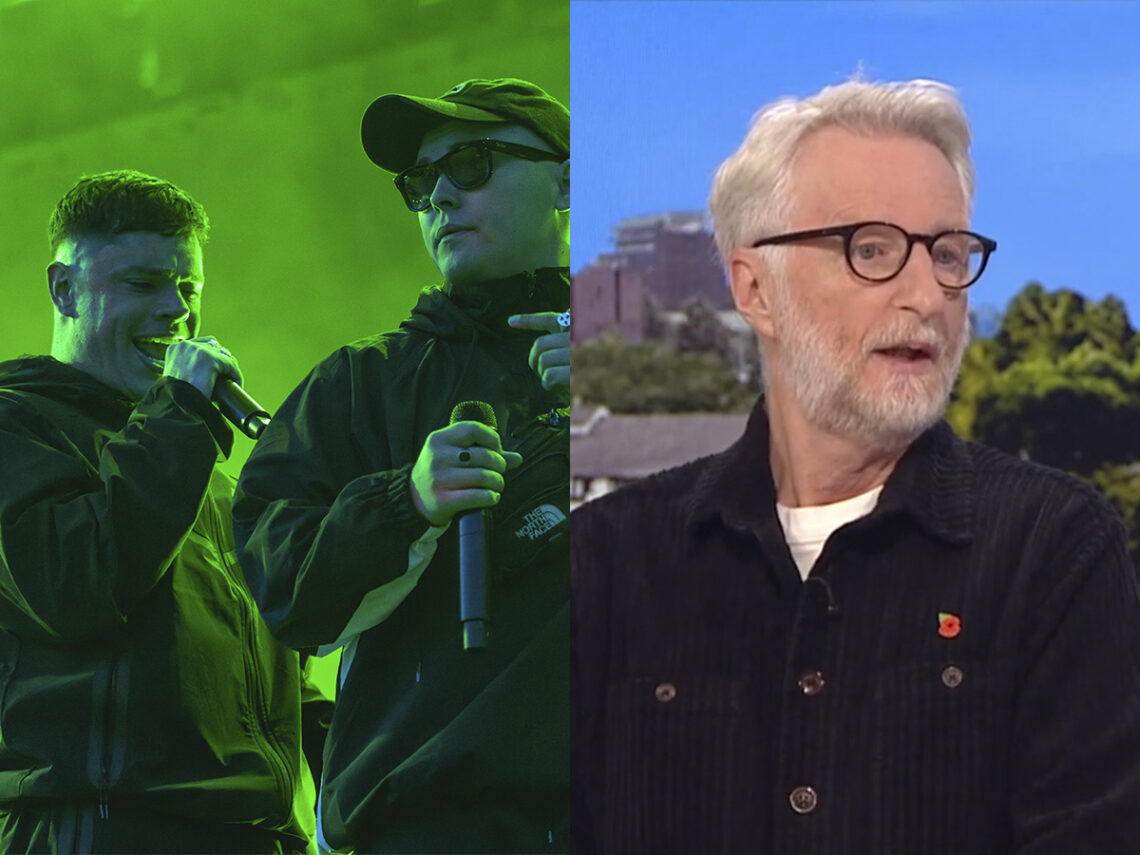
Billy Bragg releases statement of support for Kneecap amid terror charge

Billy Bragg has released a lengthy statement in support of Irish rap group Kneecap, who have recently been charged with a terror offence after allegedly waving a Hezbollah flag at a London gig in 2024.
Bragg was on a different side of this debate previously, as he hit out against an open letter signed by friends of the band in the music industry. The letter supported Kneecap openly, with signees including Paul Weller, Pulp, Massive Attack, Fontaines DC, Idles, Annie Mac, Tom Morello, Brian Eno and English Teacher.
At the time, Bragg wrote that the letter was “trying to avoid the complexities of this issue by claiming that the politics of an artist’s views are irrelevant, [therefore] the signatories are arguing that the only principle at stake here is free speech. I disagree.”
However, he has newly clarified what he meant by this feedback on the letter. “As someone who protested against Paul Simon when he brought his sanctions-busting Graceland tour to London in 1987, I find this demand for free speech absolutism to be counter-productive.”
He continued, linking this to the plight of the Irish trio. He wrote, “While I believe that being an artist doesn’t absolve you from taking responsibility for your actions, I do not believe that creative expression should be subject to criminal charges.”
In the Facebook post, Bragg suggested that the current court ruling against Kneecap is symptomatic of a greater trend. He wrote: “The charging of Kneecap’s Liam Óg Ó hAnnaidh with a terrorism offence by the Metropolitan Police is the latest development of a disturbing and broader trend over the past few years during which the state has sought to criminalise creative expression.”
Providing evidence, the star continued: “Since 2005, there have been over 100 cases in which prosecutors have put lyrics, music videos and audio recordings in front of juries to help secure criminal convictions.”
Bragg went on to point out that this “disproportionately affects young Black men and boys from under-resourced, marginalised communities.”
Bragg then linked to a charity who are aiming to remove, or at the very least limit, the admissibility of creative expression as evidence in the criminal courts.

Never Miss A Beat
The Far Out Music Newsletter
All the latest music news from the independent voice of culture.
Straight to your inbox.