


How the Bible helps to decode the message of ‘No Country for Old Men’

No Country for Old Men is a masterpiece that gets better with repeat viewings. The first time you watch it, the ending feels like a damp squib. This, invariably, urges you to revisit the film. On second viewing, the Coen brothers‘ masterpiece – one of many in their filmography – doesn’t end on a blunt full stop, but rather a clever question mark that prompts you to think about it on a deeper level.
The best aide to quell your musings is the Bible. Throughout the adaptation of Cormac McCarthy’s novel of the same name, the Brothers dim provide biblical inflexions that add a grander philosophical subtext to the cash-in-a-carry-on-case caper. Looked at from a secular standpoint, the message and ending of the film might seem confusing and arbitrary, but, as with most things from a biblical perspective, it is black and white.
The first hint that the Bible is the key to deciphering this classic arrives when Llewelyn Moss is chased by dogs that could otherwise be interpreted as hellhounds. They pursue him, in a slavering bid for retribution, almost at the very second that he decides to take the satchel of cash.
Viewed casually, this is no more than a high-octane setpiece that serves to propel the sense that Moss isn’t in for an easy ride. Theologically, however, it is more direct: Moss has wronged, and now divine judgment is upon him. The reason that this doesn’t come across quite so clearly to most of us sinners is because, faced with an errand briefcase containing $2million, we might be perturbed by the bloodbath surrounding it, and the sense of fear that we might be sought after, but the morality of the act itself seems justifiable.
Surely, in this crooked movie, Moss is the good guy? Well, biblically, you can’t be a good guy just by being the least bad bad guy. He has wronged by taking the briefcase of cash, presented next to a tree like the proverbial apple of original sin. He’s aware that it is blood money and that it isn’t his to take, but he takes it anyway.
There are, of course, plenty of rational reasons why Moss might think that his actions are morally justified, but in the Bible’s view, you can’t reason your way out of a wrong.
Perhaps the crucial chapter on this comes from Corinthians: “For what partnership has righteousness with lawlessness? Or what fellowship has light with darkness? What accord has Christ with Belial? Or what portion does a believer share with an unbeliever? Therefore go out from their midst, and be separate from them, says the Lord, and touch no unclean thing; then I will welcome you.”
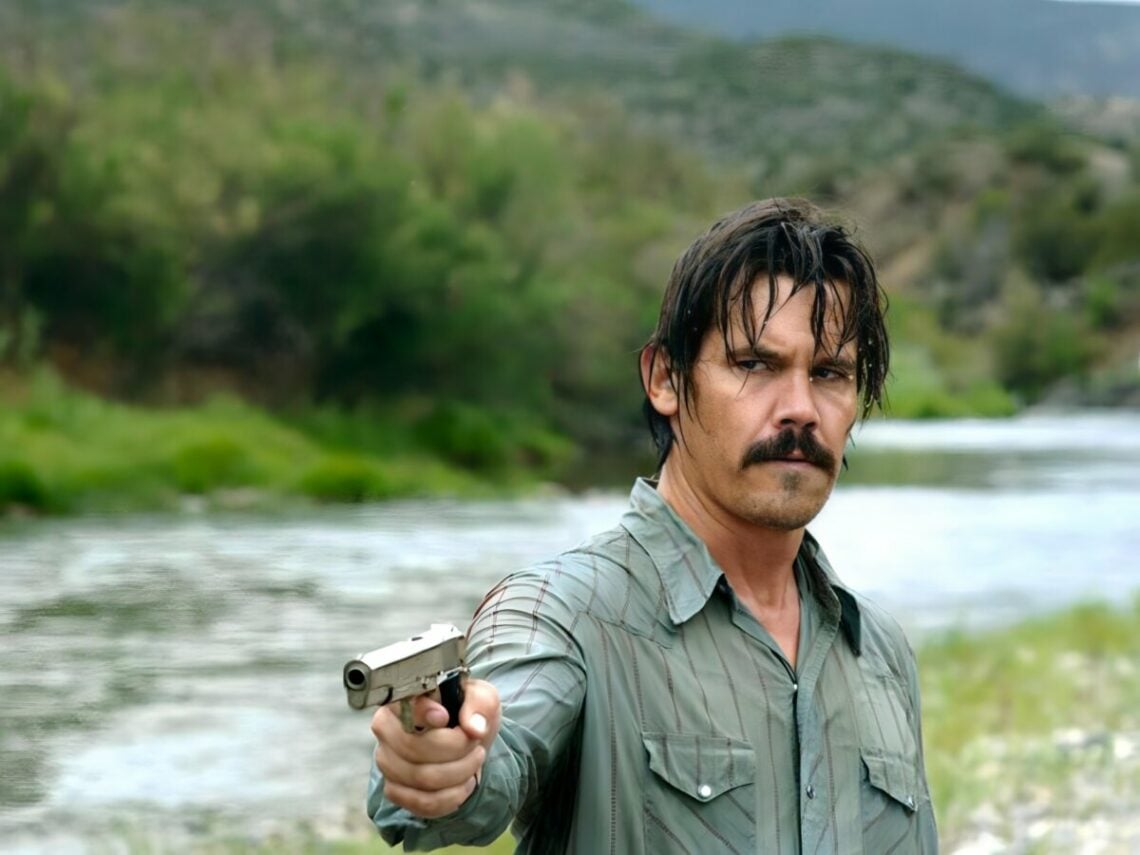
Moss has touched an unclean thing. For that, he will pay the price. The inescapability of this is signified clearly by the fact that the briefcase is fitted with a tracker. This GPS is like a marker upon his door as Anton Chigurh searches him out like Beelzebub to pay for his crime. You can’t negotiate with evil, it says, you can’t bend it to meet your end with corrupt moral reasoning.
Ephesians states: “Have nothing to do with the fruitless deeds of darkness, but rather expose them.” In a morally perfect world, Moss would have seen the bloodbath and called Sheriff Bell, refusing to engage with the darkness and exposing it himself. But the world isn’t morally perfect, and the film subtly argues that this sorry state of affairs has as much to do with Moss’ rather more understandable wrongdoings as it does with Chigurh’s more pure form of evil.
In the end, this is why Sheriff Bell is so bereft and disillusioned. After a lifetime observing society’s attempts to negotiate evil, his own sense of God has abandoned him. If old men were once seen as society’s shepherds, the sort who could stand by a briefcase of cash and do the right thing, then the point is that there are none of them left. Even the supposed good guys are now a law unto themselves.
