


The five best fake commercials in movie history

Advertising is an inescapable part of our everyday lives, and with the proliferation of social media, the industry has even more avenues to target and persuade us to part with our cash. These days, and if you’re around a certain age, you’re more likely to be sold something by an influencer on TikTok or as sponsored content from a YouTuber than you are a traditional television infomercial or an ad placed in the cinema.
Lately, the generational gap has even become a marketing tool in itself with the ‘our Gen Z intern wrote the script for this’ type of viral video hopeful delivered unironically – but sort of ironically – by deadpan Boomers. Deliberately bad ads are now considered ‘good’ to rack up likes and shares.
But the funniest fake commercials in film, however dated they seem now, still ring true with us as consumers. This history of lambasting the advertising industry ranges from swipes at product placement (Tropic Thunder’s ‘Booty Sweat’) to fake trailers for other non-existent films or TV shows (Grindhouse’s ‘Machete’). Both examples were so well-received that they manifested as real consumable things: the Booty Sweat drink was created and sold, and Machete was adapted into a feature-length film by Robert Rodriguez.
Often, these inserts into a fictional film world tell us something about the society we live in or critique the corporations that produce them. The common thread is that we’re usually being sold something we don’t need, forcing the company behind said thing to focus on its manufactured conceptual value: the product won’t add any real value to your life, but what if it made you feel like it did?
There are too many fantastic examples of fake commercials in the film to list concisely, but here are five we think are especially worthy of praise.
The five best fake commercials in cinema:
‘Conan The Librarian’, UHF (Jay Levey, 1989)
‘Conan The Librarian’ is a funny title on its own. When turned into a full-blown skit, it’s absolutely hilarious. This commercial appeared in the “Weird Al” Yankovic-starring 1989 film UHF (which stands for ‘ultra high frequency’, a broadcasting band used by low-budget TV stations in the United States). Directed by Yankovic’s manager, the comedian and parody musician plays a TV station manager who changes the fortunes of Channel 62 from a dud to a surprise network hit.
This is thanks to his bizarre but well-received new programming blocks, including giving the station’s janitor his own kid’s show. It’s also where the ‘Conan The Librarian’ ad appears, teasing what appears to be a made-for-TV-film in which a strapping barbarian in Conan’s signature fur loincloth, sword in hand, admonishes a library user for not knowing the Dewey Decimal system, then cleaves a young man in two as a late return punishment. Naturally, he sports an unmistakable Schwazzenager lilt when delivering his lines.
The ‘Conan The Librarian’ spoof isn’t Levey or Yankovic’s invention – it’s actually an adaptation of an idea that first appeared in comic form in the early 80s. The parody garnered TV and even radio versions across the decade. The UHF iteration arguably remains the most accessible though.
‘MagnaVolt’, RoboCop II (Irvin Kershner, 1990)
Judge Judy and executioner, as Nick Frost in Hot Fuzz would put it. RoboCop is one of the most scathing and nakedly graphic indictments of the way corporations can wield political power and expose the flaws in our criminal justice systems. RoboCop II and its sequel may have sent the series downhill after its initial explosive debut, but moments like the ‘MagnaVolt’ advert remain in the cultural consciousness.
The commercial is structured like an infomercial, with actor John Glover playing a salesman talking to directly to the viewer. The MagnaVolt is a high-tech piece of security technology that triggers if someone tries to steal your car. In the infomercial, a carjacker breaks into a vehicle and attempts to make off with it, only for metal bands to burst out of the seat, trap and then electrocute them to death. Glover plays this off with a chilling calm as if he’s selling you a mundane device that’ll save you time prepping food in the kitchen and not an in-built electric chair in your car.
Emphasising RoboCop’s overarching warning about the privatisation of crime prevention, the MagnaVolt ad’s ludicrousness also emphasises the film’s intention to parody the first; a parody within a parody.
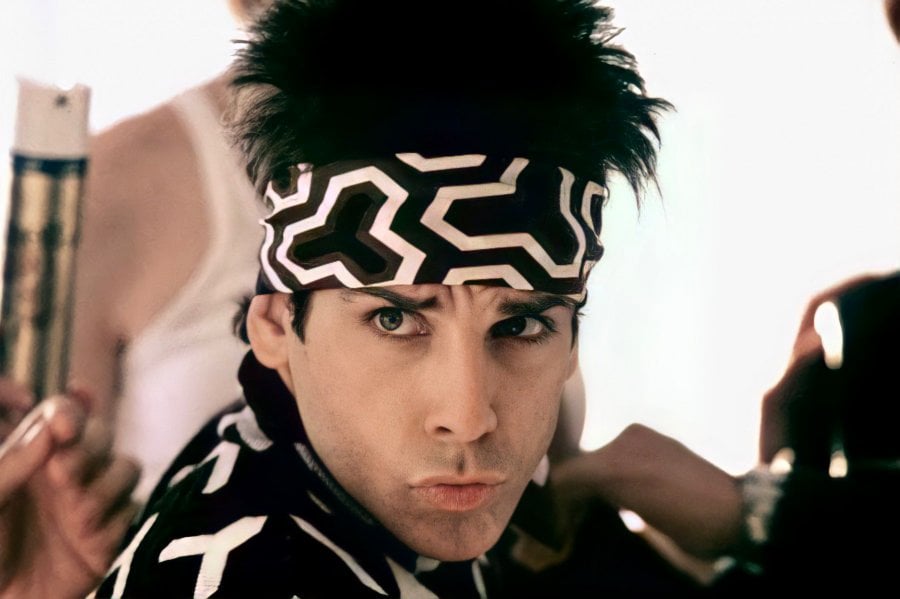
‘Aveda’, Zoolander (Ben Stiller, 2001)
“Wetness is the essence of beauty…” The cult comedy classic Zoolander is a treasure trove of quotable moments, both in physical and verbal comedy. From ‘Blue Steel’ to hobo runway chic, Ben Stiller’s campy send-up of the fashion world has never lost its relevancy even as the industry has made steps in recent years to be more inclusive and less elitist.
The ‘Aveda’ commercial is a slither of a joke in a film packed with bigger, bawdier gags from a stacked cast of comedy character actors. Yet it’s one of the most potent illustrations of not only the surreal way cosmetic and beauty products are sold to us, but within the film’s story, the perfect punchline for how far removed Stiller’s male model protagonist, Derek Zoolander, has become from his working-class routes.
Having returned home to a rural mining community, Derek tries to reconnect with his father, Larry, played by Jon Voigt, in a local bar after work. The bar’s TV plays an advert for something called ‘Aveda’, depicting Derek as a mermaid (or “merman” as he insists) doing a line-reading parodying the nonsense commercials for beauty products spout. Derek’s re-assimilation tactics are instantly dashed as the other men in the bar snicker, and his father simply looks bewildered.
‘Globo Gym’, Dodgeball: A True Underdog Story (Rawson Marshall Thurber, 2004)
Ben Stiller does it again. Considering it’s become a sleeper favourite, it might surprise some to learn Dodgeball was not as well-received as Zoolander upon release. The extremely spoofy sports movie earned Stiller a Golden Raspberry nomination for portraying ego-maniacal gym owner White Goodman, which was criticised for being too over the top.
Perhaps that’s why this commercial for his character’s Globo Gym, the sleek, impersonal rival gym to protagonist Peter LaFleur’s schlubby but friendly Average Joes, works as well as it does. Giving Goodman a smaller container for his self-hatred-fueled energy, the Globo Gym commercial serves as a succinct introduction to the character and his backstory. It also encapsulates Dodgeball’s ripping apart of toxic masculinity.
With comments about not “hating yourself enough” to commit to self-improvement, Goodman also says the quiet part out loud for the health and wellness industry, culminating in him revealing his gym includes a cosmetic surgery wing, essentially bypassing the need for even working out at all if you view fitness in shallow terms. Wheeling out a full-body bandaged customer and shoving them off-screen is also the funniest representation of Goodman’s attitude towards his clientele compared to Average Joe’s ‘found family’ dynamic.
‘Who Ya Gonna Call?’, Ghostbusters / Ghostbusters II / Ghostbusters: Afterlife (Ivan Reitman, 1984 & 1989 / Jason Reitman, 2021)
It was such a good commercial that it spawned its own sequel. Between the kaiju-like Marshmallow man finale and earworm of a theme song, one of Ghostbusters’ most lowkey, charming gags is the team’s painfully low-budget advertisement of their services.
The stilted delivery by comedians doing their best non-actor acting, poor editing and bad framing is something shows like It’s Always Sunny In Philadephia would perfect decades later. Writer and star Dan Ackroyd’s formative work on SNL likely served him well here.
As comedy sequels are one to do, the gag is repeated in Ghostbusters II and is somehow even more poorly made despite the operation being far more successful. It’s one of the few examples of fake commercials in film that aren’t biting satire; rather, affectionate and grounded portraits of a group of bumbling oddballs.
This is heightened in the deeply nostalgic canon ‘threequel’, Afterlife. Paying tribute to Egon Spengler’s actor, the late Harold Ramis, the commercial is rediscovered by Ramis’ granddaughter, hoping to connect with him. Snippets of it play while she dials the number for Ackroyd’s Ray Stanz, transforming it into a window to a time that can never be regained, and the spectre of a friendship long since vanquished.
