


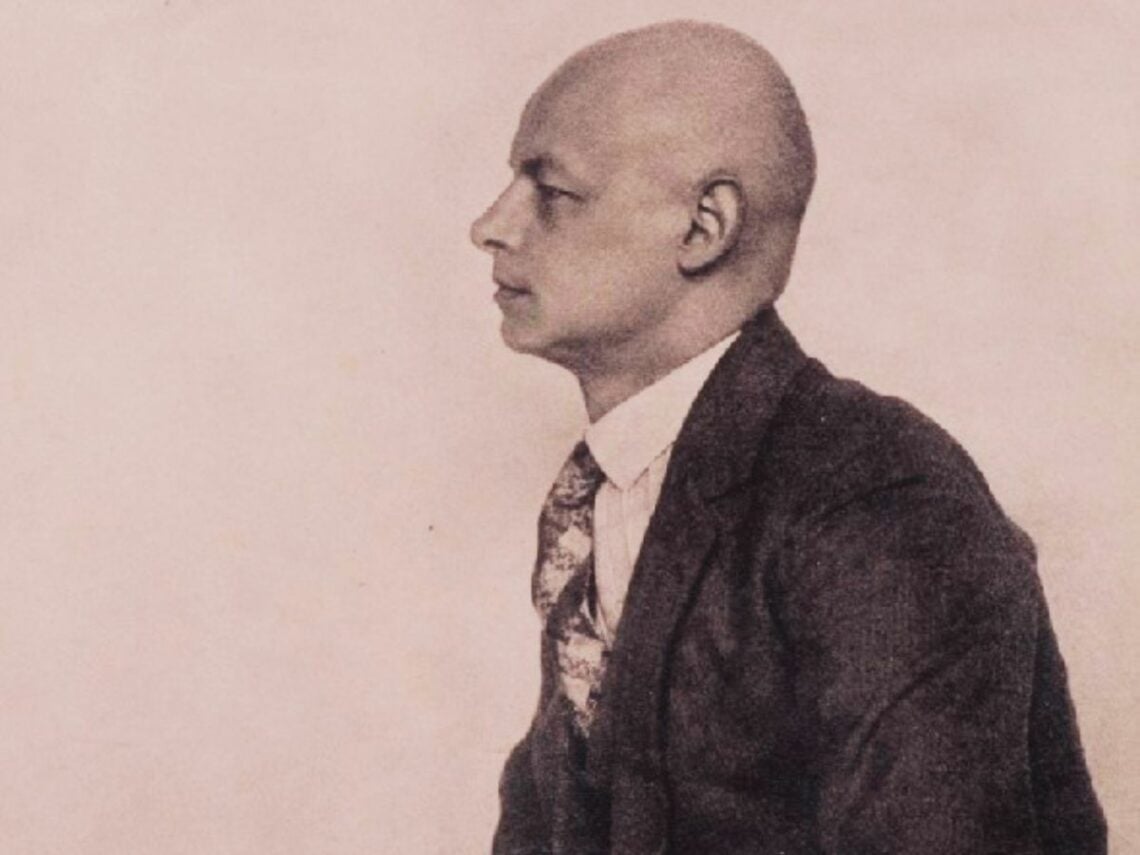
Oskar Schlemmer: the Bauhaus master who painted to defy the Nazis

In the 20th century, fine art entered a period of vigorous transformation. In the 1920s, in the aftermath of the First World War, the Dada movement gained traction across Europe as a direct artistic reaction to the absurdity and atrocity of war. Challenging societal norms, brave artists during this period sought to shock, confuse or outrage the public with avant-garde artworks and unprecedented concepts. As World War II approached, similar attitudes would be used to defy the Nazis.
In 1919, the German art school Staatliches Bauhaus – or the Bauhaus, as it is more commonly remembered – was founded in the city of Weimar by German architect Walter Gropius. Championing and teaching crafts and fine arts, the prestigious institution sought to marry a progressive artistic vision with mass production and functionalism in design.
“The artist is a heightened manifestation of the craftsman,” Gropius announced as he opened the school. “Let us form a new guild of craftsmen without the class divisions that set out to raise an arrogant barrier between craftsmen and artists! Let us together create the new building of the future, which will be all in one: architecture and sculpture and painting.”
As the school grew from strength to strength, it became revered as one of the world’s most influential bodies in design and modernist architecture. In 1925, the Bauhaus relocated to Dessau and, again in 1932, to the Garman capital, Berlin, under architect director Ludwig Mies van der Rohe.
Refined establishment as it was, the Bauhaus attracted prominent staff, including Paul Klee, Wassily Kandinsky, László Moholy-Nagy and Oskar Schlemmer, at various points throughout its existence. Schlemmer remains the Bauhaus’ most associative master, thanks to his iconic signet design for the school, which the British post-punk band Bauhaus used on both volumes of their popular Bauhaus 1979–1983 compilation.
While the Bauhaus set up shop in Berlin in the early 1930s, insidious movements had begun to simmer in the nation’s government. Preying on the post-war depression, Adolf Hitler and his Nazi party took office in January 1933. The new ruler swiftly suspended basic rights with the Reichstag Fire Decree and the subsequent Enabling Act, thus imposing a fascist totalitarian dictatorship.
After assuming power, the Nazis began to model Germany under Hitler’s vision, as laid out in Mein Kampf. This would include the progressive marginalisation and oppression of Jewish communities alongside other ethnic minorities. Concurrently, Hitler sought to rid Germany of Marxism, toppling establishments associated with communist ideals.
One such establishment was the Bauhaus. The Nazis feared that the modernist outlook of the institution made it a breeding ground for Marxism. Under pressure that had been mounting before the Nazis even took office, the Bauhaus was forced to close its doors permanently in April 1933.
Although the Bauhaus never reopened in Germany, its spirit prevailed overseas, most directly in Chicago, where the New Bauhaus opened in 1937. As a final farewell and a show of defiance against the Nazis, Oskar Schlemmer created one of his most famous paintings, The Bauhaus Stairway.
The 1932 painting depicts a staircase at the Dessau building on which several students are walking away from the viewer. One student, however, is seen countering the current, facing towards the viewer down the stairs. The Bauhaus Stairway has since become a symbol of defiance and one of the school’s most famous artefacts, now preserved at The Museum of Modern Art, New York.
Yamawaki Iwao, a Japanese student who studied architecture at the Dessau Bauhaus until 1932, also created a more overtly defiant art piece. The iconic collage, titled Der Schlag gegen das Bauhaus (The Attack on the Bauhaus in English), presents a high-ranking Nazi politician stomping over a cutout of the Bauhaus building.
