


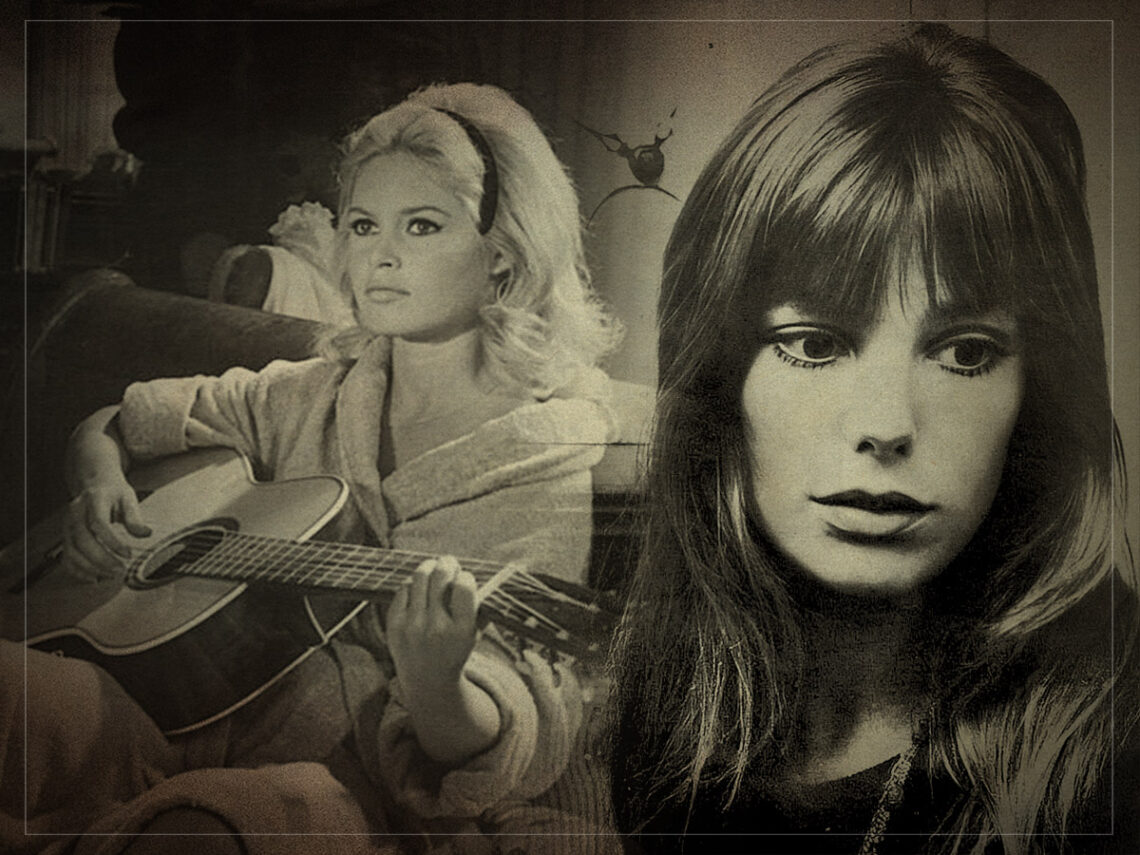
Brigitte Bardot vs Jane Birkin: Who recorded the ultimate version of ‘Je t’aime’?

“I just did it entirely out of jealousy,” Jane Birkin once acknowledged about her chart-topping but controversial 1969 duet with Serge Gainsbourg, ‘Je T’aime . . . Moi Non Plus,’ although that was far from an admission of regret.
In fact, well into her golden years, Birkin almost always spoke fondly about her time as Gainsbourg’s partner, collaborator, and muse, despite the latter’s sometimes unseemly reputation.
“I lived with [Gainsbourg] for 13 years and saw him at his most charming,” Birkin told the KRT News Service in 2003, speaking of the relationship that lasted from the late 1960s into the early 1980s. “We made about five or six albums together and we had the most extraordinary life and daughter, Charlotte.”
When the relationship ended, “Serge went on being my friend,” Birkin said. “He left me 25 percent of his publishing . . . He took care of me like an angel.”
From Jane Birkin’s perspective, her connection with Serge Gainsbourg was a story of day-to-day existence; a bond that stretched over some of the best years of her life. To much of the outside world, though, that relationship would always be reduced back to its early origins, and particularly that memorably bizarre sex duet, ‘Je t’aime . . . Moi Non Plus,’ in which Jane and Serge whisper sweet nothings to one another in French over a Procol Harum organ while growing increasingly breathy and horny with each subsequent verse.

Birkin’s breathiness finally reaches such a degree of wordless moaning ecstasy that listeners couldn’t help but wonder if the two were literally getting off with each other in the recording booth. As a result, ‘Je t’aime’ was banned by the BBC and countless other radio networks, not for “indecent” subject matter in the usual sense of the term, but essentially for just sounding way too sexy for mainstream public consumption.
What made the sultry dance of ‘Je t’aime’ even a tad more risqué or bizarre in retrospect, however, was the fact that Gainsbourg had already recorded it, in the exact same way, two years earlier. In 1967, he’d written the song for his belle of the moment, the iconic French actress Brigitte Bardot, and convinced her to record it with him, full orgasmic breathiness already baked into the concept.
Bardot, widely recognised as planet Earth’s preferred sex kitten of the Summer of Love, was more than happy to oblige. Unfortunately, Bardot’s husband, a German businessman called Gunter Sachs, was less thrilled when he heard about the recording session, forcing Gainsbourg to scrap the single’s release and hide it away in his archives.
When Birkin entered Gainsbourg’s life shortly thereafter, she was well aware of the history of ‘Je t’aime’, including the existence of the Bardot recording. But when Gainsbourg asked her to do a new version—an invitation he’d apparently also sent out to Marianne Faithful and half a dozen other women—Birkin jumped at the opportunity. Along with having some lingering jealousy toward Bardot and concern about the original version of the song resurfacing, Jane was also legitimately enamoured with Serge, and wanted to capture that feeling in the studio. Controversial as it proved, the song’s success soon shot her to a new level of stardom at the age of 23.
“We were sort of feted in our own country,” Birkin said, noting that ‘Je t’aime’ came right at the tail end of the “free love” movement and hippie idealism. “All that gaiety and the innocence of that era was shattered,” she recalled, after the murder of the actress Sharon Tate by Charles Manson’s cult later that same year. “Suddenly, everything was tainted with that. Things weren’t the same—all those hippie flowers on our faces, suddenly it all just went.”
Birkin and Gainsbourg did make a film adaptation of their hit song, also titled Je T’aime Moi Non Plus, in 1975. About a decade after that, the original Brigitte Bardot version of the song was finally released, with Bardot’s consent, and Gainsbourg fans were given the chance to compare the performances of the dueling ‘60s chanteuses.
As for who wins the day? Well, Birkin is the better singer, although she was apparently instructed by Gainsbourg to sing in a higher register “like a little boy,” which we’ll avoid analysing any further. Beyond that, trying to rank or compare the merits of orgasmic breathing feels like a misguided undertaking. To each their own, really. But if we do take context into account, it’s worth some extra points that Bardot was, for lack of a better term, originating the role here.
Gainsbourg wrote the song for Brigitte, and the two created the template for its energy with their first infamous studio duet, during which they were allegedly pawing each other throughout and testing the limits of maintaining a professional working environment. Birkin, having presumably been played this original tape by Gainsbourg, was sort of unavoidably put in the position of re-creating what Bardot had already done, which sure sounds like a weird and uncomfortable assignment from the outside looking in, but apparently was no big deal to Jane. In the end, her version is still the one people know. But it’s hard not to suggest that Bardot’s take is the more definitive one, created in the performer’s true voice, going toe to toe with Gainsbourg rather than jealously seeking to appease him.
