


‘Bad Girls Go To Hell’: exploring Doris Wishman’s sexploitation

Sexploitation movies remain one of the most fascinating cinematic subgenres to emerge from the 1960s. Made on low budgets and typically designed to include as much gratuitous nudity as possible, sexploitation directors often used the eroticised female form to entice viewers, who were predominantly male.
These days, many sexploitation movies, with their bad acting and laughable plotlines, have become cult classics. While some films from this period were genuinely offensive, seemingly existing only to objectify women, Doris Wishman emerged with a distinctively feminine and subversive take on the genre. Born in 1912, the filmmaker began making movies to cope with her husband’s death. She started making nudist films before moving towards sexploitation, becoming one of the most active female directors in the industry.
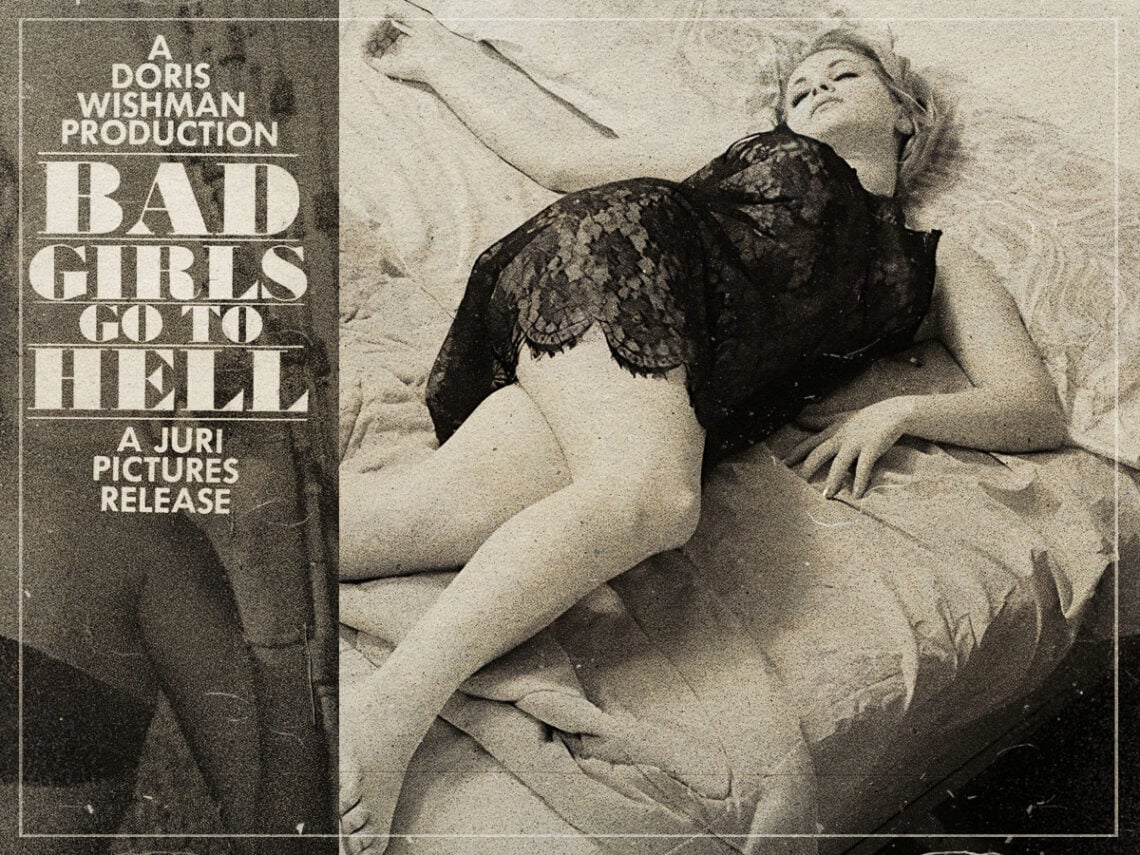
In 1965 she released Bad Girls Go To Hell, starring Gigi Darlene. Upon first glance, you might be fooled into thinking that the movie is nothing more than a rape-revenge story involving clichéd images of a semi-naked ‘damsel in distress’ figure. Yet, under Wishman’s direction, Bad Girls Go To Hell makes a powerful statement about the unending violence against women at the hands of men. Naturally, the rough-around-the-edges style – editing and acting aren’t the film’s strong suits – give the movie an air of unintentional humour. Still, at its core, Wishman’s movie is a groundbreaking exploration of abuse, made at a time when second-wave feminism was still in its infancy.
Bad Girls Go To Hell is not without flaws, and it’s far from the perfect feminist film, yet Wishman’s attack on the patriarchal powers that constantly loom over women is utterly compelling. The movie begins with Darlene’s character Meg waking up beside her husband, her makeup perfectly immaculate. They have an overly-theatric conversation as she strokes his chest hair and begs him not to go to work before slipping into the shower together, their naked bodies narrowly obscured by the frosted screen.
After her husband leaves, she attempts to assume her role as the perfect American housewife. Yet, she seems unsure what to do with herself, cleaning as she wanders around in a see-through lace dress and impractical heeled slippers. Then, in the stairwell of her apartment, she encounters a man cleaning the floors, who swiftly attacks her, pinning her to the floor. The man is portrayed as a terrifying villain, with Wishman framing him from behind. He turns to look at the camera before staring slightly above the lens over at Meg. We witness his fear-inducing, leering gaze – depravity emanating from every crevice of his face. It’s a moment of pure horror, with Wishman’s camera moving closer to his face to create an uncomfortable atmosphere of claustrophobia. An intensely dramatic jazz score plays as Meg is thrown around, trying to fight back as the man asserts, “You wouldn’t be so foolish”.
The camera work is choppy, with the handheld shots often taking on Meg’s perspective. While it’s evident that this is a scene from a low-budget B-movie, it would be unfair to disregard the cinematic prowess at the heart of the scene, with Wishman capturing the attack with an unflinching lens, painting the attacker as the ultimate horror movie monster.
Soon, she is reluctantly reunited with the man, who pins her down once again, this time pulling off her clothes. Wishman’s direction of rape feels starkly different to many male filmmakers from the period, making full use of her camera to disorient the viewer and induce high levels of anxiety, subsequently reflecting Meg’s traumatic experience. She often zooms in on items such as Meg’s discarded shoes or the attacker’s disgruntled face. Wishman also uses some shadowy, chiaroscuro lighting to give the scene a more dramatic look, conveying the intensity of the situation.
Meg reaches for a bowl and smashes it over his head, killing him. Terrified by her moment of self-defence, she takes off to New York City, hoping to find a new life under a new identity. However, with its domineering, phallic skyscrapers and bustling streets, the city takes on a masculine, oppressive form. Her safety is continually threatened as she attempts to find somewhere to take respite, with Wishman making it apparent that women can’t truly find a sense of security anywhere – especially not in the big city.
While countless male movie characters have the privilege of taking off into the city to avoid their problems, Meg can’t do so without men attempting to claw their way in. She is soon subjected to the violence of another man, whom Wishman often frames from Meg’s point of view.
After a few more incidents, Wishman uses the age-old cliché – it was all just a dream. Yet, she cleverly subverts the cliché with a Groundhog Day-esque moment, with Meg’s day taking a similar shape to the beginning of the film. Subsequently, she runs into the attacker again, and the pair struggle on the stairs before the film ends with a shot of Meg letting out a guttural scream, immortalised in freeze-frame. With a final nihilistic flair, Wishman suggests that women’s scariest nightmares are very much real.
It would be reductive to dismiss Wishman’s film as painting women as helpless victims of sexual and physical violence. Although the movie often feels overly theatrical, Wishman conveys the hopelessness felt by countless women, particularly at a time when women were expected to remain loyal, subservient housewives. The director might not have had the best resources, but out of her low-budget B-movie, a powerful indictment of male violence and patriarchy emerges.
