


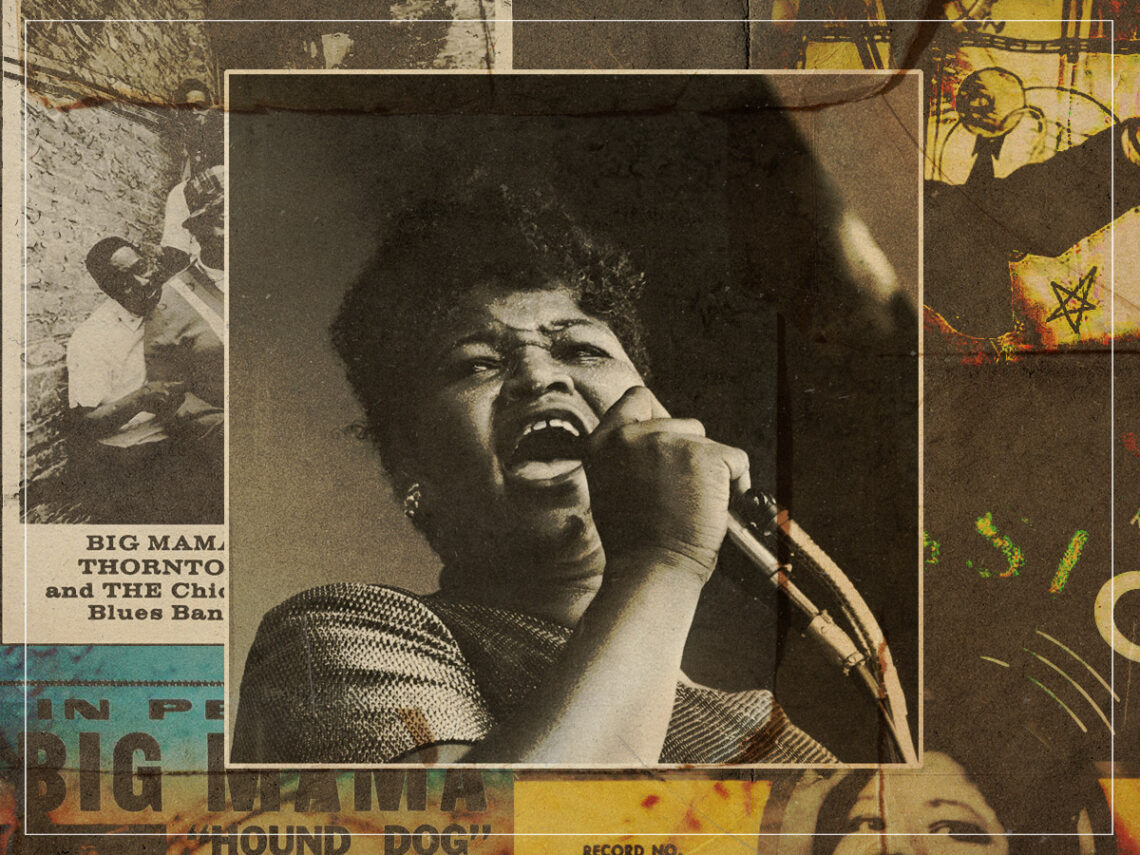
The other side of ‘Hound Dog’: The B-side to Big Mama Thornton’s birth of rock and roll

Rock and roll music is among the most expansive genres in music history, but if you had to pin the exact origins of the style to one artist, Alabama songwriter Big Mama Thornton would be among the prime candidates.
A criminally underappreciated genius, Thornton was an entirely self-taught musician and cut her teeth as one of the few female blues artists of the 1940s and 1950s. Rather than wallowing in the melancholic self-pity that was rife throughout the blues scene during that time, though, Thornton instead chose to inject her work with a kind of swinging, rebellious R&B energy.
In time, that distinctive style found success with the teenagers of the rock and roll age during the 1950s, and Thornton’s music became a core influence on that world, even if she was rarely credited for her work.
‘Hound Dog’ is perhaps the most egregious example of this underappreciation. Penned by Jerry Leiber and Mike Stoller, Thornton recorded the first version of the song during the early 1950s. When it was eventually released in 1953 by Texan blues label Peacock Records, the song became Thornton’s most successful record, spending multiple weeks on the R&B chart. However, any fame garnered by the 1953 recording was dwarfed when, three years later, the song was re-recorded by Elvis Presley.
Presley’s version cemented the early rock and roll scene as an all-encompassing pop culture movement, typifying the sound and attitude of the period, as well as topping the pop charts for a whopping 11 weeks. In fact, the song was so popular that Thornton’s original version was largely forgotten about by most mainstream audiences.
Plus, given that she didn’t write the song herself, it is said that she only earned $500 from the recording in total, despite the intense success of Presley’s version, which would have never happened without her.
At this point, the discussion surrounding the two different versions of ‘Hound Dog’ has waged on for decades. An often overlooked aspect of Thornton’s recording, however, is the masterful B-side of the original single, ‘Night Mare’. A lush, beautiful track that perfectly demonstrates the extent of Thornton’s vocal prowess, the B-side is among the most underrated songs of the musician’s extensive discography.
Musically, the track is heavily indebted to the blues, with Thornton’s incredible guitar styling evoking the Delta blues sounds of iconic artists like John Lee Hooker. Deeper, though, the song also draws upon the influence of jazz, particularly within the effortlessly cool keys, and Thornton’s typical proto-R&B sound ties it all together in a genre-defying package.
In a similar vein to how ‘Hound Dog’ inspired the later generation of rock and roll stars, in ‘Night Mare’, you can hear how Thornton’s vocal performance impacted later stars of R&B and soul music. The laid-back, intimate instrumentation coupled with the commanding presence of Thornton’s voice is particularly reminiscent of early Aretha Franklin recordings, for instance.
So, while Big Mama Thornton’s ‘Hound Dog’ might be one of the most underrated anthems of the rock and roll age, the single’s B-side is just as groundbreaking, inspirational, and similarly underrated. If nothing else, ‘Night Mare’ is a fantastic reminder of the intense, prolific quality which permeates the entirety of Thornton’s discography and reflects the many hidden gems recorded by the rock and roll progenitor over the years.
