


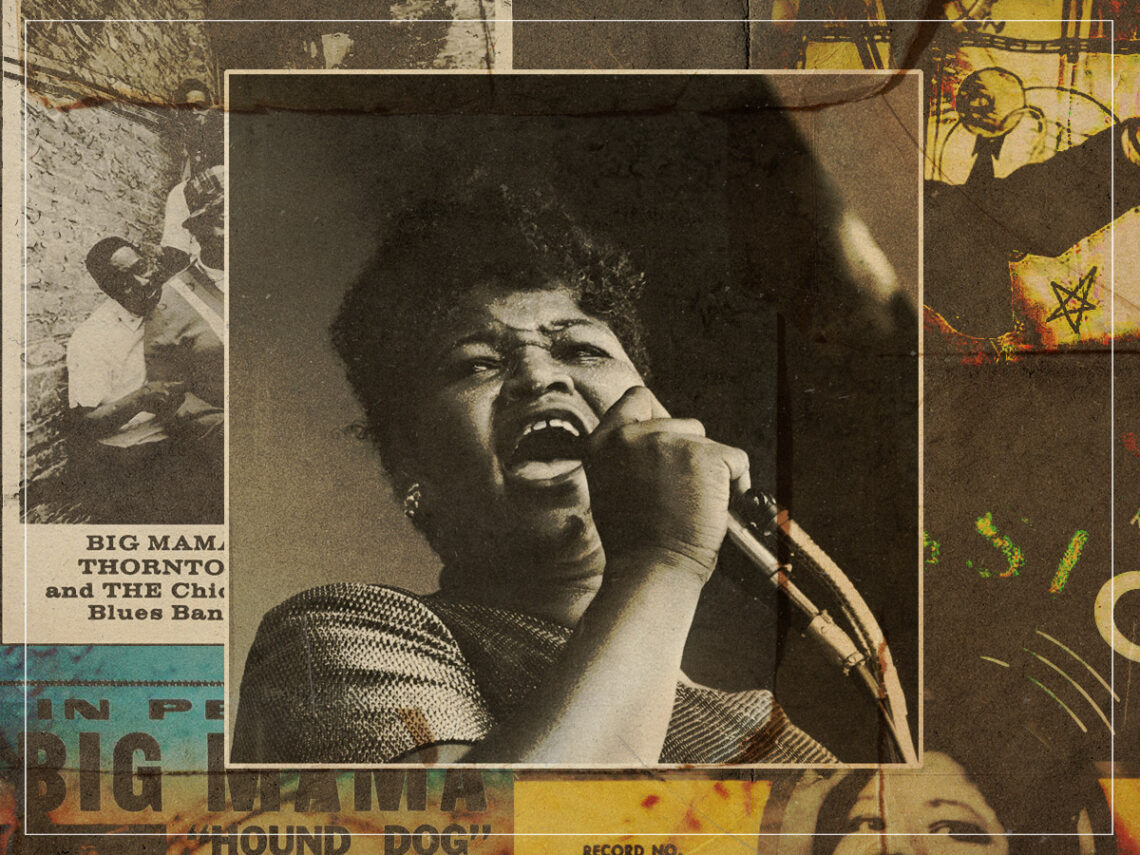
The under-appreciated impact of Big Mama Thornton on rock ’n’ roll history

The pages of musical history are practically awash with underappreciated, forgotten, and ignored artists who never fully received the recognition that they deserved. However, that theme was particularly common during the very early days of rock ‘n’ roll. As we all know, rock originated from the sounds of blues, which had been pioneered by Black artists in America. Despite this, the vast majority of white rock stars became globally successful icons, whereas the Black artists who initially inspired the genre remained virtual unknowns.
There are few figures within rock history who have had the same all-encompassing impact and simultaneous underappreciation as the Alabama singer Willie Mae ‘Big Mama’ Thornton. From her early years singing as a teenager in a Baptist church, Thornton left home in 1940 at the age of only 14 to pursue performing. Unlike many prominent vocalists of the period, Thornton had no formal training or even singing lessons; her incredible talents were all self-taught and based on her own life experiences.
As a Black woman in mid-century America, Thornton was forced to adapt to a prejudiced, discriminatory society from a depressingly young age. Particularly in the southern states, like her native Alabama, the 1940s and 1950s were a ruthlessly horrific time to be Black in America; public lynchings by the Ku Klux Klan were not uncommon, virtually every aspect of society was segregated by skin colour, and Black Americans were generally treated as second class citizens. This endless oppression faced by Thornton caused her to channel an awe-inspiring level of emotion into her performance.
Although Thornton regularly recorded music that had been written by other people, she managed to make every track she sang uniquely her own. So, when her music began to be hijacked by the new generation of rock and rollers during the late 1950s, there was certainly a feeling of injustice. The most prominent example of this came with ‘Hound Dog’, a song Thornton had originally recorded in 1952 that became a colossal hit for Elvis Presley in 1956.
Cover versions were a much more regular occurrence during the 1950s than they are now, and there were fewer laws surrounding royalties and musical copyright. This meant that Thornton made virtually no money from the success of ‘Hound Dog’, despite it being one of Presley’s biggest hits.
“That song sold over two million records,” the singer later recalled to Rolling Stone, “I got one check for $500 and never saw another. Didn’t get no money from them at all. Everybody livin’ in a house but me. I’m just livin’.”
On one hand, you could argue that Thornton did not write ‘Hound Dog’ herself; it had been constructed by Jerry Leiber and Mike Stoller before she became the first to record it. Nevertheless, the intense popularity of Elvis’ version compared to the obscure nature of Thornton’s original contributed to an overwhelming feeling of ‘whitewashing’ within the early rock ‘n’ roll scene. Seemingly, that regressive policy never went away, even within the progressive counterculture period of the late 1960s.
One of Thornton’s most extraordinary songwriting efforts came with the release of the 1968 single ‘Ball and Chain’ and, despite being one of the greatest blues releases of the decade, failed to make any sort of impact on the American music charts. Nevertheless, the song became popular as a result of hippie queen Janis Joplin, who covered the track with her band Big Brother and the Holding Company. Even though Joplin regularly acknowledged the influence of Thornton on her own work, a loophole by Joplin’s record company meant that, initially, the songwriter earned no money from the success of the cover.
Thankfully, Thornton has finally started to gain the recognition she rightfully deserves in recent years, despite decades of music industry whitewashing. When you take a step back and look at the music, performance, and songwriting of Big Mama Thornton, it is truly difficult to think of many figures who have had as mammoth an impact on modern rock and roll. Without her innovative blues records, the world would not have experienced Presley’s ‘Hound Dog’, and we might never have heard Janis Joplin.
While that might be a somewhat facetious argument, it is certainly true that the landscape of modern rock and roll would look very different without the distinctive, emotionally-charged tones of Big Mama Thornton. She might have gone unappreciated and overshadowed during her own lifetime, but the musical legacy she left behind lives on to this day.
