


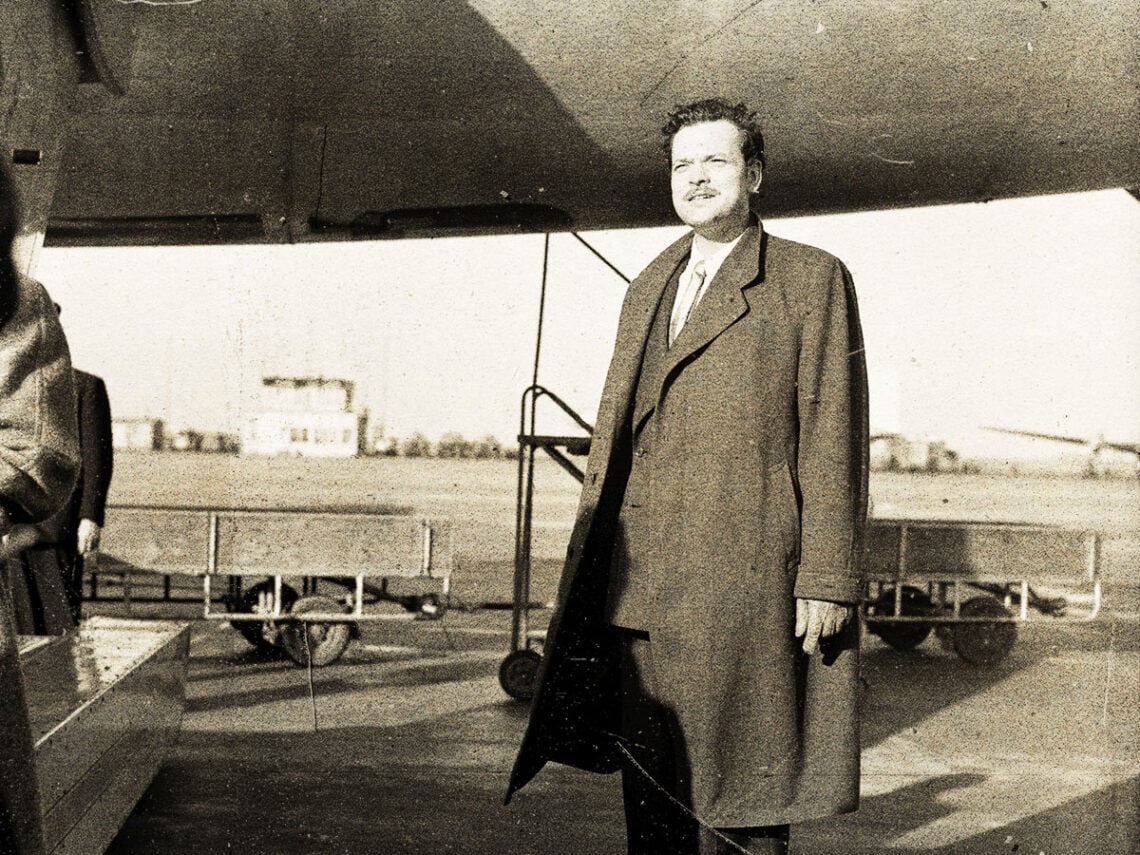
“Kill him”: The “asshole” filmmaker Orson Welles wanted to assassinate

The later years, or decades, to be more accurate, of Orson Welles‘ career were defined by half-finished scripts, abandoned ideas, and paycheque gigs that saw him taking roles well below his station as a Hollywood legend to try and scrape together the money for his next passion project.
It was a startling fall from grace for an actor and filmmaker who’d completely changed the course of cinema when his feature-length directorial debut, Citizen Kane, was widely celebrated as one of the greatest movies ever made, and that adulation hasn’t subsided more than eight decades later.
However, having gotten a taste for complete creative freedom, Welles was unwilling to give it up. As a result, he ditched many more pictures than he actually got around to making, and wasted his prime being caught in the mire of studio politics, effectively exiling himself instead of bending the knee.
As strange as it sounds to describe one of the most naturally gifted and imaginative auteurs in cinema history as a case of unfulfilled potential, it sums up the anomaly that was Orson Welles. When he was firing on all cylinders, few have ever been better, but those instances became fewer and farther between.
In the early 1980s, Welles had written a screenplay for an adaptation of The Cradle Will Rock, a play he’d first helmed on Broadway almost half a century previously. As was the case with almost everything that entered his orbit, though, he found himself running into behind-the-scenes troubles.
Plans were tentatively in place for a ten-week shoot in New York and Los Angeles, with Michael and Kathy Fitzgerald among the producers. Cameras were still a long way away from rolling, but Welles nonetheless explained to Henry Jaglom that he was in a strong position to be well-compensated for his contributions.
“I’m assured of it, but I haven’t got it yet,” he said of his contract. “I talked to Fitzgerald and said, ‘You know, your letter says I have absolute artistic control. But your two other producers are not friendly to me.'” Based on the names who were attached at the time, one of them was likely executive producer George Folsey Jr, and the other was definitely John Landis.
Or, as Welles called him, “The asshole from Animal House.” Or, to be even more specific, “A real shit.” When Jaglom suggested that he was familiar with Landis and was in a position to influence his decision-making, Welles had a completely different idea for how to cope with the problem: “Kill him.”
Understandably, Jaglom wasn’t sold on the prospect of assassinating Landis for Welles’ benefit, which didn’t stop the latter from embarking on another tirade. “[He] won’t leave me alone,” the latter moaned. “Keeps phoning me and giving me advice on how to make the movie in a very patronising way. Everything he says is dumb!”
In the end, like so many other Welles projects, it never went into production. Instead, the events surrounding the creation of the play served as the basis for Tim Robbins’ semi-fictionalised 1999 effort, Cradle Will Rock, with Angus Macfadyen playing the director onscreen.
