


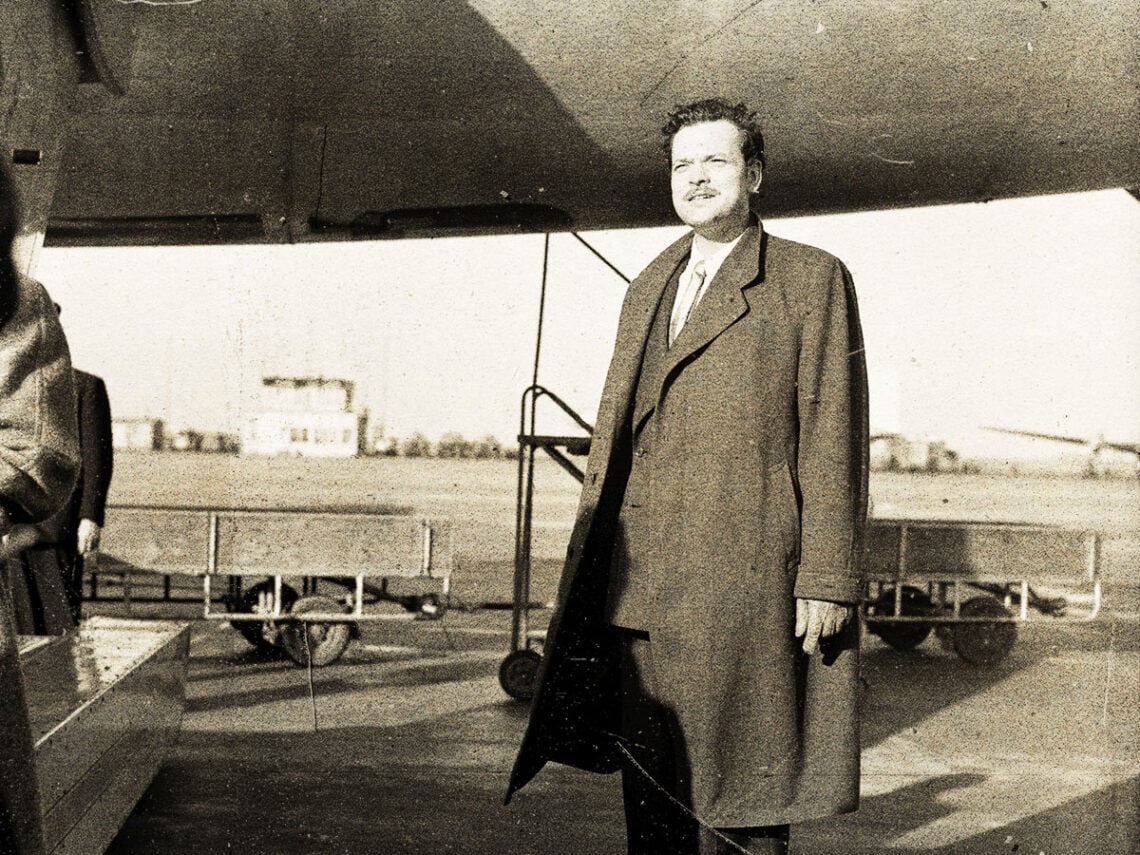
“I am a man of ideas”: how Orson Welles sought to capture the “marvellous” magic of cinema

Cinema has rarely produced talents as mercurial as Orson Welles, with the precociously talented filmmaker ultimately becoming illustrative of the dangers inherent to exploding out of the blocks with those world-class gifts on full display.
Even before he made his feature debut, though, it was evident Welles was going to be something special. He made his stage debut at the age of 16, having travelled from America to Ireland following his father’s death, and he was producing and designing his own original works in Dublin while still a teenager.
By the age of 21, he was directing pioneering stage performances, including a 1936 adaptation of Macbeth with an African-American cast. By the time he was 23, he’d founded his own repertory company and hosted a radio anthology series, which gave rise to his legendary performance of HG Wells’ The War of the Worlds.
Among those in the know, Welles’ reputation already preceded him by the time he tried his luck in Hollywood, and any doubts he wouldn’t – or couldn’t – live up to the hype dissipated when he wrote, directed, produced, and played the lead role in Citizen Kane, which released in theatres when he was 26.
One of the greatest movies ever made, he shared an Academy Award win for ‘Best Original Screenplay’ for a film that earned another eight nominations including ‘Best Picture’, ‘Best Director’, and ‘Best Actor’. By the time he’d even turned 30, Welles had helmed The Magnificent Ambersons and played Harry Lime in The Third Man, so he was quite clearly the real deal.
That rapid ascent turned out to be a long-term downfall, with Welles’ confidence in his own abilities regularly pitting him in opposition to studio heads and high-powered executives. An auteur who wanted to be an outsider, the final decades of his career were defined not by works of excellence but by unfinished projects, unmade films, and paycheque gigs that cast him as a sensation who burned out too quickly.
That was the duality of Welles in microcosm, but never let it be said he didn’t know how to weaponise the potent power of cinema to the fullest. He even had his own set of rules for doing so, explaining in conversations with Juan Cobos, Miguel Rubio, and JA Pruneda that there was a specific type of magic he was seeking to acquire.
“What is marvellous about the cinema, what makes it superior to the theatre, is that it has many elements that may conquer us but may also enrich us, oiler us a life impossible anywhere else,” he offered. “The cinema should always be the discovery of something. I believe that the cinema should be essentially poetic; that is why, during the shooting and not during the preparation, I try to plunge myself into a poetic development, which differs from the narrative development and dramatic development.”
Welles saw himself not as a storyteller or a filmmaker but as a poet, and even poets need to keep their creative juices flowing. “In reality, I am a man of ideas,” he reflected, even if many of those ideas went unrealised. Not that it prevented him from achieving greatness, but that desire to maintain control over every aspect of his work – for the sake of analogy, the words in his poems – saw him fail to maximise the near-unlimited potential he possessed when first breaking through.
