


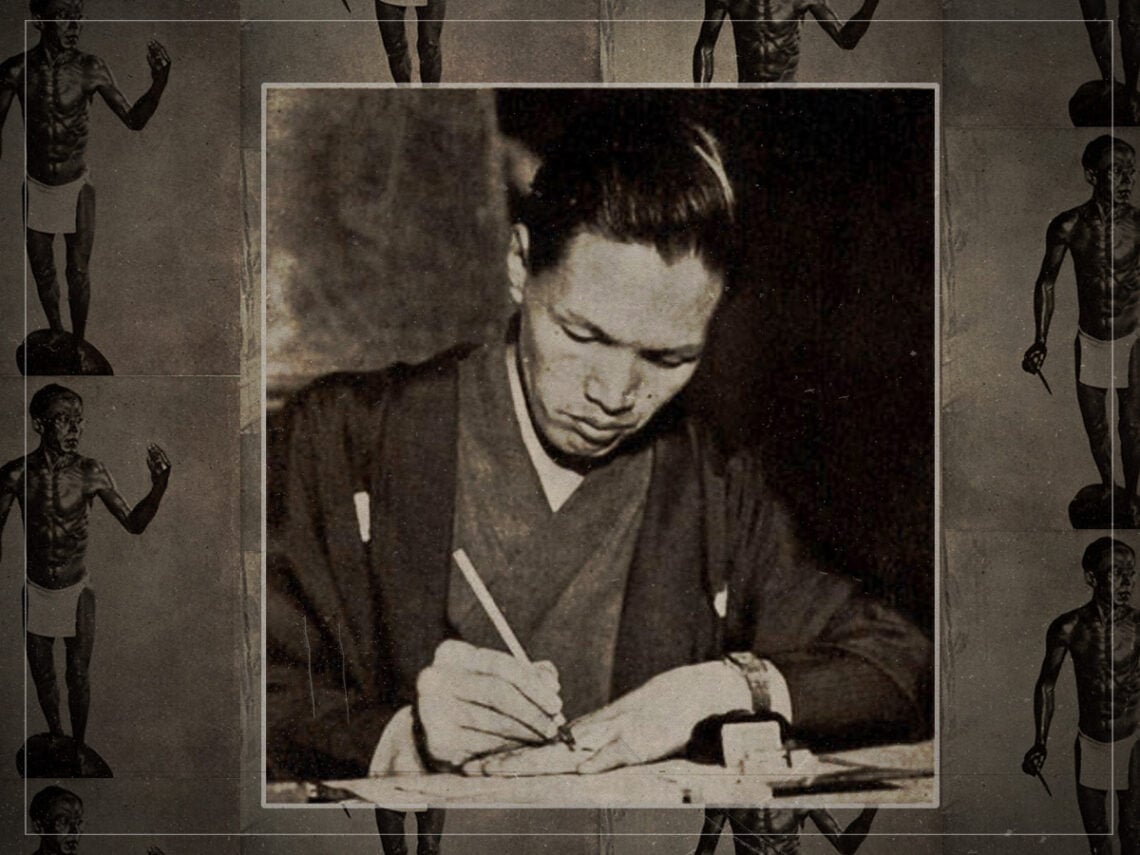
One last disturbing work: the artist who became his own statue

Hananuma Masakichi was an unknown Japanese sculptor for most of his life, and those who knew him only knew about his speciality, making “iki-ningyo” or lifelike dolls. Then, following a tuberculosis diagnosis, convinced he was going to die, the man embarked on his most ambitious project: a life-size, hyperrealistic sculpture of himself for his lover to keep when he passed away.
Masakichi used his usual techniques but took this sculpture to a whole new level, to a point that people couldn’t tell the difference between him and the lifeless sculpture. He carved each part separately, making around 5,000 individual strips of dark wood which he meticulously painted and lacquered to match his skin tone. Each piece was connected with dovetail joints, glue and pegs so that they seamlessly attached to each other. The skin was polished to give it a palpable effect, with every muscle and bulging vein defined. Masakichi used mirrors to correctly replicate every anatomical part, even going to the extent of drilling tiny holes to represent every pore on his skin’s surface.
Things got a bit creepy when he chose to pluck his own hair, teeth and nails to attach to the sculpture. It was as if he wanted a life-like replica of himself, as closely resembling him as possible, to live on after him. Naturally, to complete the piece, he dressed his lifeless twin in his own clothes and glasses.
Did he want his lover to fall in love with this lifeless statue so as not to forget him when he was gone?
By the time he completed his work in Yokohama in 1885, word had spread of his jaw-dropping masterpiece. When he officially unveiled it, he stood motionless beside it, mimicking the same position as the figure, and people watching were shocked as they couldn’t tell them apart.

To his surprise, Masakichi lived on for another ten years but died in 1895 in extreme poverty. The successes of his sculptures were only recognised posthumously. At some point, the statue travelled to California and became the mascot of several bars around the state. In one particular bar, coins were minted with its image, which could be exchanged for free drinks, and this was where Robert Ripley, an amateur anthropologist, discovered it.
At the time, Ripley was pretty much a nobody, but once he acquired some fame and wealth, which led to the opening of his museum of conspiracy theories and illusions, Ripley’s Believe It or Not!, he was able to buy and display the sculpture for just $10. He toured it across America for all to see, and many were shocked by its hyper-realism. Ripley also developed a strange fondness for it, taking it with him wherever he went and placing it in hidden locations in hotel rooms so that it would scare friends.
However, akin to Masakichi’s tragic death, an unknown artist in penury, his statue had a similar ending. It was damaged during the 1994 Northridge earthquake. Luckily, experts were able to restore it, leading to it finding a permanent home in Ripley’s second museum in Amsterdam, the Odditorium.
It’s certainly clear that this statue had an unusual power to captivate those close to it, almost as if it were a person itself. In the final act of destruction in the earthquake, the sculpture still managed to survive and “live” on. This very much echoes Masakichi’s life with tuberculosis and his eventual passing. I wonder whether all his efforts to make the statue led to a part of his soul living in it.
