


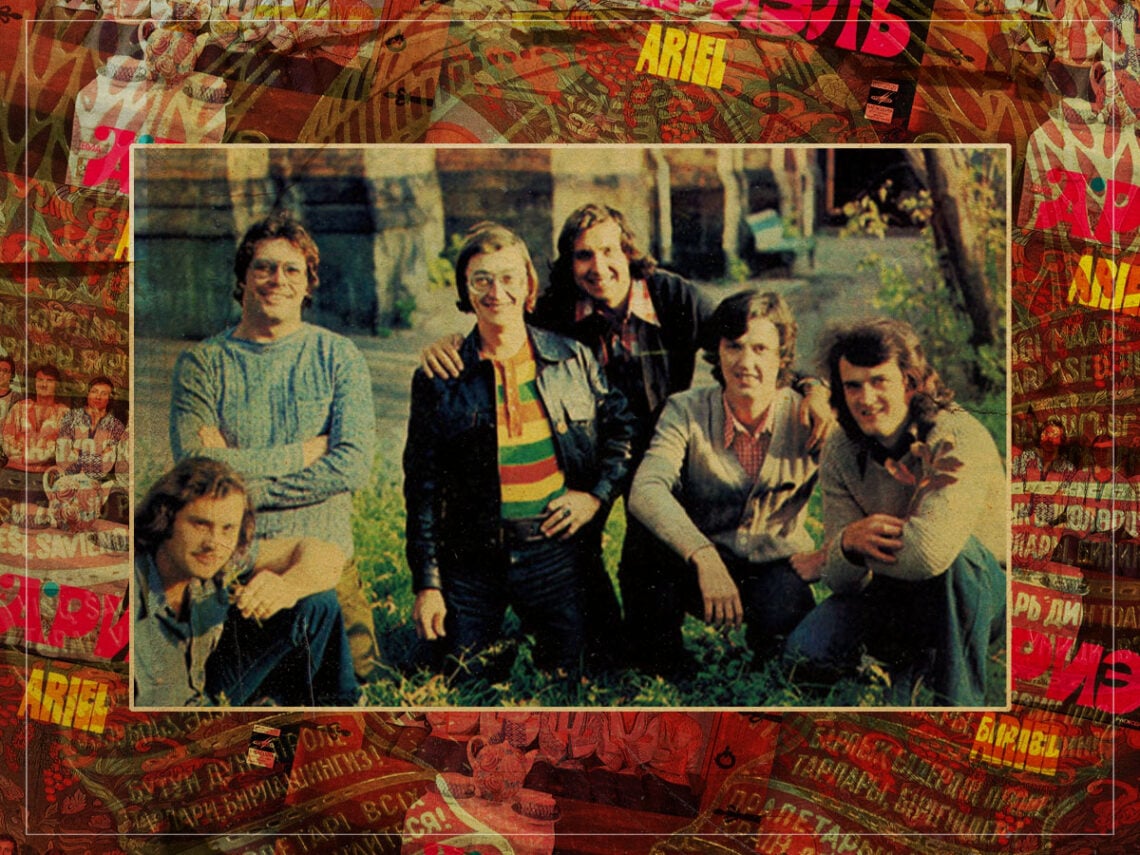
Ariel: The story of the Soviet Union’s coolest funk band

Even the Iron Curtain wasn’t able to stem the countercultural beckon swept across the Atlantic and Western Europe. By the late 1960s, Soviet dissidents began embracing the long hair and drop-out lifestyles of the hippie flower power so seriously suppressed as bourgeois decadence by the Kremlin. Yet, The Beatles and The Rolling Stones found their way into the USSR, smuggled in as forbidden musical samizdat via all manner of novel ways, including black market records made from X-ray emulsion plates.
The Soviet authorities couldn’t just ignore rock and roll. Avoiding the inevitable fascination that would surround pop’s censorship, the government introduced the Vocal and Instrumental Ensemble, an effort to satisfy the demand for Western music while warding off any of its political challenges.
Now, any budding act had to apply for a permit to perform and record, and was provided an official ‘artistic director’ who ostensibly acted as manager while also keeping an eye for subversive material. While losing its usage after the USSR’s dissolution, VIA still exists in the Russian lexicon as a nostalgic shorthand for the kinds of bands offered a platform for their orthodox rock songs.
One such act was Russia’s Ariel. Initially conceived in 1968 in Chelyabinsk, Ariel’s roots were founded by the city’s Music College student Lev Fidleman, largely covering Beatles and Monkees numbers. Two years later, Chelyabinsk’s Central District committee invited several VIA artists to a meeting and assembled Ariel from a composite of both bands present—Pilgrims had failed to turn up. Established in November 1970, Valery Yarushin stepped up to front the band for the next nearly 20 years.
Steadily releasing LPs via the state-owned Melodiya label, Ariel would absorb the funk and disco that dominated Western pop charts, caked in oodles of synthesisers and occasional psychedelic guitar jangles, with the odd romantic ballad thrown in. What endeared them to broader Russian tastes was their lifting of the country’s musical heritage, lacing their family-friendly VIA rock with undercurrents of folk and traditional arrangements that straddled the ‘Old World’.
Ariel would tour and drop albums to a reasonable level of success as one could in the USSR, including playing out of competition in the Georgian SSR’s 1980 Tbilisi Rock Festival. As the years rolled by and Soviet premiers began dying in quick succession, Mikhail Gorbachev’s leadership of the socialist state in 1985 ushered the Glasnost era, a period of media transparency and, crucially for Russian music fans, an ease of artistic censorship and an opening up of the Soviet republics to the West’s biggest names.
Suddenly, Russian glam-metal group Gorky Park was played on MTV, and Billy Joel was performing in Moscow. VIA had become old hat.
Yet, Ariel held affection for a generation of Russian pop fans whose musical curiosities were met by Yarushin’s colourful songcraft. Leaving in 1990 and allowing pianist Rostislav Gepp to captain the band then on, Yarushin formed a new band, Ivanych and later moved to Moscow in the early 2000s. Still touring, Yarushin plays music with his daughter Alyona under the name ‘Back from the USSR’, a playful nod to a time in Russian pop when the joy of music cracked the seemingly impregnable barriers of the Soviet state.
