


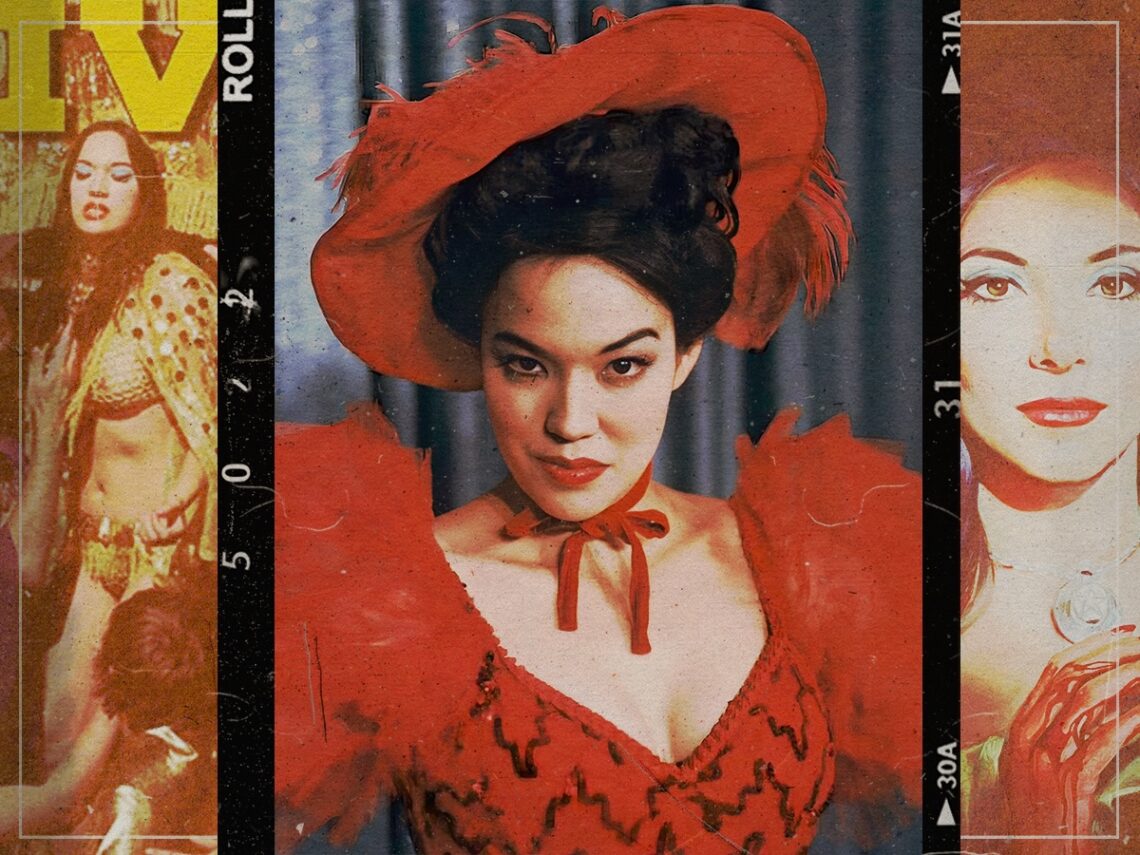
Inside Anna Biller’s technicolour dream world

Plenty of male directors have a distinctive visual style. Take, for instance, Wes Anderson, whose obsession with symmetry, pastel hues, and intricately crafted set design is unmistakably associated with his name. However, it is often the case that female directors are lambasted for the same thing – criticised for supposedly indulging in style over substance. Two of the most prominent examples include Sofia Coppola and Anna Biller, female filmmakers with rigidly defined, feminine aesthetics.
Both directors use rich visual worlds to communicate the specific themes found in their films, which, more often than not, are concerned with hyperfeminine women. For Biller, a director whose work has often been wrongly criticised for lacking thematic weight, filmmaking allows her a chance to explore the glamour of being a woman, projecting her ultimate visual fantasies, no matter how sexy or surreal, onto the screen.
At the same time, Biller uses her films to subvert expectations of traditional womanhood, explore alternative angles of femininity and question the hetero-patriarchal demands placed on women as objects of desire and fantasy. In an industry where most directors are white men, with most mainstream movies giving a rather narrow view of the world, the existence of a filmmaker like Biller is not only refreshing and revolutionary but vital.
Biller is not merely a director – when it comes to creating her movies, she completes much of the production herself. From writing to editing, designing sets, handmaking costumes, recording the score, and, in the case of some projects, starring in the leading role, Biller is a woman of many talents. The filmmaker is a cinephile through and through, with a particular affinity for vintage cinema, ranging from Old Hollywood-era movies to the work of French auteurs such as Jacques Demy.
Talking to A Rabbit’s Foot, Biller explained: “The classic movies also had great female protagonists, which the modern era ushered out because femininity was seen as part of the embarrassing old phoney style. But that lost craft is, to me, what makes those movies such a sensual and visceral experience, and so sexy. The sexiness, the glamour, the pleasure — that’s partly what’s lacking in the newer films. There’s so much bleakness and nihilism now.”
With a penchant for brightly painted worlds, fairytales, surrealism, erotica, campiness and ultra-femme aesthetics, Biller’s movies are all visual delights, with every frame practically begging to be screenshotted. Biller’s preoccupation with aesthetic perfectionism only aids her thematic explorations. In a world where male objectification is, sadly, an intrinsic part of experiencing life as a woman, Biller uses rich imagery to her advantage.
For example, in Viva, Biller’s debut feature, the filmmaker pays direct homage to retro sex magazines that depict women as little more than their bodies. As the titular protagonist, Biller is the sexually liberated housewife who indulges in campy dialogue while wearing over-the-top costumes – all underlaid with complex satire and an analysis of traditional femininity and societal expectations. She told The Guardian how “the sense that you take the woman, the objectified sex symbol, and you ask what’s inside her mind” is at the centre of Viva.

Detailing further, she added: “The sexual revolution promised all kinds of freedom to women, and none of it was accomplished – at least, not for women.”
Biller’s most popular movie remains The Love Witch, a technicolour horror fantasy starring Samantha Robinson as Elaine, a woman starting a new life following the death of her abusive husband, whom she may or may not have murdered. She engages in witchcraft, creating potions and practising sex magic, seducing men who ultimately meet their untimely fate once they’re wrapped up under her seductive spell.
Wearing ‘60s-inspired outfits and makeup, Elaine is ultra-feminine, something that is never compromised in Biller’s world. She longs for a man to love her above anything else, yet none can satisfy her needs – none see her as anything more than a sexual object – something Elaine constantly plays into in her quest for love. The Love Witch is a complex depiction of womanhood and the differing modes of feminism that shape our worldviews and relations with the opposite sex.
Stylistically, the film’s heavy reliance on retro aesthetics from the ‘60s and ‘70s emphasises the lens through which Biller wants us to consider femininity and female objectification. This was a time when women were supposedly achieving liberation, particularly sexually, while simultaneously existing under relatively unchanged traditional, oppressive structures.
Thus, to write The Love Witch and Viva off as overly aestheticised fodder completely misses the point of both films. In the same interview with A Rabbit’s Foot, Biller explained, “I’ve had critics say things like, ‘it isn’t really a movie.’ And ‘it isn’t cinema.’ Or they say I’m parodying filmmaking styles instead of creating social satire. A lot of people don’t think the work is serious. Some of the resistance is from men who are irritated with my feminist themes.”
From the beginning of Biller’s career, which started in 1994 with the short film Three Examples of Myself as Queen, Biller has consistently allowed female fantasy to triumph, carving out the freedom for women to indulge in dreamy worlds and exist in a way they are rarely allowed to on screen. Championing independent filmmaking, Biller’s ideas are always seemingly uncompromised – watching one of her movies feels like we’ve been given exclusive access to the inside of her mind. Filmmakers like Biller, who use their work to question gender dynamics, liberation and the depiction of women on screen, are necessary to the diversification of the cinematic landscape.
