


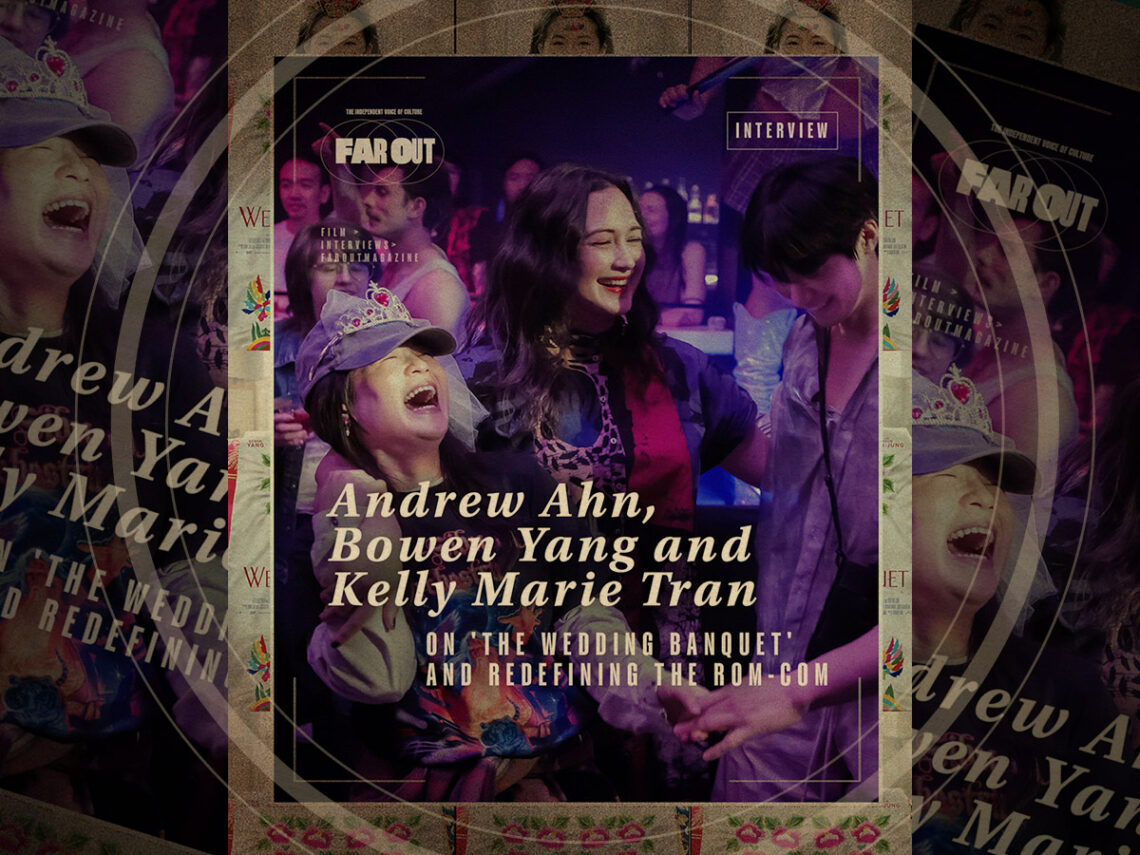
Andrew Ahn, Bowen Yang and Kelly Marie Tran on ‘The Wedding Banquet’ and redefining the rom-com

For a long time, queer stories occupied a sparse corner of cinema that was largely neglected by the film industry, something that the characters in Andrew Haigh’s revelatory 2011 film Weekend discuss while lamenting about how there isn’t a ‘gay version’ of Notting Hill. Heterosexual relationships and romances are everywhere, with countless stories that document every kind of romantic quandary and situationship under the sun, with an endless number of straight couples that are shoved down our throats as the sole representation of love. From Pretty Woman to 10 Things I Hate About You and Romeo and Juliet, audiences have been bombarded with the idea that this is the only way to love, with the traditional values associated with heterosexual relationships, whether it be a big family or picket fence, make up the bedrock of society as we know it.
Queer characters have generally been delegated to punchlines, secondary characters or stereotypes, with the likes of the ‘gay best friend’ and closeted gay who lashes out at other gay kids becoming staple characters within the playbook of ‘90’s and noughties television. But over the years, many trailblazing filmmakers have paved the way for nuanced and compassionate stories on queer experiences, whether it be through implied stories such as The Loneliness of the Long Distance Runner or those like Fox and his Friends, The Watermelon Woman and Brokeback Mountain, which despite being released in 2005, was met with intense backlash and scrutiny.
While queer cinema has certainly expanded since then, with Ang Lee’s heart-wrenching classic becoming a benchmark in the movement towards representation, there are still many gaps in the medium that queer filmmakers and artists are attempting to mend, with Andrew Ahn’s recent film The Wedding Banquet existing as an ode to closing this gap not just in terms of queer representation, but specifically for queer Asian people.
The Wedding Banquet is a remake of legendary filmmaker Ang Lee’s 1993 film, but with a twist. It follows Min as he proposes a green-card marriage to his friend Angela, doing so after his commitment-phobic boyfriend refuses to marry him. In exchange, Min offers to pay for Angela and her partner Lee’s IVF treatment, leading to an onslaught of complications after his grandmother surprises them with an extravagant Korean wedding banquet. Each character is then caught in a web of pretending to be in a straight relationship to appease Min’s family, leading to both hilarious misunderstandings and emotional confrontations over strained family dynamics, acceptance and authenticity.
While we have seen every version of heterosexual love on the silver screen, whether it be between humans, mermaids or cartoon characters, there is no story out there like the one at the heart of The Wedding Banquet, with Ahn creating something that feels refreshingly honest and genuinely reflective of modern queer culture, while also doing so through an entirely Asian cast and carving out space for a group of people who are rarely reflected on screen. And so, after being given the chance to interview Andrew Ahn, as well as Bowen Yang, Lily Gladstone, Kelly Marie Tran, Joan Chen and Han Gi-chan, we spoke about what it means to redefine the rom-com, queer love and healing through laughing at sad things.

The prospect of growing up and creating a family is a daunting prospect for many, but when so many traditions have been created on the terms of straight people, The Wedding Banquet looks at the idea of chosen family in queer communities and what it means to redefine certain traditions in a way that feels authentic to this experience, weaving together a life that incorporates the old and the new. In many ways, this is a story as old as time itself, with the struggles that come with trying to start a family and moving into an uncharted phase of life remaining universal, something Ahn wanted to explore through a specific lens.
“The Wedding Banquet, for me, is just putting a lens on all the many different stories that exist in our society, but focusing on people that I care about and want to emphasise”. The dynamic between Min, Chris, Lee and Angela is not one I have ever seen on screen before, with their closeness reflecting the intimate bonds in found families and all the gloriously heartwarming mess that comes with it, joined through unspoken and unwavering understanding.
The rarity of this type of story is not lost on Bowen Yang, who previously worked with Ahn on Fire Island and has had a year of soaring highs after his role in the record-breaking screen adaptation of Wicked. I asked Yang about what it feels like to redefine the rom-com, especially given the current romantic recession that has plagued all of us and the criminally bland love stories that have dominated mainstream media. Yang reflected, “I’ve gotten to have these rom com moments that I never thought I would have as an actor, as an Asian person, as a queer person.”
There is already a huge gap in stories centring around Asian characters, yet alone for queer Asian characters, with the disparity in Hollywood still remaining glaringly obvious as straight stories and those around non-white people are often placed front and centre. I asked about their first experiences of feeling seen through a character or story on screen, with Yang saying, “Another film that James and Ang made, Brokeback Mountain. I think that we’re just looking for characters who are treated with respect. I’m not a cowboy, but I love that movie because you could tell that the filmmakers cared about these human beings.”
The impact of Brokeback Mountain cannot be understated, with the film coming at a time in which the world felt increasingly divided and less tolerable towards queer people, with Heath Ledger and Jake Gyllenhaal being met with vitriol for their performances and bigoted comments about the supposed ‘moral implications’ of making such a movie. But the depressing backlash towards the film does not diminish its power, with the final scene in which Ledger’s character looks at a photograph of the mountains he used to visit with Jack still reducing me to tears, despite how many times I have seen it.

For many, the experience of coming out and living authentically is not a straightforward journey, with the freedom of self-expression often being something that is curated over time, and not always with easy beginnings. But while these experiences can be painful, comedy can often become a form of catharsis, with The Wedding Banquet delicately balancing moments of vulnerability as the characters let go of repressed anger and hurt over their early experiences of not being accepted, as well as doing so through humour, with many laugh-out-loud moments as the core four fumble their way through awkward family interactions and romantic mishaps.
When asked about making sense of pain through comedy, Tran said, “I guess the stuff that I have been drawn towards just have been comedies, because, like, the trauma of living with the experience of coming out in a family that maybe doesn’t accept that is enough. I’m like, I just want to laugh about this. Sometimes that’s the best way of approaching it. I think we laugh when something resonates with us, whether it’s a knowing laugh, that’s like, yeah, I get that. I’m not laughing at it to diminish it. It’s because it’s heightening it.”
Within a community that has often been excluded from cinema, with personal histories that can be inherently painful and complicated, the rom-com becomes the perfect mode of catharsis, with this knowing laugh having the power to heighten our sense of understanding and camaraderie within these experiences. The Wedding Banquet is a story full of joy and the wonderful chaos of figuring it all out, with the characters fumbling their way through each hurdle in the best way they can, and coming out the other side with a beautiful life created solely on their own terms.
