


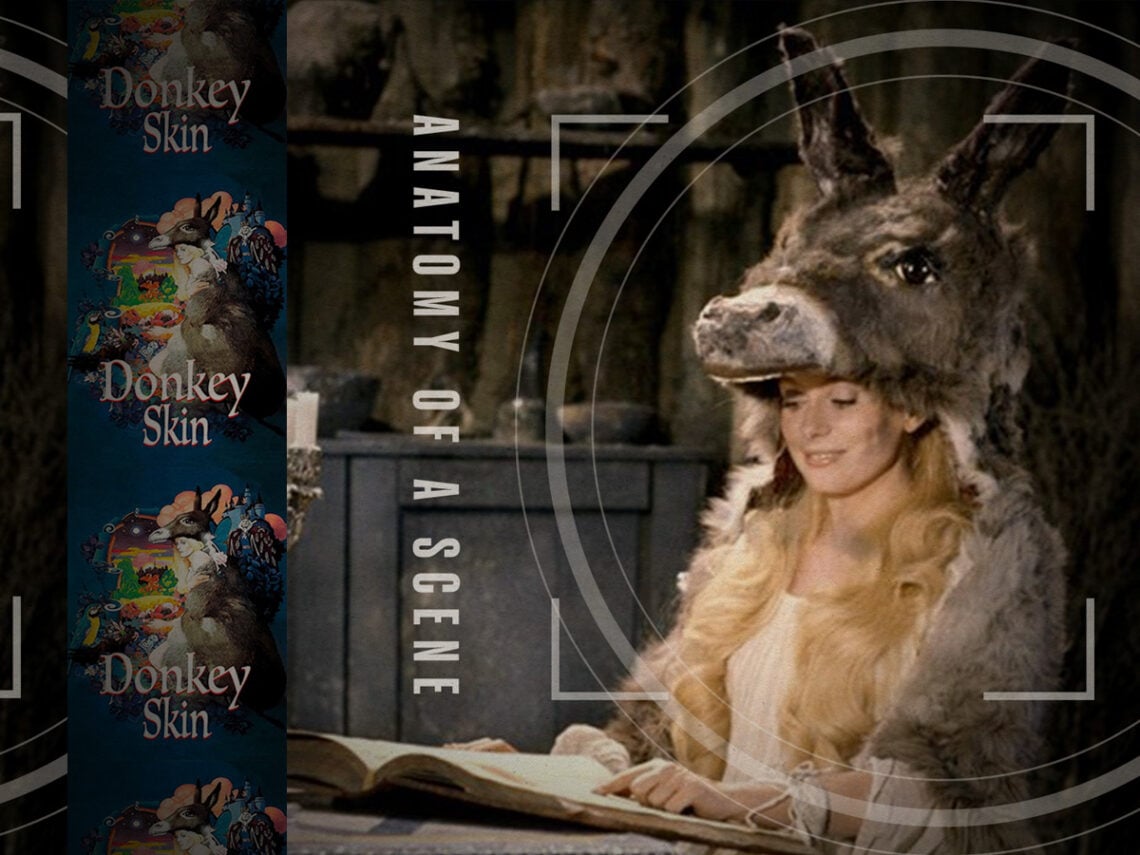
Anatomy of a Scene: The princess bakes the love cake in ‘Donkey Skin’

We tend to think of fairytales as stories about true love, magical transformations and happily ever afters, but beneath the romance and the magic is often something more twisted, and few filmmakers understood that better than French director Jacques Demy, whose 1970 musical Donkey Skin transformed Charles Perrault’s classic fairy tale into something unlike anything ever seen on screen.
For those who grew up in France, Donkey Skin is not simply a French classic, but a piece of childhood that was impossible to escape, one that you could watch on repeat and never get bored by, especially when it happened to be the only film downloaded onto your mother’s laptop. Among all of Donkey Skin’s unforgettable images, from the magic donkey that excretes jewels and the gowns the colour of the weather to the arrival of the fairy godmother, it is the film’s most ordinary moment that feels the most bewitching: the baking of a cake.
Hidden away in her hut in the woods, a disguised princess, played by French cinema icon Catherine Deneuve, is asked to bake a cake for the prince, who cannot stop thinking about the mysterious girl he caught a glimpse of in the forest. Forced into exile to escape her father’s unwanted advances, the princess spends conceals her identity under a heavy donkey skin, and through this, Demy presents two versions of the princess at once.
He creates a strange and almost surreal interaction between them as one version of herself instructs the other on how to prepare the cake, and the scene becomes a conversation between the identity she has adopted for survival and the person she has always been, transforming what could have been a simple baking sequence into a visual representation of a young woman caught between the role she has been forced to play and the identity she is slowly reclaiming.
Demy finds magic in the smallest details of the scene; every handful of flour, cracked egg and stir of the mixture feels carefully choreographed, as Deneuve sings the recipe and works to transform an ordinary domestic task into something enchanting, and the beauty of the sequence comes from watching the princess exist without fear, beyond the donkey skin cloak.
The brilliance of Demy’s direction is evident in the way he elevates the domestic into an act of quiet romance. As the princess mixes the ingredients together, she slips her ring into the batter, a tiny token that will eventually reveal her identity to the prince, a fairy tale device that immediately recalls Cinderella’s glass slipper, but unlike the slipper, the princess chooses to place it there herself.
For perhaps the first time in the film, she is not reacting to the choices of others, but actively shaping her own future.
When the cake is presented at court, the prince insists on eating it immediately, despite being confined to bed by what is revealed to be nothing more than lovesickness, and discovers the ring, declaring that he will marry the woman whose finger fits it. What makes the moment so satisfying is that the princess is not recognised because of her royal blood or her beautiful gowns, but because of something she created, with the prince falling ultimately loving both versions of her, the one donning the donkey skin and the one without.
Of course, by the end of Donkey Skin, the princess sheds her disguise for good, the ring finds its rightful owner, and the lovers are finally united, and yet, the moment in her kitchen, hidden away in a hut, baking a cake for a prince she barely knows, the princess creates something far more powerful than a simple dessert: a way back to herself.
