


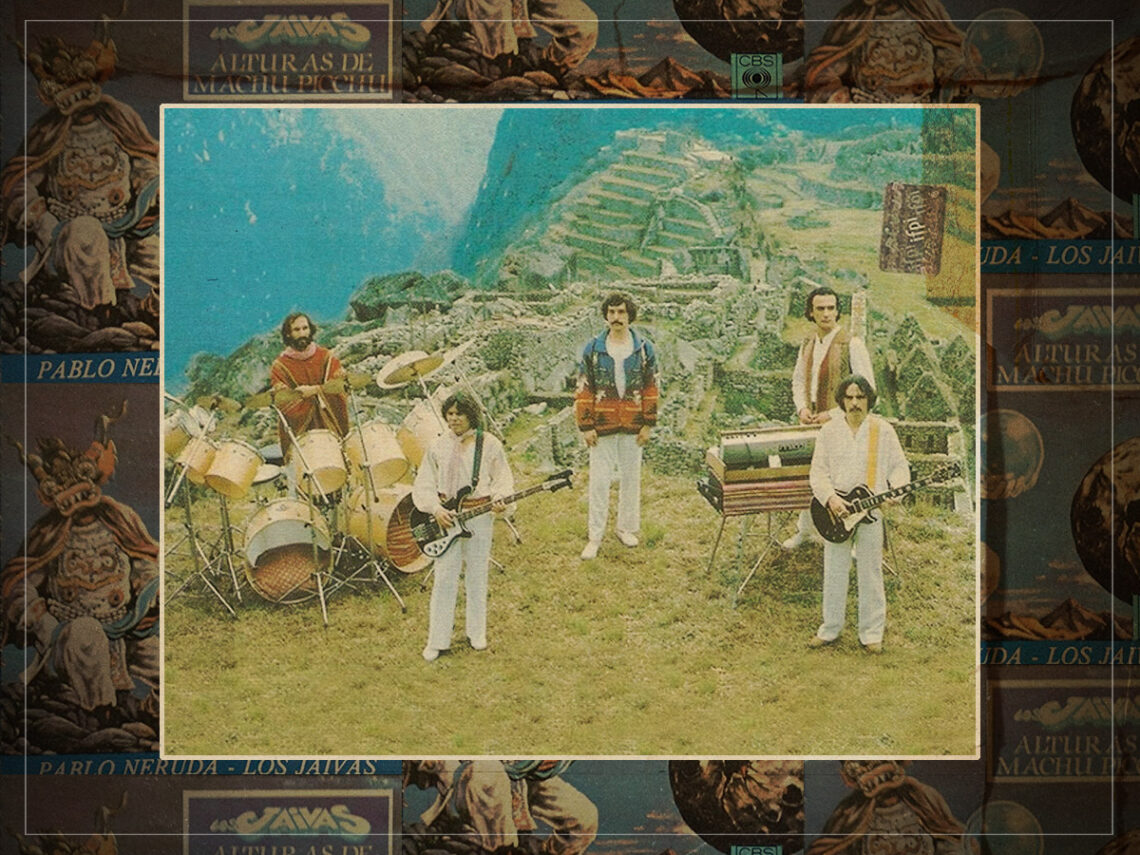
‘Alturas de Macchu Picchu’: the revolutionary concept album that challenged General Pinochet

Rock music has never been just another musical genre. Since the dawn of its existence, the defiant style of rock has been used as a form of cultural revolution, subverting the societal status quo and carrying messages of hope, unity, and rebellion. From the anti-war anthems of the 1960s, to the furious feminism of the riot grrrl movement, rock has repeatedly proven its weight as a form of political rebellion, and the groundbreaking sounds of Los Jaivas are a prime example of that fact.
Hailing from Viña del Mar on the coast of Chile, Los Jaivas first came together in 1963, under the name The High & Bass. During those early years, the band devoted itself to combining influences of rock music with the traditional sounds of Chilean folk. Thanks to their prevalence in the local scene, the band’s sound soon developed to incorporate high-energy styles like bossa nova and bolero, but they always retained their passion for creating border-defying folk-rock, too.
Los Jaivas continued to hone their craft throughout the 1960s, becoming increasingly interested in the emerging experimental sounds of progressive rock and improvisational compositions. At the same time that their unique celebration of Chilean folk history began to take root in the nation’s mainstream culture, the political landscape of Chile was undergoing rapid and sinister changes.
Following the 1970 presidential election in Chile, the Marxist senator Salvador Allende Gossens was elected to power. During the early part of his administration, Allende oversaw the growth of the economy, a decline in unemployment, and increasing rights for workers in Chile; the South American nation was making rapid strides forward under this democratically elected socialist government. However, the idea of a functioning socialist government did not sit right with the United States, who were deeply entrenched in Cold War conflict.
So, under the orders of President Nixon, the CIA sought to sabotage and cripple Allende’s administration, which they did successfully. After tanking the Chilean economy, the American administration supported a military coup d’état which seized control of Chile in September 1973, placing the military dictator General Augusto Pinochet Ugarte in power, and causing Allende to commit suicide.
Unsurprisingly, the newly established military dictatorship quickly stripped away civil liberties from Chilean citizens and became increasingly authoritarian as time went on. The state imprisoned, tortured, and murdered thousands of innocent civilians in Chile in only the first few years of the dictatorship, and these deaths rarely take into account people like Pablo Neruda, the Nobel Prize-winning poet, whose suspicious death in 1973 bore all the hallmarks of the dictatorship.
During this tumultuous period, Los Jaivas left Chile, settling first in Argentina and then relocating to Paris, France. However, the band never lost sight of their roots in Chile, and strove to provide a message of hope, unity, and resistance for the Chilean people through their music. This culminated in the recording of their 1981 album Alturas de Macchu Picchu, a prog-folk-rock concept record based on a poem by Pablo Neruda.
Prior to the release of this defiant album, Los Jaivas organised a live performance that—with the support of the Peruvian government—saw them play the album in full at Machu Picchu in September 1981. This seminal performance was filmed and broadcast in Peru and the band’s home nation of Chile.
By the time the broadcast came to fruition, Los Jaivas had already amassed a colossal audience in Chile, regularly hailed as the nation’s most popular group. So, the Canal 13 broadcast of the band’s show at Machu Picchu found an expansive viewership in Chile, with people tuning in in droves to witness this historic symbol of hope, music, and freedom for the nation.
With Machu Picchu being an essential aspect of South America’s shared folk history, and a symbol of hope and spirituality for many people across the continent, the sight and sound of a Chilean rock outfit performing an album based on the works of Neruda in those historic surroundings was an all-encompassing image of freedom.
By this point in time, the military dictatorship in Chile was beginning to loosen its grip on the nation, allowing for increased freedom of speech and expression. As such, Los Jaivas returned to the country for three shows at Teatro Caopolicán in Santiago, which furthered the beautiful defiance and heritage of Alturas de Macchu Picchu. The following few years would see further resistance to the nation’s dictatorship, and in 1989, Patricio Aylwin was elected as the nation’s leader, following a referendum that ended the rule of General Pinochet.
While there are countless social, economic, and political factors to take into account when discussing the rule of General Pinochet and his eventual ousting from power during the late 1980s, the cultural aspect of Chile’s resistance to the dictatorship should certainly not be ignored. Groups like Los Jaivas and seminal records like Alturas de Macchu Picchu were essential in providing a sense of hope to people in Chile, in addition to reminding the nation of its strong heritage and folk history, which was consistently being erased by Pinochet’s dictatorship.
