


‘All My Trials’: tracing the origins of a folk classic

Folk music is among the most community-driven genres. Before the mid-20th-century folk revival, the style evolved over many decades across parts of Europe and North America, defined by accessible acoustic instrumentation and vivid, often didactic, lyrical narratives. Much of this development occurred during small social gatherings in the American Midwest and heady taverns in the British Isles in the 18th and 19th centuries.
During the 20th century, music of all different genres gradually globalised with advancements in technology. Folk had traditionally passed from person to person, tavern to tavern and country to country through word of mouth and imitation. Songs evolved with performers using classic progressions to frame their new lyrics, adapting lyrics of preexisting standards to suit their own vision or even reciting old songs from memory with inaccuracies in a chain of musical Chinese whispers.
As such, the global folk community not only welcomed but actively encouraged one another to share ideas and hone the classics. The serious question of origin only really arose when artists began to enter studios and turn a profit from record sales. All of a sudden, multiple artists would claim to be the original writers of each folk song in question. Even if each helped evolve said song, evidence for most claims was markedly scarce.
The initial wave of the folk revival began in the US during the 1930s and ’40s. Lead Belly, Woody Guthrie and Pete Seeger were among the movement’s leading proponents who brought the tradition to a wider audience with early recordings. Even at this early juncture, conflict began to arise in the community regarding songwriting credit, prompting the line, “That guy stole that from me, but I steal from everybody,” which Seeger attributed to Guthrie when explaining the folk process.
Throughout the 1950s and ’60s, the folk revival gained traction parallel to the emergence of rock ‘n’ roll. Artists like Bob Dylan, Joan Baez and Peter, Paul & Mary played a crucial part in bringing folk to the younger audience and began to shift serious volumes of vinyl. Before he kickstarted a countercultural movement with anthems like ‘Blowin’ in the Wind’ and ‘The Times They Are A-Changin”, Dylan modelled much of his early work on traditional folk music he picked up on the New York circuit. One of his first songwriting attempts, ‘Song to Woody’, used the melody from Guthrie’s song ‘1913 Massacre’.
During the folk revival, several American folk standards prevailed and became particularly popular in the countercultural movement. Dylan was fond of a song of unknown origin named ‘Dink’s Song’. Sometimes titled ‘Fare Thee Well’ and appearing in several different guises, the song has appeared in the canons of Pete Seeger, Fred Neil, Dave Van Ronk, Cisco Houston and, more recently, Jeff Buckley.

Another exceedingly popular standard in the 1960s was ‘All My Trials’, a plaintive song of religious origin which resonated with anti-war protests. In most versions, the lyrics set out on the sombre line, “Hush, little baby, don’t you cry / You know your mama was born to die / All my trials, Lord, soon be over”. Initially, the song, which also mentions a “little book” that spells “liberty” on every page and the Jordan River, seemed to comfort the listener in the knowledge that Earthly struggles are finite and that “paradise” exists thereafter. However, in a secular, war-torn setting, the lyrics lose hope and underline the importance of seeking peace on Earth.
The first known commercial recording of ‘All My Trials’ appeared on Bob Gibson’s 1956 debut album Offbeat Folksongs. Other versions of the song, often with truncated or adapted lyrics, are titled ‘Bahamian Lullaby’ and ‘All My Sorrows’. The Kingston Trio, who recorded ‘All My Sorrows’ in 1959, popularised the latter. The Shadows recorded another popular ‘Sorrows’ version in 1963.
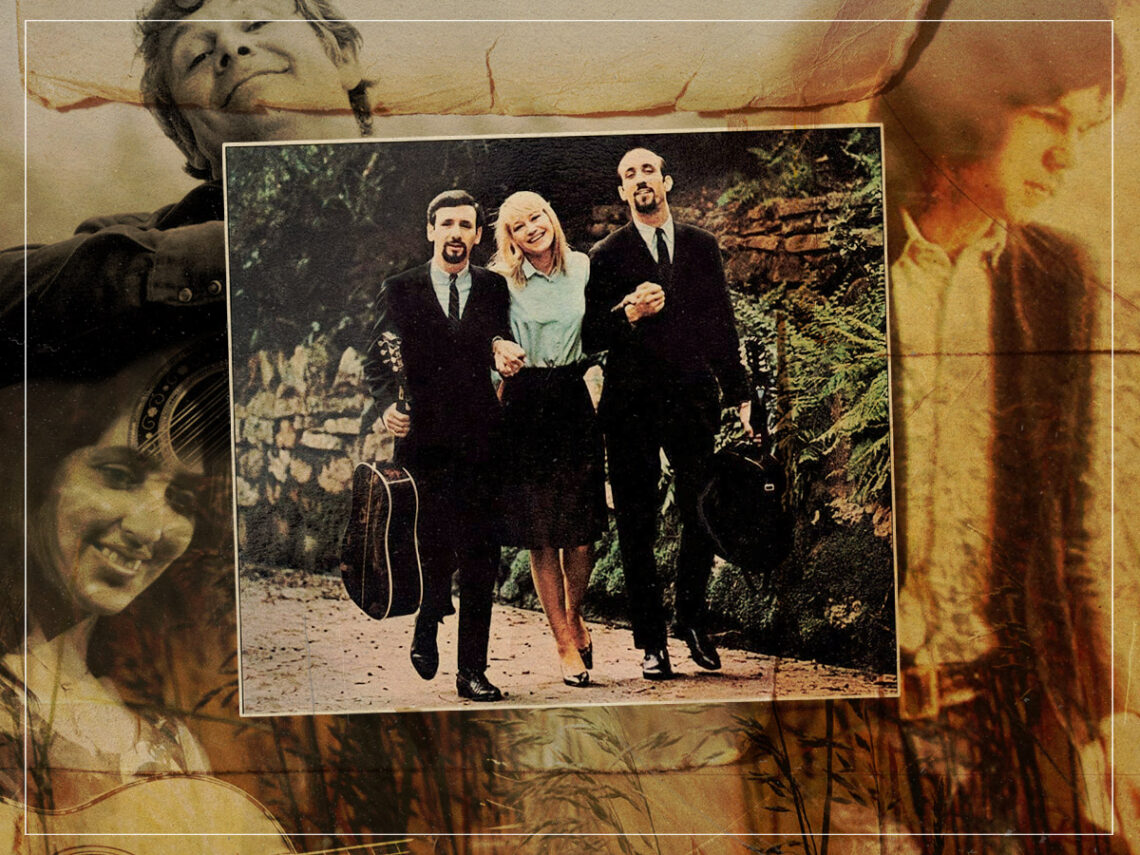
As ‘All My Trials’, the song appeared in the oeuvres of Pete Seeger, Dave Van Ronk, Anita Carter, and Joan Baez. Peter, Paul, and Mary released a particularly resonant rendition on their third studio album, In the Wind, in 1963. The British singer-songwriter Nick Drake was fond of Peter, Paul, and Mary and recorded a similarly harmonious cover of ‘All My Trials’ with his sister, Gabrielle Drake. The recording appeared on Drake’s posthumous compilation Family Tree.
Sadly, beyond Gibson’s recording from 1956, the trail runs somewhat dry. Many folk standards appeared on records in the Roud Folk Song Index or the Archive of American Folk Song. However, ‘All My Trials’ seemed to be a word-of-mouth composition, a supposition strengthened by the extent to which the song has been re-interpreted through the years.
The alternate title ‘Bahamian Lullaby’ suggests that the song originated in the Caribbean. Cynthia Gooding, who released the second known recording of the song in 1957, detailed in the liner notes that she learned it from folk legend Erik Darling. He told her the lyrics referred to “a white spiritual that went to the British West Indies and returned with the lovely rhythm of the Islands.”
According to the Joan Baez Songbook, ‘All My Trials’ began life as an early 19th-century American Southern gospel song. It somehow travelled to the Bahamas, where it survived as a lullaby and was meanwhile forgotten in the US. If both stories are accurate, perhaps the spiritual Darling told Gooding about, who mistook the song for a Bahamian original, was unaware that the melody he fell in love with originated in his homeland.

Never Miss A Tale
The Far Out Bob Dylan Newsletter
All the latest stories about Bob Dylan from the independent voice of culture.
Straight to your inbox.