


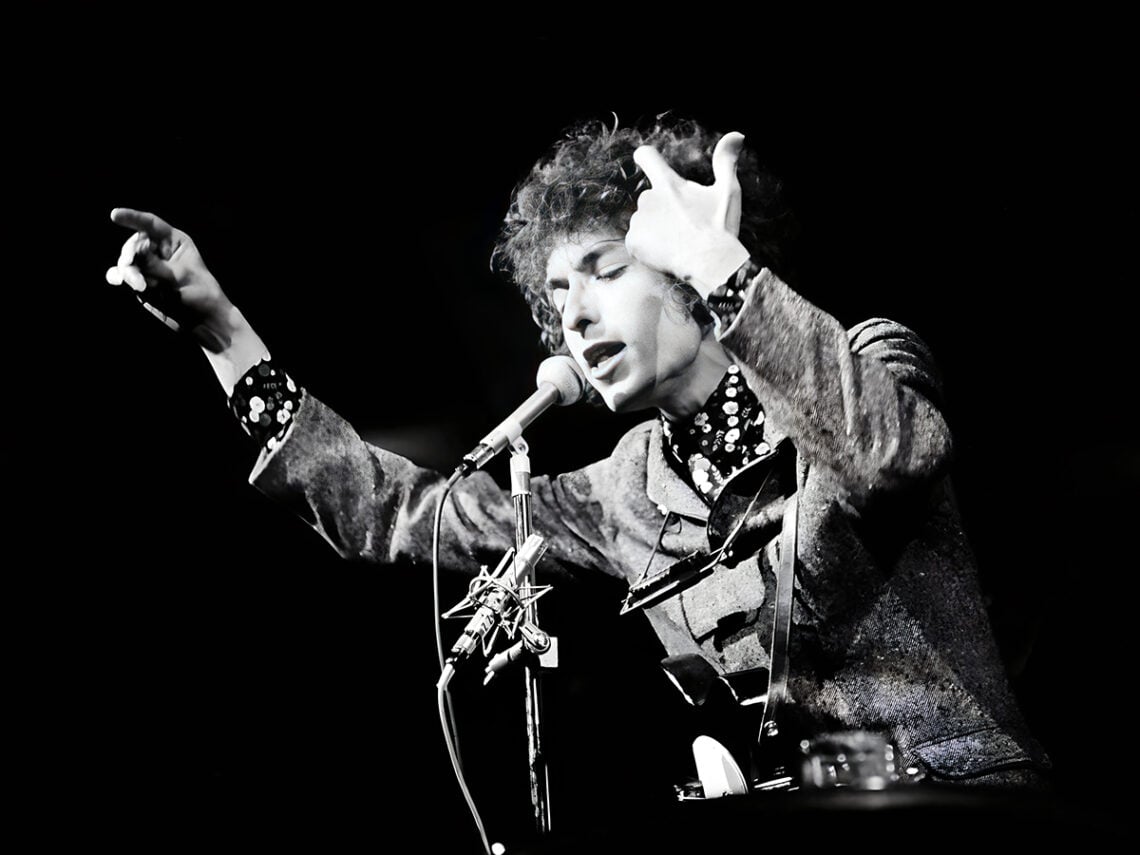
When Bob Dylan fought back against plagiarism claims: “Those motherfuckers can rot in hell”

Although his musical passion gestated in an adolescent attachment to Little Richard and Elvis Presley, Bob Dylan found his artistic footing as a folk musician. While many folk artists turned the aspiring troubadour’s head, none quite rivalled the life-changing impact of Woody Guthrie. Dylan’s affections were such that when he left Minnesota for New York City in 1961, item one on his agenda was to visit Guthrie at his hospital bed, where he suffered from Huntington’s disorder.
Like many artists, Dylan set out performing covers but eventually began to alter traditional lyrics and set some of his own to classic folk progressions. One of his earliest compositions was the touching tribute ‘Song to Woody’, structurally based on Guthrie’s song ‘1939 Massacre’.
As we know, Dylan eventually abandoned the inflatable armbands of covers as he became a competent and consummate songwriter. Although he controversially embraced rock in 1965, Dylan never severed ties with his folky roots. One folk doctrine Dylan paid heed to was famously outlined by Guthrie. “That guy stole that from me, but I steal from everybody,” Pete Seeger once recalled the folk progenitor saying when discussing the folk process.
In 2006, Dylan released his 32nd studio album, Modern Times. The release was widely applauded but raised several complaints in the media pertaining to alleged plagiarism. Some critics took issue with the liner notes, which stated, “All songs written by Bob Dylan,” despite derivative qualities to some of the tacks.
At the time, Dylan didn’t credit the artists but casually admitted to deriving some progressions and melodies from some legendary artists. Ostensibly, he had Guthrie’s folk doctrine in mind. Of course, none of these derivations were lucid to the point of legal action, but similar complaints have resurfaced several times since, especially in 2016 after he won the Nobel Prize in Literature.
Notably, fellow folk artist Joni Mitchell accused Dylan of plagiarism in a 2010 interview with the Los Angeles Times. “Bob is not authentic at all,” she said. “He’s a plagiarist, and his name and voice are fake. Everything about Bob is a deception. We are like night and day, he and I.”
Mitchell later softened these statements while speaking to CBS. “I hate doing interviews with stupid people, and this guy’s a moron,” she said of the LA Times interviewer, claiming he twisted her words. “I like a lot of Bob’s songs, though musically he’s not very gifted,” she explained.
“He’s got a lot of borrowed things. He’s not a great guitar player. He’s invented a character to deliver his songs. Sometimes, I wish that I could have that character — because you can do things with that character. It’s a mask of sorts.”
In response to the media frenzy surrounding Mitchell’s initial comments, Dylan educated journalist Mikal Gilmore on the Guthrie doctrine. “Wussies and pussies complain about that stuff,” he said. “It’s an old thing — it’s part of the tradition. It goes way back. These are the same people that tried to pin the name Judas on me. Judas: the most hated name in human history! If you think you’ve been called a bad name, try to work your way out from under that. Yeah, and for what? For playing an electric guitar? As if that is in some kind of way equitable to betraying our Lord and delivering him up to be crucified. All those evil motherfuckers can rot in hell.”
“I’m working within my art form. It’s that simple,” Dylan elaborated. “I work within the rules and limitations of it. There are authoritarian figures that can explain that kind of art form better to you than I can. It’s called songwriting. It has to do with melody and rhythm, and then, after that, anything goes. You make everything yours. We all do it.”
Listen to Bob Dylan’s ‘Song to Woody’ below.

Never Miss A Tale
The Far Out Bob Dylan Newsletter
All the latest stories about Bob Dylan from the independent voice of culture.
Straight to your inbox.