


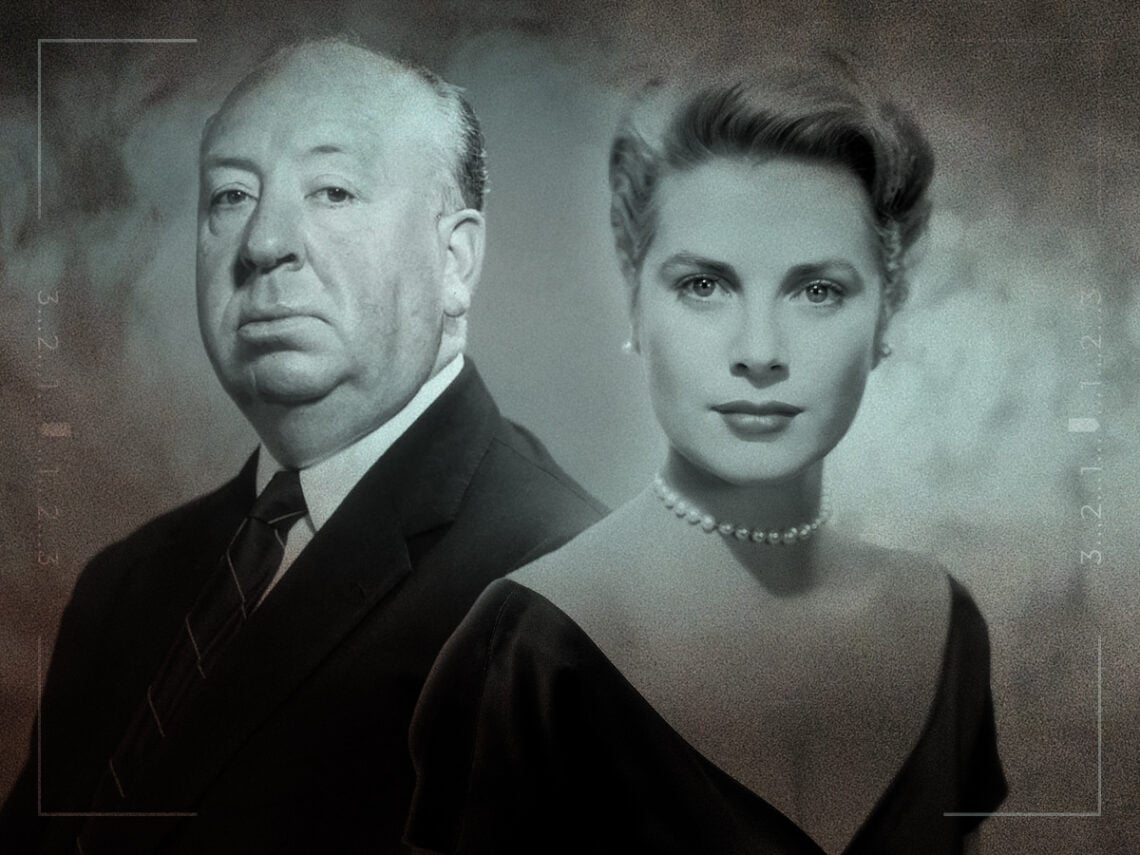
The comeback that never was: Grace Kelly and Alfred Hitchcock in 1964

It’s sometimes easy to forget that despite Grace Kelly’s legacy in Hollywood, she actually retired from acting when she was just 26 years old, and from that moment on, nothing could persuade her to come back to the silver screen, not even the chance to work with Alfred Hitchcock again.
The actor’s career moved fast, which saw her begin on the stage, leading her to bag a small role in the film Fourteen Hours in 1951, and marking her entrance into the world of Hollywood. Then, over the coming years, Kelly secured consecutive hits, like High Noon and Mogambo, the latter earning her an Oscar nomination for ‘Best Supporting Actress’, after which, of course, came her Hitchcock collaborations in 1954, where she appeared in both Dial M for Murder and Rear Window.
The director had a fascination with blonde women, a recurrent feature in his work, and Kelly became his latest muse, whose inherent elegance drew him in, yet he recognised something darker, a little sensual, underneath her poised exterior, which was what he was interested in breaking down.
Kelly is terrific in every Hitchcock role, her final collaboration with him coming in 1955 when she starred opposite Cary Grant in To Catch a Thief, and while their creative partnership was intense but brief, the pair certainly left their mark on one another, with Kelly citing ‘Hitch’ as the greatest teacher of her career.
“Mr Hitchcock taught me everything about cinema. It was thanks to him that I understood that murder scenes should be shot like love scenes, and love scenes like murder scenes,” she once said.
The actor would turn in her final performance in 1956’s High Society, a musical remake of The Philadelphia Story, while also marrying Prince Rainier III of Monaco that year. As a princess, Kelly had other duties to consider, so she stepped back from acting for good, much to many people’s dismay. That same year, she won ‘World Favourite Film Female’ at the Golden Globes, clearly proving how much people loved her.
If anyone could get her back in front of the camera, surely it was Hitchcock, and he hoped he could persuade her to return to what she was best at, but he knew that he could hardly ask a princess to ditch her duties for the sake of a motion picture. “I saw her and the prince several times over dinner in Paris. I am too much of a gentleman to mention work to a princess. That would be most uncouth,” he told the Daily Express.

Yet, Kelly seemed to know that she was wanted, and she reportedly agreed to work with him on his next project. “I waited, and finally she came to me. It happened this way. I brought this novel called Marnie and simply could not find an actress suitable for the part. So I sent it to her agents in New York, she always kept her agents, you know, and they passed it on to her.
“Then, a week ago, I was told that she would do it, just like that. I have not even spoken to her about it, not even a wire. I suppose I should send a wire, congratulations or something.”
So it seemed Kelly was on board to appear in Marnie, which would, so officials claimed, be her final role for good, but the actor was soon met with strong opposition from the people of Monaco, and even Charles de Gaulle supposedly encouraged Prince Rainer to stop his wife from returning to the screen in such a shocking role. Thus, just like that, Kelly announced she was not going to be in Marnie after all, and another classic Hitchcock blonde, Tippi Hedren, took on the role, while Kelly sadly never acted again, instead dedicating herself to royal life for good.
