


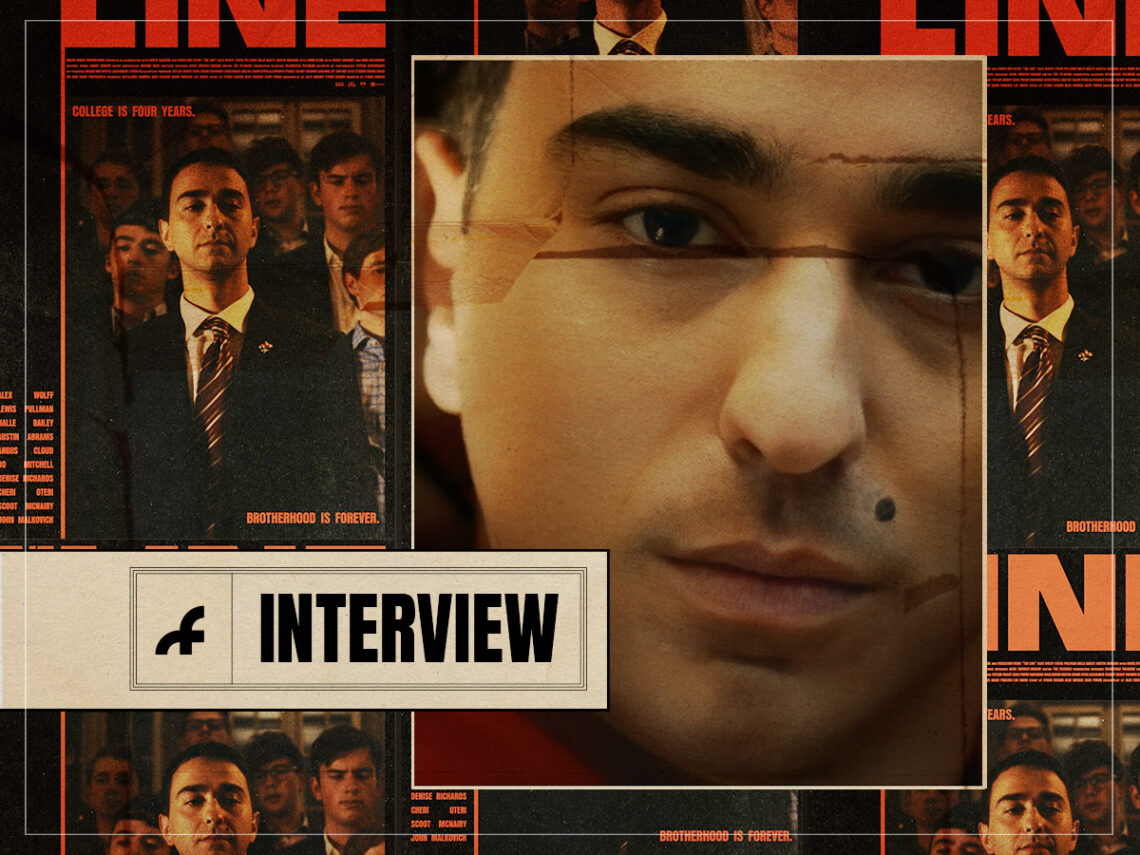
“This is not just a problem of a few bad apples”: Alex Wolff on exploring the dark side of fraternity life in ‘The Line’

A lot has changed for Alex Wolff since the actor was officially announced as the star of director Ethan Berger’s debut feature, The Line, in early 2019, all of which has continued reinforcing his credentials as one of the brightest young talents in the industry.
Since the intense drama focusing on the dark side of fraternity life was unveiled, his own directorial debut, The Cat and the Moon—which he also wrote, produced, and starred in—has premiered. His onscreen efforts have seen him work with some of the biggest names in the business on projects that alternate between the micro and macro of Hollywood.
Wolff lent support in blockbuster sequel Jumanji: The Next Level, appeared alongside Hugh Jackman in the Primetime Emmy-winning Bad Education, shared the screen with Nicolas Cage in the acclaimed Pig, played a major role in M Night Shyamalan’s Old, embodied Luis Walter Alvarez in Christopher Nolan’s seven-time Academy Award winner Oppenheimer, and most recently took third billing behind Oscar winner Lupita Nyong’o and Joseph Quinn in box office hit A Quiet Place: Day One.
With that in mind, and The Line having originally premiered at the Tribeca Film Festival in June 2023, how does it feel for the actor to know that the journey will be over when the film arrives on October 18th, 2024? “Man, good question,” Wolff contemplated. “I think I’m nervous to get people to see it. It’s very rare that you have a labour of love like this that you work so hard on come out, so I think I’m just very eager to have people go see it.”
Wolff heads up the ensemble as Tom Backster, a college student dedicated to the fictional Kappa Nu Alpha fraternity. Lured in by the promise of the status and connections that come with the organisation, he’s so committed to the lifestyle that he’s in danger of losing his sense of self after adopting accents, mannerisms, and behaviours that even his own mother doesn’t recognise.

Fraternities may be a largely American thing, but The Line uses an institution closely associated with one country to explore themes that the majority of people can identify with. When asked how he approached a character so embedded in an American way of life and used them as a conduit to dig into universal ideas, Wolff opted to turn the question on its head.
“Did you connect with the lead character at all, or did you understand him?” he inquired. “Because you’re not from America, I’m curious.” The answer is that this writer – and most people, in reality – either have or know somebody who’s bent themselves to the will of others to fit into a social or societal group pretty much hit the nail squarely on the head.
“Yeah, I think that’s what the movie’s about,” Wolff responded. “I think that is a very American film and that it’s really about this long-standing, in my opinion, antiquated tradition of fraternities. I didn’t go to college, so I didn’t see this up close. I would hear about it the same way that other people would hear about it.” Unfortunately, that news was rarely positive, with 40 students dying from hazing rituals between 2007 and 2017 alone.
“I knew these stories about Timothy Piazza and people that had tragically lost their lives because you can’t go a few days in America without hearing one of those stories,” he continued. “I think that the most important thing is the only way to change anything is to identify that it’s there. We have to identify that this is a wide problem. This is not just a problem of a few bad apples or a problem of, ‘Oh, kids, they drink too much.'”
“I think this is an institutional issue, and we as a society of adults have turned a blind eye to the unlimited resources that we give these kids that are in fraternities and the chokehold they have on the schools that they’re in. It’s just a terrifying reality in this country. But to tie into you being out of the country, I think that, at the same time, the movie is about something more primal. It’s about a need to survive, a need to fit in, a need to feel connected to your own sense of self and power and an especially old-fashioned masculine idea of being able to endure the most pain. And I think that is universal.”
In The Line, it isn’t just Wolff’s Tom who pretends to be somebody he’s not. All of the main characters are putting on a performance to mould themselves into what they think the fraternity wants them to be. In Tom’s case, he presents different sides of himself to his frat brothers, Halle Bailey’s Annabelle and John Malkovich’s Beach Miller, to name but three, which means he’s rarely presented as the same person for more than a couple of scenes consecutively.
“Oh, I really like that,” Wolff said of the analysis. “That was one of the first things, well, it was the challenge of the character that excited me when I first read it because the idea of a movie is that you want people to believe your lead character. Very rarely do you have a lead character who’s sort of unreliable from a few scenes to the next in terms of who they’re being, a sort of phoniness.”
Woff acknowledged that “I don’t think we have many characters who do that, in my opinion,” except for “maybe secret agent characters or serial killers.” However, that’s kind of the point, with the duality of Tom and the rest of the main players in The Line speaking to a wider societal issue and one that resonated with the leading man.
“I think it’s something, especially young men, constantly go through,” he explained. “I mean, we all know someone who goes and spends time with their family or a group of kids from their childhood or something where they now have a new accent, or they retreat from their old way of speaking. There’s a lot of switching that goes on, especially at the age of 18/19.
“I think it’s trying on different paths until something works, and I think this movie is about this character, Tom, realising that he has been playing a role. That is something I think everyone can identify with. I certainly could, and I found it to be challenging because of how much it resonated with me and because of how much it resonated with friends of mine.”

There’s one scene between Tom and Annabelle that distils The Line down to its essence; there’s potentially a burgeoning romance between the two, but things fizzle out quickly when she asks to see his frat house, and he declines. The audience knows why, but the two sides of Tom make it impossible to verbalise why he won’t let it happen without pushing her away, which ultimately happens anyway.
“I was talking about that scene last night with one of my best friends, and he said that scene really upset him. Really upset him,” Wolff revealed. “Quick little scene, but it gives you a chill. I didn’t realise that when we were filming, and when I watched, I went, ‘Oh, that’s pretty icky.'”
It might sound unusual for an actor to confess they had no idea one of the most important scenes in the movie was going to come across that way, but not only does the majority of the drama come from what’s left unspoken and unsaid rather than dialogue, but Wolff credited filmmaker Berger for pulling it off while he remained oblivious of its greater context.
“Sometimes, as an actor, you’re meant to be the idiot,” he put it, self-deprecatingly. “You’re not meant to know how high-stakes something is and how a movie hinges on a certain moment. And Ethan Berger did a great job of protecting me from knowing how important that moment was because I didn’t really realise it. I thought it was a harmless little scene because I didn’t really consider the way of the whole movie, and it wasn’t until I saw it that I really got it.”
To prepare for the role, Wolff spent some time with a real-life fraternity, which came with its own challenges when it’s a protective, almost secretive world that exists in plain sight, and in walks this outsider immersing themselves for a movie that doesn’t paint that culture in the best light. “I had to drink a lot of gin to gain their trust,” came the ominous reply.
“We ended up kidnapping a few of the kids in the fraternity and putting them in the movie,” he shared, indicating he ended up on their good side. “The irony is, I think that there are a lot of kids, especially towards the end, if they’ve stuck it out for three or four years, who start to see how things begin to erode inside of a fraternity. I think that a lot of kids start to see the evil side of things, so to speak.”
Of course, Wolff isn’t painting every frat member as a bastion of unspeakable evil because “the movie is not about that time.” Instead, The Line “is about the moment you start to realise until it’s too late.” The actor reiterated that “they were secretive, they were tough, they were judgmental and said things to me that haunt me to this day, but at the same time, they’re just kids who want to be accepted like anybody else.”
The concept of trickle-down trauma is an unsavoury byproduct of fraternity life because these institutions have operated for centuries under the mindset of, ‘This needs to happen to you because it happened to us, and that’s just the way it is’. As a result, The Line can often be a dark and uncomfortable film to watch, but Wolff didn’t find those scenes as nightmarish to perform as they were to witness onscreen.
“They weren’t nearly, not even close,” he clarified, although it was hardly plain sailing. “I think that they were freeing. I think that it’s awful to film those scenes, and so you need to be in a place of trust. No, it never got too dark, I don’t think, for any of us. I think we all knew what we were doing there, and we all trusted each other and loved each other. I think those scenes came later, so we all knew there was a deep love of admiration there.”

At the time, many students would do anything to be part of a fraternity, but it’s something they can end up looking back on with regret. Following an incident that shakes Tom to his core, he reunites with Bo Mitchell’s Mitch Miller in one of The Line‘s final scenes, with a literal barrier placed between them, but did the actor view that sequence as indicative of the double-edged sword at the heart of frat life, especially when it was the same inciting incident that brought them to that point?
“That’s such a good question; I thought the same thing when I read the script. You’re asking the best questions I’ve been asked about the movie because that’s something I really like.” Praise for Far Out‘s journalistic insights aside, Wolff didn’t want to take the credit. “That was all Ethan, again. That was one thing that didn’t 100% hit me until I saw how they’re now separated by that. I’m in love with that interpretation.”
It’s been a typically busy period for Wolff, having explored the dark side of fraternity life in The Line, starred in the reigning ‘Best Picture’ winner, played Leonard Cohen in the miniseries So Long, Marianne, not to mention the fact he and brother Nat are the support act on Billie Elish’s current tour of the United States and Canada, and he’s returning to filmmaking as the writer, director, and star of the thriller If She Burns.
“Oh yeah, man, I’m hungry,” he said of his desire to keep pushing himself creatively. “I’m hungry, and I’m looking, so if you hear of anything that’s good, I’d love to. Where are you right now?” An unusual question perhaps, and the answer wouldn’t mean much to most Americans, apart from the fact the answer was the Scottish coastal town of Oban, where Lynne Ramsay filmed large parts of Morvern Callar.
“That’s so crazy! Because when people ask me what directors I want to work with, Lynne Ramsay is one of the three people that I say,” he exclaimed, proving the world really is a small place after all. “I say Lynne Ramsay because Morven Callar is one of my favourite movies ever, and Ratcatcher and You Were Never Really Here. She’s one of my favourites. I’d love to make a movie in Scotland; that’s what’s on my bucket list, so please let me know if they need an American in Scotland.”
