


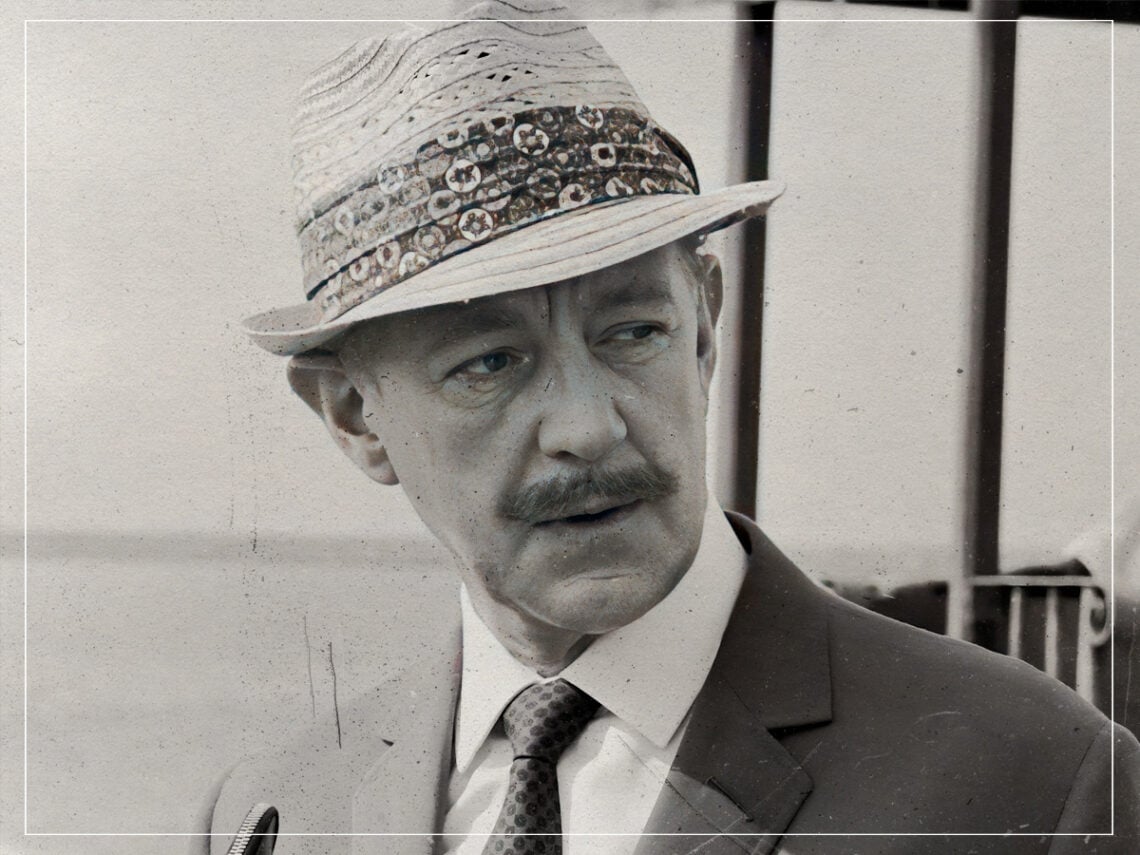
Alec Guinness had an “irresistible desire” to play Adolf Hitler

In March 2004, the renaissance man of British film, Peter Ustinov, passed away aged 82. Ustinov is widely remembered as a cinematic great, winning two Oscars, including one for his role in Stanley Kubrick’s Spartacus. Away from the big screen, as well as a controversial and often outspoken figure, he was also known as a wonderful storyteller.
One of his most extraordinary and hilarious stories involves the legendary Obi Wan Kenobi actor Alec Guinness. While on Michael Parkinson’s talk show in the 1970s, Ustinov described how Guinness suddenly became fixated on playing a particular acting part. When he heard rumours that Dustin Hoffman had been offered the part, Ustinov said he became “desperate”.
The role Guinness had an “irresistible desire” to play, in Ustinov’s words, was none other than the dictator of the Third Reich, Adolf Hitler. Ustinov claimed this was very “unlike him”, as he couldn’t think of two people more different than Hilter and Guinness.
Guinness was so keen to prove his aptitude for the part that he hired a photographer to take pictures of him posing in a Hitler costume on an “isolated street” of Bayswater, west London. “There was Alec Guinness standing on the sidewalk [dressed as Hilter] … and nobody took any notice,” Ustinov explained. “People passed with prams … Maybe dogs hesitated, but they didn’t stop.”
Finally, a policeman apparently wandered up to Guinness and said, “Excuse me, sir … Is that your car over there? On the double yellow lines?”
When Guinness confirmed the car was his, the policeman replied, “Well, actually, sir, that is a no parking area”. According to Ustinov, the policeman then added, “I’m only gonna warn you on this occasion, I’m not giving you a ticket as I have no desire to spend the rest of my life in a concentration camp.”
Ustinov and Guinness became good friends after working together on the radio. They also starred in the 1967 film The Comedians alongside Elizabeth Taylor and Richard Burton. Ustinov described how he was “tremendously devoted” to Guinness, who died four years prior to him, both as a person and an actor.
While Ustinov established himself as a versatile supporting actor and wrote prolifically, including dozens of plays and several non-fiction books, Alec Guinness was revered for his leading roles on stage and screen. He transitioned effortlessly from Shakespearean theatre to Dickensian cinema and won the ‘Best Actor’ Oscar for The Bridge on the River Kwai in 1957.
