


An alchemist’s guide to Europe

Alchemy is very, very old. Guided by material handed down through the centuries from ancient Egypt, Arabia and China to classical Greece and Rome, and then to western and central Europe, the practitioner of alchemy has three key aims: to determine the whereabouts of or else synthesise the Philosopher’s Stone, to uncover the secret to eternal life, and to establish a way of turning base metals into gold.
While we might claim that such pursuits are clearly founded on a fundamental misunderstanding of chemistry, in the eyes of many monarchs, alchemy was well worth investing in. All over the world, and especially in Europe, leaders and governments hired the services of alchemists, many of them becoming very rich people in the process – even if they did fail to secure the knowledge they had promised. The patronage of alchemists helped lay the foundations on which many scientific intuitions were later built. Take the Royal Society in London, for example, which published an alchemical text in 1676.
That’s not to say that alchemy has always been accepted. In the medieval period, many alchemists were persecuted and accused of witchcraft, leading scholars to devise secret symbolic languages. Around the same time, cheats, quacks and charlatans became increasingly common, leading to a huge backlash against the study of alchemy. After a resurgence in the early modern and renaissance periods, the scientists of the 18th century started to distance themselves from this arcane art and pursue what they regarded as true sciences.
It might seem impossible now, but there are countless sites, monuments and artefacts across Europe which serve to remind us that we once lived in a world in which science and magic were intertwined. We’re going to take you on a trip to visit some of the most fascinating.
The remains of John Dee (London, England)
Our first stop takes us to Mortlake, a leafy suburb in the London borough of Richmond which just happens to be home to the remains of one of Tudor England’s most prominent alchemists and occultists, the mathematician, astrologer, astronomer and antiquarian Dr John Dee. When he wasn’t advising Queen Elizabeth I or advocating the establishment of colonies in the New World, Dee was dedicating his time to the study of the occult and the alchemical.
He even claimed to have uncovered an angelic language, which he believed would allow humans to communicate with the spirit realm. Dee and his friend Edward Kelly believed that the language had first been spoken by Enoch and Adam, though others argued that it was more demonic in nature, probably because Kelly told Dee that the angel Uriel had commanded them to swap wives, an incident that unsurprisingly marked the end of Dee and Kelly’s partnership. The remains of John Dee are located in what was once the churchyard that lay beyond the boundaries of his house and garden in Mortlake, though all that remains of the pre-reformation structure today is its tower.

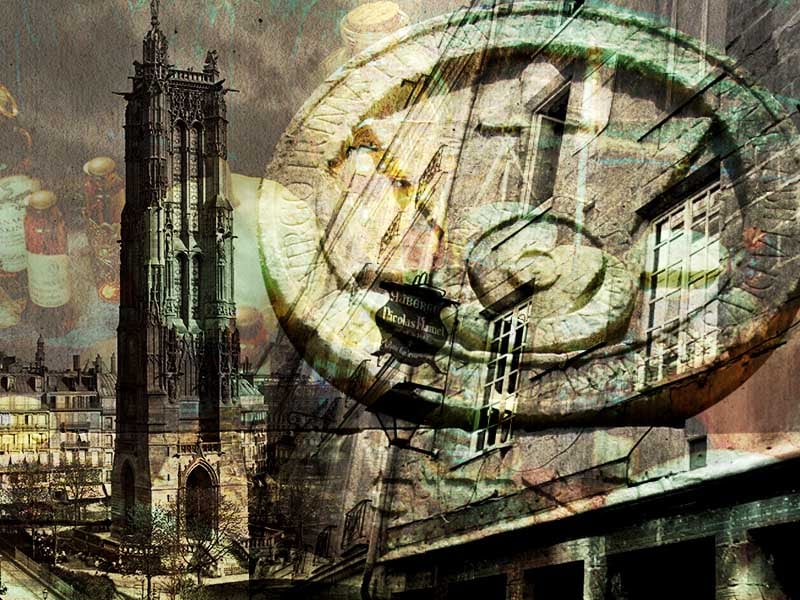
The House of Nicolas Flamel (Paris, France)
Thanks to J.K Rowling’s Harry Potter series, everyone knows the name Nicolas Flamel. In truth, we have no idea if the medieval philanthropist’s wealth came from the successful transmutation of base metal into gold, but his name is intimately bound to alchemical lore nevertheless. Born sometime around 1340, Flamel worked most of his life as a bookseller and scribe. Many believe that in the process of sifting through antiquarian tomes, he happened upon an ancient text that instructed the reader on how to create that most sought-after alchemist’s prize: the Philosopher’s Stone, which may not have been a stone at all but a powder the colour of saffron.
After travelling to Spain to translate the text, Flamel apparently succeeded in transforming a half-pound of mercury into silver and gold. Rather than spending his vast wealth on luxurious personal items, he used it to fund the construction of churches, schools and hospitals, each of which received a plaque featuring alchemical messages and symbols. The fabled alchemist’s house on Montmorency Street, Paris, was built in 1407, making it the oldest stone house in the city. It, too, bears a variety of strange arcane symbols, as does his tombstone, which features its own symbology and is currently on display at the Musée de Cluny.

Porta Alchemica (Rome, Italy)
If you happen to be in Rome, take the metro to Vittorio Emanuele and wander across the road that greets you on the opposite side of the road. There you will find the Porta Alchemica, a small doorway guarded by two pale homunculi. This is all that remains of a grand palazzo built in the early 1600s by the Roman marquis Massimiliano Palombara, a notable member of ‘The Alchemists of Palazzo Riario’, a group of late-Renaissance thinkers who frequented the court of Queen Christina of Sweden – herself an ardent supporter of alchemy and the sciences.
The story goes that the Marquis once met a fellow alchemist at a dinner party, a pilgrim who told him that a mysterious herb could be used to transform elements into gold. In the morning, the alchemist (later identified as Giuseppe Francesco Borri) was gone, having located the necessary herb in the palace gardens. All that was left of his successful transmutation was a few gold flakes and a sheet of symbols. Unable to translate the recipe, the Marquis had it chiselled on a door in the hope that another, greater alchemist might understand it and reveal the secret to the pilgrim’s success.

Cappella Sansevero (Naples (Italy)
Practically every inch of Naples’ historical centre contains something to fascinate and bewilder. Cappella Sansevero is just about as mind-bending as it gets. The small chapel is home to the famous Veiled Christ, sculpted from marble by Giuseppe Sanmartino in 1953. Wander down to the crypt, however, and you’ll find something even more astonishing: a twin-set of anatomical machines with their full nervous systems laid over their skeletons.
Anatomist Giuseppe Salerno constructed these fleshless bodies under the orders of the Prince of Sansevero, Raimondo di Sangro, a dedicated polyglot and mystic, not to mention a renowned and feared practitioner of alchemy. Fluent in several languages, including Arabic and Hebrew, the prince was the inventor of many strange devices, including an eternal flame made of chemical compounds and an amphibious carriage pulled by wooden horses. Unsurprisingly, the townspeople viewed di Sangro with suspicion, leading to the suggestion that he had two of his servants killed to create his anatomical “Adam and Eve”. Though it was long believed that Salerno accomplished an early form of plasticization using molten led, it has since been discovered that the nervous systems of the two figures are made from a combination of beeswax, iron wire and silk.

Castle Frankenstein (Mühltal, Germany)
Though its connection to Mary Shelley’s proto-science-fiction novel Frankenstein is tenuous at best, Castle Frankenstein was home to one of the most bizarre and fascinating characters in scientific history: Johann Konrad Dippel, an alchemist who was rumoured to concoct potions and conduct gruesome experiments on cadavers in his lofty gothic castle in Mühltal.
Dippel was determined to become the first man to successfully transplant the soul of a living being into a dead body. This irrepressible ambition led him to engage in all manner of brutal experiments, the majority of which involved him dissecting living birds and other animals in a state of sickening euphoria. Indeed, it was Dippel’s taste for stitching animals together to create vile chimaeras that have led some to suggest that he was the model for Mary Shelley’s titular scientist, Victor Frankenstein.

