


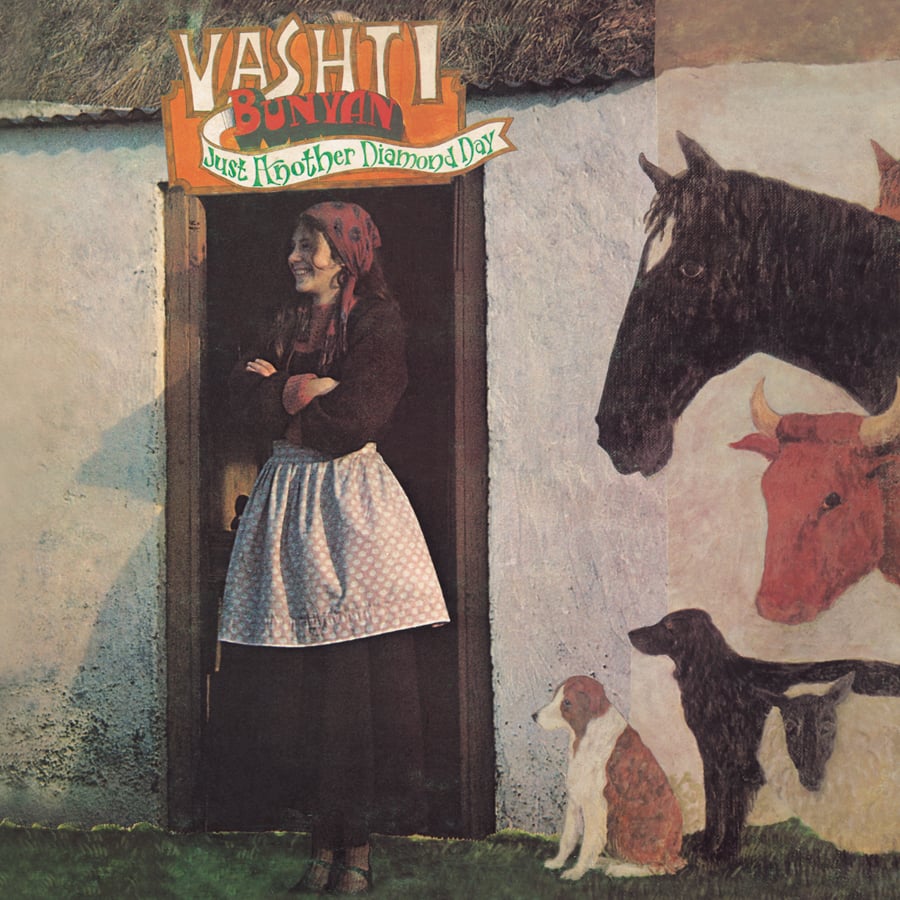
The album that inspired Vashti Bunyan to become a “wandering singer”

I think people get a little too fixated on music being an ‘industry’. It’s understandable, considering it’s arguably the most immediate and affecting form of media in the world. It stands to reason that people can lose the forest for the trees, focusing solely on the cabal of men in suits at the very top. They act like the public’s taste in music is controlled by them and only them. As the story of Vashti Bunyan shows though, sometimes music is found by people not because some A and R exec said so, but because enough people were moved by it.
Born in South Tyneside but raised in London, there was a part of Bunyan’s very being connected to myth and legend. After being told for years that her middle name came from her father’s boat, she found that it was actually a secret nickname for her mother, Helen – both of them being named after the Biblical Persian queen who refused to show off her beauty for her husband’s cronies. Fittingly, Bunyan grew up as something of a black sheep of the family.
She was less interested in formal education and more interested in art, travel, and especially music, taking up the guitar, much to the chagrin of her teachers. Everything changed when Bunyan was 18 and went to visit her sister, who was living in New York at the time. Her sister introduced young Bunyan to the peak days of the Gaslamp Café folk scene, in which she was completely immersed after she spotted a record in a shop window that would change her life completely.
She elaborated on this in an interview with Tidal, saying, “The songs on The Freewheelin’ Bob Dylan opened my eyes to a world so different to mine, one that I wanted to be part of and understand. It sowed the seeds for my romantic notion of becoming a wandering musician.” The iconic album was all the inspiration Bunyan needed to turn her love of music into a new direction in her life. She began work on a number of new songs and literally walked the streets of London trying to find connections to bring her into the world of music.
As a sign of how accessible all this was back in the day, she found a connection with Andrew Loog Oldham, better known as the manager of The Rolling Stones. A fairly important person to know in music in the mid-1960s, I’m sure you’d agree. She was introduced to Oldham by a friend of her parents at exactly the right time, as Marianne Faithful had just departed his stable of artists in a huff, so he was looking for a young woman to mould into a pop star in her image.
Despite having literally everything you could possibly want at the time, from the look to the industry backing and especially the songs, the five years Bunyan spent trying to make her music career happen were ultimately fruitless. By 1971, she’d jacked the whole enterprise in with a single album to her name, the previous year’s Just Another Diamond Day, and by her own admission, “wouldn’t even sing to [her] kids” for the next 30 years. All the while, something amazing was happening.
Just Another Diamond Day was becoming a collector’s item, with copies of it selling for up to a thousand pounds on auction. Her legend began to spread, and by the turn of the 21st century, new folk artists like Devendra Banhart and Joanna Newsome were publicly singing Bunyan’s praises. …Diamond Day was re-released in 2000 to great acclaim, and after three decades away, Bunyan threw herself back into music, releasing records and touring to this very day.

Never Miss A Tale
The Far Out Bob Dylan Newsletter
All the latest stories about Bob Dylan from the independent voice of culture.
Straight to your inbox.