


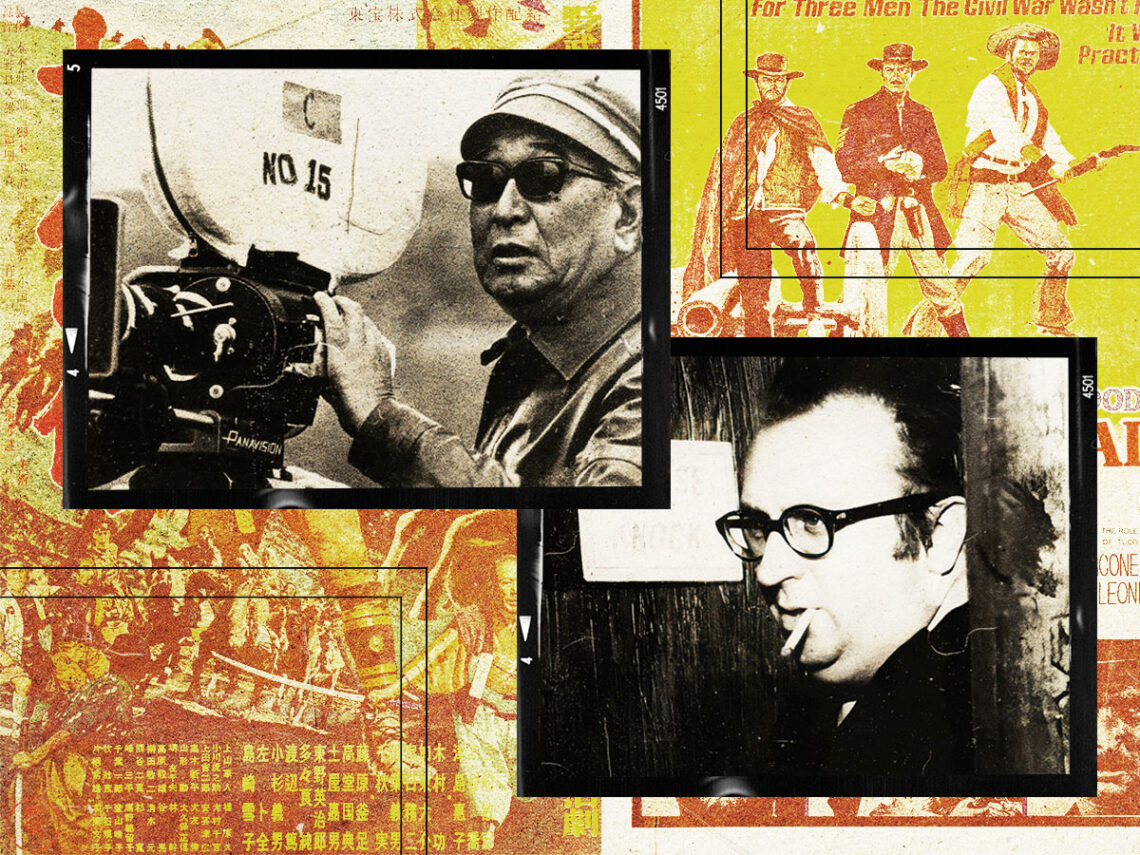
Cultural Connections: Akira Kurosawa, Sergio Leone and the masterless cowboy

Out on the shimmering horizon, a man rides atop his trusted horse. Dressed in the fashions of old, he cuts a lonely figure against the blackening skies. The rains will surely come soon, he thinks. Then, from behind the weeds and bushes, bandits attempt to ambush our hero. They are no match for him, of course. Excelling in both wit and strength, he dispatches them with ease, spits at the ground and watches as the dust sucks up the moisture.
The truth, however, is that this is not one man, but many, from opposite sides of the world and from historical cultures at once contradictory to one another. They are the samurai and the cowboy from Japan and America, and while their differences in language and in dress are blatantly apparent, at their core, in their soul, they are one and the same.
Nowhere is this similarity between the two classes of men more explicitly stated than in the artistic medium of cinema, particularly in the works of the masterful directors Akira Kurosawa and Sergio Leone, and their respective actors Toshiro Mifune and Clint Eastwood, although there are admittedly several other examples in film history.
The samurai has existed in one form or another in Japan since the 12th Century; a class of fierce mercenary warriors charged with defending their lords and masters from any sort of physical danger. They abide by a strict moral code that can sometimes lead to honourable suicide. One of the most interesting kinds of samurai, though, is the ronin, a samurai with no master, and it’s the ronin that ought to draw the most comparison to his gunslinging counterpart; his own master, answering to none but his own beliefs.
Kurosawa famously cast Mifune again and again in roles that would go on to exemplify what we know and love in the samurai film genre, and in Seven Samurai, Mifune’s gruffness and toughness would greatly influence the kind of disaffected characters Clint Eastwood would play in several western films throughout the proceeding years.
In fact, Mifune and Kurosawa’s 1961 film Yojimbo would become one of the biggest influences on the western genre and certainly Leone’s Dollars Trilogy, which serves as the western remake. Then again, perhaps Kurosawa had also been influenced by the cowboy films of the 1930s and ’40s, which was arguably the most popular American film genre at the time.
Both the samurai and western genres explore the end of an era, ushering in a new age from the old ways. For the cowboy, this meant that the age of lawlessness was drawing to an end; he no longer needed to take bounties to catch outlaws nor to protect any vulnerable towns or villages. Quite simply, he was free to return to his cattle and live a simpler life.
In many ways, the story of the samurai is similar. The anarchy of the Sengoku and Edo periods of Japan came to an end, and the lawlessness of warlords and tyrants was slowly replaced by an ever-strengthening form of central government. Again, as with our mid-19th century cowboy, the samurai was simply no longer needed. Rice-farming villages were less threatened by bandits and their violent crimes, and suddenly, the samurai, as the cowboy, was out of a job.
Of course, this all lends well to the idea of a lonely, masterless ronin/cowboy wandering the lands in search of shelter and food, if not work. The glory days had well and truly moved on, and we ought to think of Eastwood in his 1992 revisionist western movie Unforgiven, in which his character, William Munny, has moved on from his old outlaw way of life to farm and look after his children. But the allure of one final job is too much to resist, and he’s dragged back into his former profession, forever destined to be what he truly is.
There’s undoubtedly just a remarkable symmetry between these two kinds of men. Doesn’t the drawing of a gun from one’s hip during a duel bear a striking resemblance to the first lift of one’s sword from its sheath? Even in a seemingly lawless time as the Old West, there is still an underlying code of honour that ought to be adhered to. Interestingly, though, historians believe that this “quick draw” type of duel did not actually exist in reality but is rather a reference to those exact types of samurai duels shown in Kurosawa’s movies.
Peeling back the layers even further, there are certainly instances of colonial anxiety in both the samurai and western genres. Native Americans find their way into many narratives of the Old West, often imploring their ancient wisdom into the barbarity of the outlawed onslaught, just as we find the indigenous tribes of Japan downtrodden by warlords in the samurai-centric movies of old.
Some criticise Leone for ripping off Kurosawa with the Dollars Trilogy, but it’s a rather unfair criticism as Kurosawa himself had undoubtedly been inspired by the barren, dusty wastelands of the films of John Ford and John Huston. Rather than focus on “who ripped off who”, it’s more interesting to consider the kind of characters depicted here, undoubtedly one and the same, isolated, lonely, and most likely tired of their exploits.
In sum, there’s just a real allure to both the samurai and cowboy, and the cinematic medium does an excellent job of exploring their undoubtedly complex nature. They both seek an existence of simplicity, even if it includes violence. They do not question the stars but rather consult them for direction. Simply, they do not ask but do. The samurai and the cowboy are brothers in arms, and they walk side by side into the distance.
Cut bruised and horseless from the night of bloody warfare, he drags his weary body into town. At a brothel, he washes and shaves. The onslaught of industry is upon us; this is no time for old men like he. At his side, he reaches for his weapon one final time, feels its weight and its history, all the bloodshed, the rights and the wrongdoing, the mistakes, the justice. The love. He places it back close to his body, where it undoubtedly belongs. This is surely the end of an era.

Never Miss A Tale
The Far Out Clint Eastwood Newsletter
All the latest stories about Clint Eastwood from the independent voice of culture.
Straight to your inbox.