


Artificial intelligence, BBC Introducing, and the future of musical expression: Is This What We Want?

Week after week, it seems as though our march towards a future ruled by artificial intelligence (AI) and its inbuilt monotony is becoming something of an inevitability.
You can scarcely scroll through your phone without being bombarded with fabricated videos of bunnies on trampolines or, much more worryingly, misinformation and hatred dressed up as information. Surely, though, the music world is one place where the human spirit still prevails?
Over the past year or so, AI technology has developed rapidly, and with every new development seems to come a deluge of generated slop claiming to be “a new age” or an essential technological advancement. The idea of an AI-dominated future is certainly a bleak one, but it is always worth remembering that robots can never truly grasp the intricacies and emotions of the human spirit, something which has always prevailed in the world of art and music.
Still, that hasn’t stopped a multitude of people from attempting to con the creative industries into accepting work created entirely by a computer.
Music is inherently human, capable of capturing our emotions and connecting our spirits, but AI is becoming an increasingly worrying and unavoidable aspect of the industry. We have already seen AI-generated artists racking up thousands of Spotify streams, the likes of Grimes licensing her voice to AI companies for others to exploit, and even the analogue world of northern soul has been infiltrated by artificially-enhanced records. Now, even BBC Introducing – one of the nation’s greatest strongholds of grassroots celebration – has seemingly succumbed to AI’s influence.

During a broadcast on November 6th, available on BBC Sounds, BBC Introducing for the West Midlands and Warwickshire platformed an ‘artist’ by the name of Papi Lamour, whose track ‘Be Inspired’ was generated by artificial intelligence. Even more worryingly, neither the artist nor the Beeb made any effort to hide that fact; presenter Theo Johnson called the song “pitch perfect” before explaining that the song was created “in a very unique way, and with the times.”
Lamour himself expanded upon that worryingly vague introduction, revealing, “I wrote a song and then programmed it and used one of the AI tools to get it to do the rest for me.” He added, ominously, “The future of music is going to change.”
Now, let’s get the elephant out of the way early doors, the song itself is terrible. It is instrumentally uninspired, and the lyrics read like a half-arsed school assignment set to music. Other than the fact that the song is AI-generated, there is very little of note within the song at all.
According to Papi Lamour, the song was written in tribute to Black History Month, so perhaps, at the very least, his intentions were good, but a much better way to honour Black History Month would surely be to honour the work created by the millions of incredible black artists out there, rather than heaping praise onto an AI language model. ‘Be Inspired’ is little more than a regurgitated mess of stolen influences, spewed out by a computer at the demands of some bloke.
Regardless of the song and how bad it is (and let’s be clear, it is bad), the very fact that it was platformed by BBC Introducing in the first place is cause for concern. This is an outlet which, for nearly 20 years, has claimed to support unsigned, undiscovered, and under-the-radar artists from across the nation. Over the years, it has provided early successes to a wealth of now-beloved artists, spanning Little Simz to Florence and the Machine. What hope is there for up-and-coming artists now, if all you need to do to get on Introducing is feed a prompt to an AI bot?
It should be noted, at this point, that the BBC have responded to the backlash against their decision to play Papi Lamour, telling Far Out, “Each track is considered based on its musical merit and whether it is right for our target audience, with decisions made on a case-by-case basis,” and that their priorities remain in supporting emerging artists within the UK music industry.
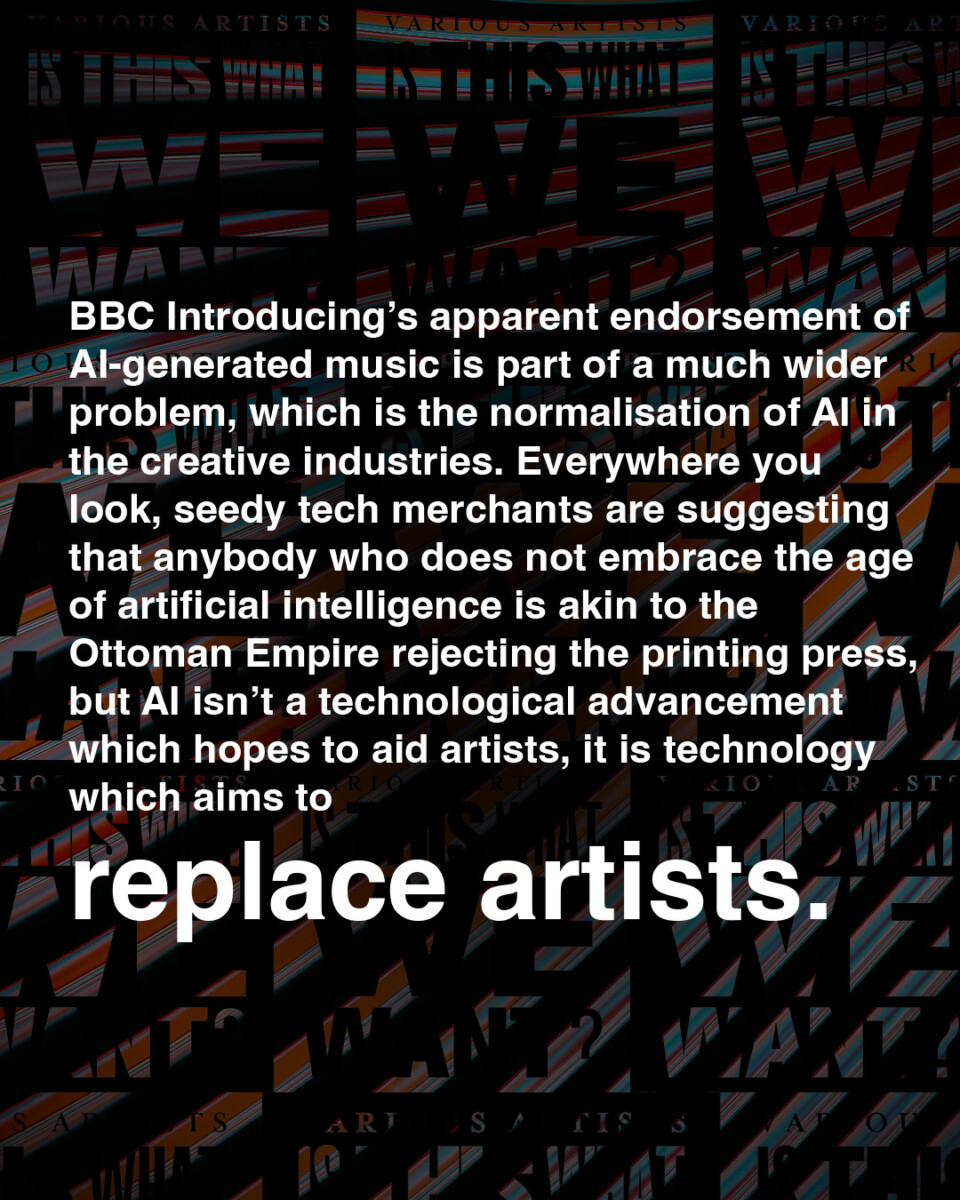
Nevertheless, BBC Introducing’s apparent endorsement of AI-generated music is part of a much wider problem, which is the normalisation of AI in the creative industries. Everywhere you look, seedy tech merchants are suggesting that anybody who does not embrace the age of artificial intelligence is akin to the Ottoman Empire rejecting the printing press, but AI isn’t a technological advancement which hopes to aid artists; it is technology which aims to replace artists.
Thankfully, the music industry has responded with some high-profile resistance to artificial intelligence. Recently, for instance, Paul McCartney – an unwavering beacon for the power of human songwriting – has lent his support to a project named Is This What We Want?, a silent LP protesting against the UK Government’s proposal to alter copyright law to allow AI companies to use artist’s copyrighted work to train their language models, without the consent of said artists.
Not only would that proposed change be a slap in the face to songwriters and artists everywhere by essentially giving AI companies free rein to plagiarise and bastardise work without even the courtesy of paying royalties, but it would also enable a further deluge of AI-generated musical slop. The support of artists like McCartney, Sam Fender, and Kate Bush, among many others, should certainly not be ignored.
“The government’s proposals would impoverish creators, favouring those automating creativity over the people who compose our music, write our literature, paint our art,” as composer Max Richter put it.
These are, after all, the artists who have soundtracked our lives, who have comforted us in our darkest moments and, aside from anything else, boosted our local and national economies for decades on end. If the future of music is allowed to be hijacked by these parasitical AI companies, suddenly, we will have lost something that is integral to the lives of millions: the creative expression of human emotions. What’s more, projects like Is This What We Want? do provide an optimistic antidote to the depressing reality of BBC Introducing’s platforming of Papi Lamour.
Ultimately, artificial intelligence will never truly replace human creativity and music. Particularly if ‘Be Inspired’ is anything to go by, AI could never create something as earth-shatteringly beautiful and life-affirming as even the shittest of Beatles’ B-sides.
Still, the future of music is certainly something worth fighting for, lest we be irreversibly inundated with AI slop for the rest of our listening lives.
