


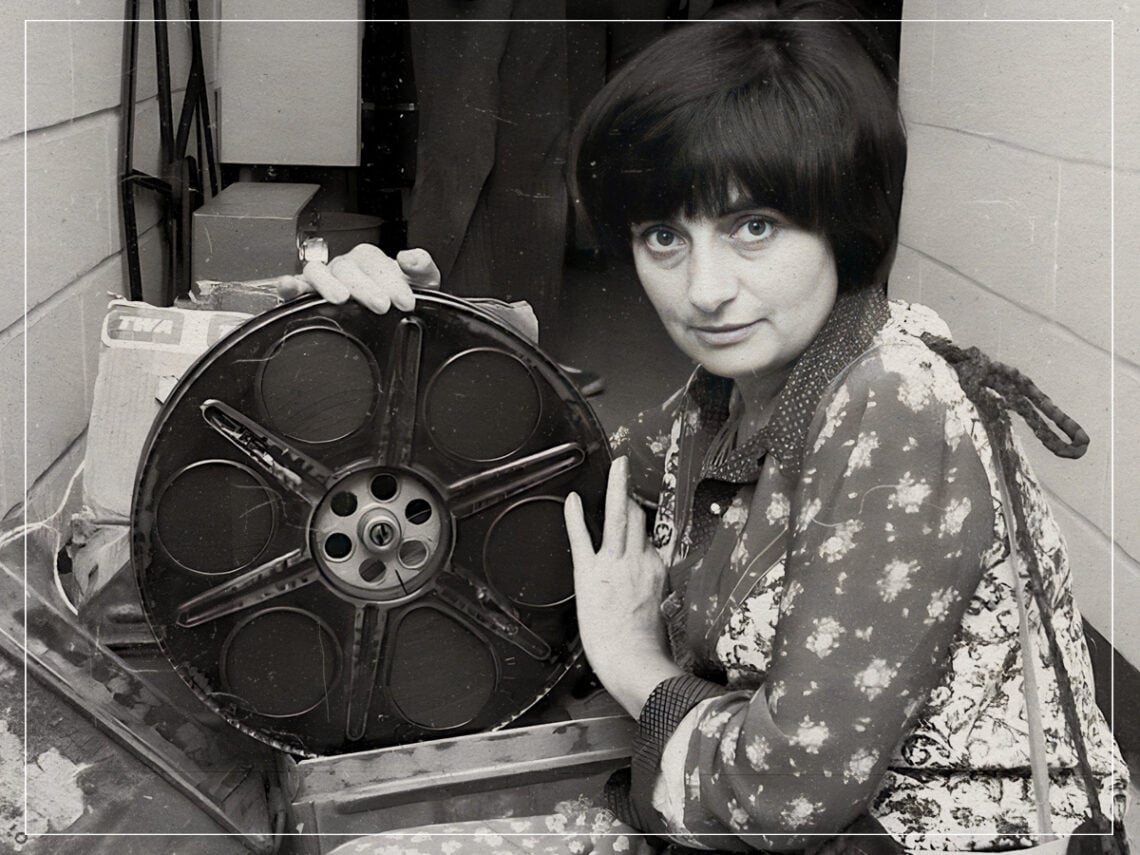
Agnès Varda and the freedom of digital technology

Few filmmakers have utilised cinema in such a personal and intimate way as Agnès Varda, whose approach to filmmaking was always uniquely reflective of her interest in the multitudinous nature of humans and the quest for civil rights. Whether she was filming feminist marches, interviewing the Black Panthers, or perhaps making fictional narratives about cheating husbands or homeless young women, Varda’s cinematic identity was always brazenly apparent.
Early on in her career, she expressed an interest in manipulating form and breaking the audience’s immersion in her films. Near the start of Cleo from 5 to 7, Varda repeats a scene of Cleo walking down the stairs, like a needle stuck on a record, while Vagabond sees Varda herself open the film in a documentary-like style, only to give way to a more traditional narrative approach. By making her method of storytelling so engaging, Varda forces us to confront the real-world themes explored in her films with more urgency and attention.
However, in the early 2000s, Varda found a new way to communicate her stories—digital technology. It was a defining moment in the filmmaker’s later career, allowing her to harness an intimate approach through relatively cheap and easy means. This resulted in serendipitous findings and the championing of scenes that might have otherwise been left on the cutting room floor.
With The Gleaners and I, released in 2000, Varda used a Sony TRV900 Mini DV Camcorder to literally glean scenes she observed on her travels through France as she interviewed various kinds of gleaners. She filmed the road as she travelled across the country, able to quickly and easily pick up the camera and start recording passing lorries. When she was at home, she used the camera to take self-portraits, turning the lens around on her own face and showing us her greying hair and her wrinkled hands.
The film hardly looks amateur due to Varda’s impeccable direction and the film’s cohesive editing, with the director’s presence helping to bind her ideas about ageing female artists, discarded rubbish, the power of art, being frugal, and living life by your own terms. Succinctly exploring class, gender, poverty, and consumerism, The Gleaners and I seems to connect with audiences because of its naturalistic, unpolished approach to documentary, with Varda’s digital camera allowing for a sense of raw and unpretentious compassion for her interview subjects.
Digital technology thus became a source of freedom for Varda, and as the dancing lens cap segment of the films suggests, handheld cameras can produce some happy accidents that might actually be worth using. In this case, Varda’s intentional inclusion of a scene that featured her camera filming the ground by accident with the lens cap hanging in the air gives us a further glimpse into her creative mind, where art can emerge from the most unexpected of places.
Over the next few years, Varda often resorted to using a digital camera for certain segments of her documentaries, like The Beaches of Agnes. Allowing audiences into her private and personal sphere with the use of the digital camera, Varda could shoot ideas that came to her when she was without her crew or any fancy equipment, giving her the opportunity to create more freely. It was a testament to Varda’s constantly evolving approach to cinema and documentary – she was always open to exploring new technologies and ways of storytelling, and her effortless use of digital technology was the ultimate proof of her brilliance.
