


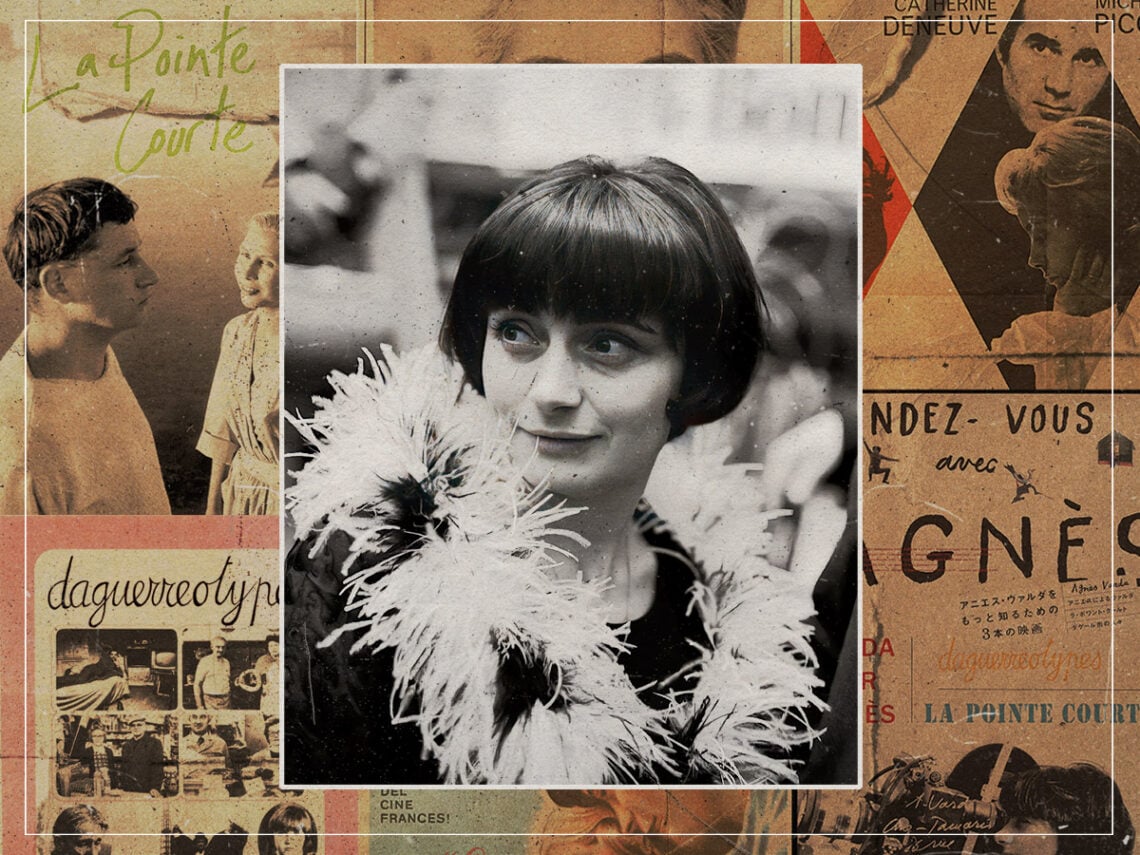
How feminist cinema icon Agnès Varda paved the way for generations of female filmmakers

In the late 1950s, a new crop of filmmakers emerged from France, determined to rewrite the cinematic rulebook and make movies that innovated the medium. This movement, known as the French New Wave, is best associated with directors such as Francois Truffaut and Jean-Luc Godard. Their debut features, The 400 Blows and Breathless, respectively, are considered some of the genre’s earliest and most vital entries.
Yet, several years earlier, a photographer named Agnès Varda decided to try her hand at filmmaking despite having very little technical knowledge. Moreover, in her 26 years, she had reportedly only watched one film: Citizen Kane. Thus, her approach to making her debut feature, La Pointe Courte, released in 1955, was wholly original, using her own initiative to guide her direction. Varda’s film is often overlooked when it comes to classifying the earliest entry to the French New Wave, yet her low-budget, on-location approach, utilising a documentary-esque lens and a series of unconventional camera techniques, makes it a quintessential entry to the canon.
She spent the latter half of the 1950s making short films, and her dedication to feminist politics quickly began to emerge. The second wave of feminism didn’t flourish until the following decade, yet Varda was already shining the torch for female visibility on screen, centring her first short film, L’opéra-mouffe, around the perspective of a pregnant woman. The director was carrying her first child at the time, using her experience as an expecting mother to influence the essayistic film’s observant narrative. As a woman both anxious and excited to bring new life into the world, Varda filmed the characters that populated the Parisian Rue Mouffetard neighbourhood, showing both the beauty and the ugliness that she witnessed.
There were very few female filmmakers working during this period, yet Varda asserted herself with a dedicated vision and a desire to highlight the lives of women who were rarely depicted on screen in such a way. Varda’s second feature film, Cleo From 5 to 7, was released in 1962 and received widespread praise. Not only is the film a defining work of the French New Wave, but it is also a cornerstone of feminist filmmaking, with Varda’s exploration of female oppression and the desire for liberation incredibly ahead of its time.
Out of all the French New Wave directors, Varda was the only woman. While many of her male counterparts attempted to explore womanhood, such as Godard with Vivre sa vie or Claude Chabrol and Les Bonnes Femmes, these men couldn’t compare to Varda, whose lived experience informed her approach to the narrative of Cleo from 5 to 7.
The film follows the titular character as she anxiously awaits the results of a medical test. Cleo, a popular singer, is vain and preoccupied with beauty above anything else, looking into the mirror and saying to herself, “Ugliness is a kind of death. As long as I’m beautiful, I’m more alive than others.” Cleo is a victim of patriarchal standards – she is obsessed with being desired, and men often stare at her as she walks down the street. Yet, with her fear of death looming, she begins to free herself from the shackles of societal expectations over the course of the film.
Varda shoots the film from a distinctively feminine perspective, understanding the weight of the male gaze and subsequently subverting it with her own lens. Cleo flourishes as she discovers life’s simple pleasures, indulges in female friendship, and comes to terms with the exhausting nature of femininity as a performance. She realises that she shouldn’t have to constantly wear pretty dresses and perfect blonde wigs if she doesn’t feel like it. Varda plays with the constraints of time and manipulates form, innovatively using both colour film stock and black-and-white to emphasise changes in Cleo’s situation.

Throughout the decade, Varda continued to make movies that focused on the experiences of women, although two of her most politically charged works came in the 1970s, following France’s decision to legalise abortion. In 1975, she made Women Reply: Our Bodies, Our Sex, in which a group of women discuss what it means to be a woman. While Varda’s approach to feminism in this specific short feels slightly dated due to its lack of visibility for women of colour and transgender women – something that cannot be ignored when analysing the movie’s consideration of womanhood – her overt exploration of the feminine experience, albeit a specific kind, was still rare for its time. One woman interviewed by Varda explains, “I can no longer bear to be loved by misogynists,” offering up a compelling insight into a time when women’s rights were beginning to change.
In 1977, she made One Sings, The Other Doesn’t, a candy-coloured drama, complete with several musical moments, about female reproductive rights. The movie’s exploration of such an important topic came just two years after abortion was made legal in France. Evidently, Varda’s dedication to female liberation shaped her work, using her beliefs to make incredibly groundbreaking films.
The great thing about Varda was her open-mindedness and willingness to learn. She immersed herself in the experiences of others in order to understand the complexities of life. Her documentaries prove this best, such as 1968’s Black Panthers, in which she depicted the protests that took place following Huey P. Newton’s arrest. However, if we fast-forward to 2000, Varda’s curiosity and dedication to showcasing people who experienced life vastly different from herself was just as potent.
At the turn of the millennium, Varda released The Gleaners and I, a stunning documentary that blended meditations on ageing with different interpretations of the word ‘glean’. From homeless people eating from bins to those who scavenge for discarded materials to make art, Varda’s empathetic (yet never sentimental) nature emanates a certain warmth from every scene. The documentary takes on a fascinating narrative as Varda interweaves themes of class and gender with art, capitalism and consumerism.
In all of Varda’s work, there is an inherent playfulness. Her love of life was apparent in everything, even her most bleak films. Because, in spite of oppression, violence and death, Varda was able to pinpoint the smallest things that keep us going, from shared community experiences and kinship to the natural beauty of a flower blooming, shooting its vibrancy and tenderness with extreme intricacy.
Varda’s incessant dedication to bringing the lives of women to the screen, using cinematic methods that had rarely been used with such vivacity before, has inspired countless female filmmakers ever since to pick up a camera. Varda was one of few female filmmakers in a male-dominated landscape, yet she used this as her strength. She has been championed by many filmmakers over the years, such as Kelly Reichardt and Greta Gerwig, inspiring countless women to challenge preconceived cinematic notions – most of which have been pioneered by men – and create their own filmmaking rules.
