


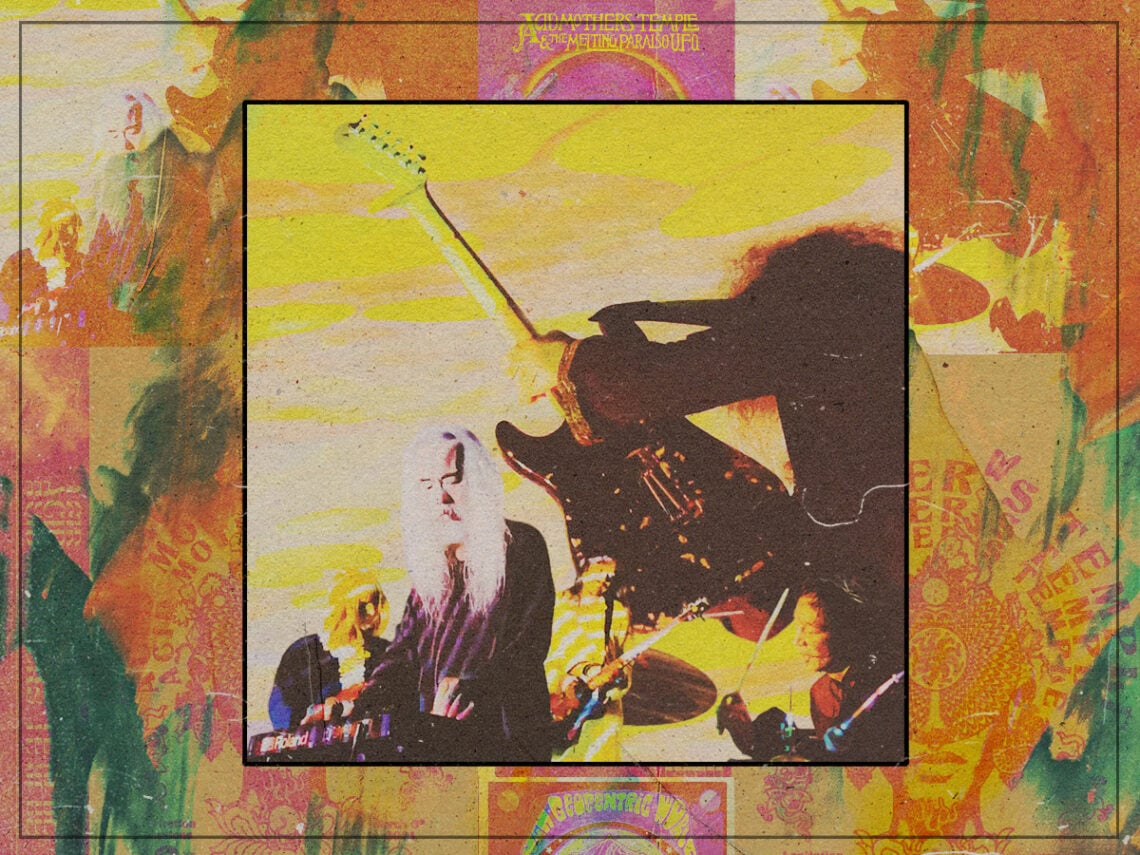
Acid Mothers Temple: a sonic force featuring an ex-Yakuza member

For decades, Japan has produced some of the most distinctive music. From the likes of Boris and Shonen Knife to newcomers Maya Ongaku, the country’s underground has continued to be a trailblazing force, bringing new sounds to a worldwide audience. One of the most intriguing and trailblazing artists Japan has delivered is the rock collective Acid Mothers Temple. Fusing the influence of Indian classical music, electronic pioneer Karlheinz Stockhausen and krautrock with a host of other genres, the group and their many related projects have an extensive oeuvre that is among the most compelling.
Formed by leader and one-time Gong guitarist Kawabata Makoto in 1995, it seems that Acid Mothers Temple, which has had over 20 members in their time, was always destined to stand out from the crowd. Whilst their eclectic music is fascinating in itself, the band’s origins are also an essential part of their story. Pulling musicians from different aspects of life, Acid Mothers Temple lived a completely countercultural existence in their early days.
The group was formed as a quartet by Kawabata Makoto, Koizumi Hajime, Suhara Keizo and Cotton Casino, all of whom had already cut their teeth in groups ranging from Musica Transonic to Mady Gura Blue Heaven. Initially, they were brought together by a desire to record their improvised jam sessions, formative moments of expression that would see the group hone their influential style.
The group pulls together an array of what they describe as “social dropouts”, which includes musicians, dancers, artists, mermaid researchers, professional vagrants, and most remarkably, an ex-Yakuza member.
Even in the early days, the band’s naturally countercultural essence saw them conflict with local residents near their base and home. In January 1996, some of their neighbours wrongly believed that their original creative abode – ‘Acid Mothers Temple Soul Collective House’ – was a hideout for members of Shoko Asahara’s cult Aum Shinrikyo, which had conducted the 1995 sarin gas attack on the Tokyo subway, killing 14 and injuring over 6,300 people.
Due to the local animosity they faced, Acid Mothers Temple were evicted and forced to relocate and transform their commune into an unstoppable, fully-fledged collective. In April of that year, they released their first cassette, Acid Mother’s Temple & The Melting Paraiso U.F.O., and continued to move headfirst into their future, which would soon bring them to Europe and North America. They showed their original detractors that they were not part of a bloodthirsty cult at all but musical trailblazers, repackaging the attitude and music of years gone by for the future.
The band explains on their website: “Everyone is free to live in whatever way they like. Our slogan is ‘Do Whatever You Want, Don’t Do Whatever You Don’t Want!!’. As a result of this philosophy, we have lost money and the trust of society as a whole, but we’ve gained time and freedom”.
They continue: “One of our members is a farmer, living together with his fields and rice paddies. There’s another member who has travelled through the Australian deserts and lived with Aborigines. There’s others who are bumming round India. One went to Africa and never came back. One dropped out of a yakuza gang and decided to travel around Japan searching for mermaids.”
As if they ever wanted to do so anyway, starting in such remarkable circumstances meant that Acid Mothers Temple was to enjoy a successful career that would not pan out in the usual manner. They began on the fringes and would continue to exist as masters of the niche, which has seen them headline festivals such as Austin Psych Fest and London’s Raw Power, two prominent celebrations of music’s underground.
The band released their self-titled debut album on Japan’s PSF Records in November 1997, a body of work which was universally hailed as one of the best of the year, and since then, have been going strong in all their different formats and off-shoots.
In an apt manifestation of their sonic resistance to the man, when they headlined 1999’s Deep Heaven Festival in Boston, the police were called, and the festival was forcibly shut down due to the immense volume Makoto and the band were conjuring. Yet, by this point, their artistic validity was undoubted, and they would go on to be lauded by a string of prominent names, including electronic outfit The Orb and late Hawkwind flautist Nik Turner, showing the broad pull their kaleidoscopic sounds have.
It must also be said that without them, one of the most lauded bands Japan has produced as of late, the brilliant but now-defunct Kikagaku Moyo would probably not have existed. A true force of nature, Acid Mothers Temple are not to be missed if they come to a venue near you.
