


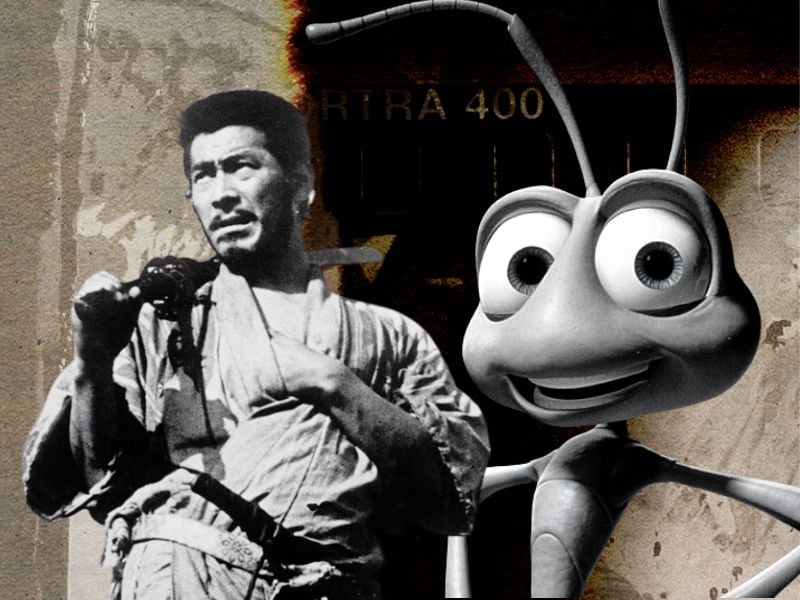
Why Disney’s ‘A Bug’s Life’ is Akira Kurosawa’s ‘Seven Samurai’

Akira Kurosawa‘s Seven Samurai is one of the most influential films of all time. The 1954 picture telling the story of a 14th Century Japanese village hiring seven masterless samurai (ronin) to defend their crops from bandits has seemingly inspired films such as Star Wars, The Dirty Dozen and The Magnificent Seven.
Another fascinating insight into Kurosawa’s masterpiece action drama is that even Disney appear to have been affected by its by-now classic trope of ‘assembling the team’. Disney films have often used older works to help write their films, with The Lion King essentially being Hamlet. On closer inspection, it appears that the 1998 animated film A Bug’s Life also directly takes its story from the Japanese classic.
For starters, Seven Samurai opens with a gang of bandits deciding to wait until harvest before raiding a nearby village for their crops. Similarly, A Bug’s Life features a band of grasshoppers who force an ant colony to give them their storage of food.
When the protagonist ant, Flik, ruins the latest offering to the grasshoppers by knocking it into the water with his invented grain harvester, the grasshoppers demand twice the original amount of food. Flik then suggests that the colony enlist the help of bigger, stronger bugs to help defend themselves from the grasshoppers.
This is mirrored in Seven Samurai when the villagers catch wind of the bandits’ plans. As such, the village elder suggests that they hire samurai to protect them. Another interesting comparison comes in the fact that the village has no money to pay the samurai, so the peasants must look to enlist hungry samurai instead. Evidentially, the ant colony are poor and hungry too, following the ruining of their crops.
Much of the first half of both films is taken up by the quest to assemble the team that will offer protection. Flik goes off in search of bugs to help him and ends up in the bug city, where he enlists the help of a circus troupe featuring, yes, seven different kinds of bugs. They all have unique attributes that will ultimately help Flik to defend the ant colony from the grasshoppers.
Back in 14th Century Japan, several villagers head into the nearby town and discover an ageing ronin named Kambei, who soon has a young samurai ask to become his disciple. Kambei then recruits five other samurai who, like the bugs, all possess different skills and attributes.
Ultimately, enlisting both the bug circus troupe and the samurai aid in successfully defending the respective homes of the ants and the peasants from their aggressors. While naturally, the Disney film ends happily – with Flik clearing out the grasshoppers, improving his inventions and falling in love – Seven Samurai is more reflective, as four of the seven ronin die. As such, Kambei claims their victory is one of a pyrrhic nature, and he says, “The victory belongs to those peasants. Not to us”.
Yet, it’s a fascinating comparison between two great films. Disney has never admitted to being directly motivated by Akira Kurosawa’s film; they cite the Aesop fable ‘The Ant and The Grasshopper’ as an influence. Looking at the two films side by side, the impact of Seven Samurai is there for all to behold.
