


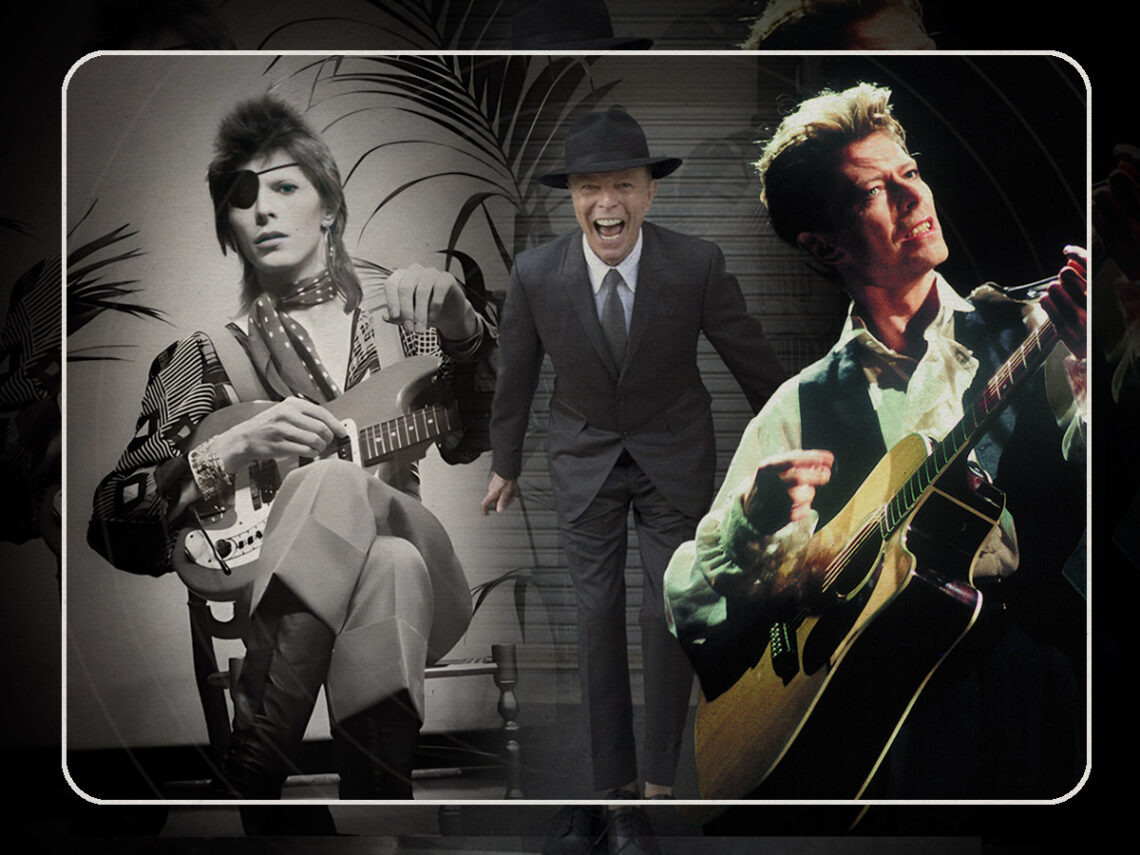
The differing production styles of new and old David Bowie across 44 years

It’s easy to say that David Bowie was an artistic polymath. Over the span of decades, albums, and eras, every moment was distinct and justified. It was just the mark of who he was.
But given that there’s only 365 days in a year, there’s bound to be moments and anniversaries which just coincidentally happen to overlap. In that spirit, here’s a fun fact for you: Bowie’s seminal 1971 album Hunky Dory and his final single ‘Lazarus’ were released on the very same day, some 44 years apart.
December 17th was the destined date, but little else between the two cornerstones of the man’s life and work remained the same. Bowie was a poster boy for musical reinvention, the examples of which you can find throughout the course of his songbook many times. However, that can often seem like a rather abstract concept until it is truly pulled into focus.
In a lot of ways, the shared anniversary between Hunky Dory and ‘Lazarus’ is the perfect manifestation of this, displaying in the starkest but most fascinating form the way in which Bowie continually kept on the move even after the world had completely changed from under his feet. This wasn’t unconscious – indeed, far from it – but a fact of life that the musician wholeheartedly embraced with every ounce of who he was.
There are many lenses through which you can obviously view this, but comparing ‘Lazarus’ to the first song of Hunky Dory, ‘Changes’, is perhaps one of the easier places to start. In certain respects, both are as ambitious and outlandish as the other in terms of their creative pursuits. But positioned at two ends of a spectrum of life, their stories could not be more different.
Let’s start at the beginning. It’s a well-known fact that ‘Changes’ was an outward expression of both frustration and freedom at the musical peripateticness that he so adored but had failed to yield him any success at that point in his career. Backed by a crack team of producer Ken Scott, a then-unknown Rick Wakeman on piano, as well as the rest of the Spiders from Mars, it seemed the mantra was that a big team created even bigger results.

The genre in itself also bears mentioning. ‘Changes’ was an elixir of art pop, rompish in its style if not in its actual meaning. Combined with the power of its lyrics, this was a young Bowie who had seen some hardships but was still overall hopeful and somewhat naive about the road ahead of him. Somehow, even then, he knew it would be a long one. On top of that, he would have to reinvent himself at every twist and turn.
Through the decades that then ensued, there were many episodes which left their mark and seared their way into the most prominent conscience of what Bowie came to be associated with as an artist – the Berlin years, the heights of Let’s Dance, and even the flash in the pan moment of Tin Machine. It’s dizzying for even an outsider to look at, but something that the singer, by virtue of his early statement of artistic expression, had to take in his stride.
It seems almost remiss to jump to ‘Lazarus’ without explaining much else in between, but it’s also probably an apt way to convey the pivot on which Bowie’s world had turned. Here he was, at that point in late 2015, when he knew he was facing the end of his life but kept the fact unknown to the rest of the world. It was evident, retrospectively, that ‘Lazarus’ was a swan song, but in turn, it also symbolised how Bowie wished to leave.
With that previously extensive production team now pared down to only Tony Visconti, it overtly reflected his outlook of only keeping his diagnosis and final projects confined to the closest quarters. Physically lying on his deathbed, as the jazz rock tones of the song float through the ether, he contemplates, “I’ve got nothing left to lose.”
Although the frames are entirely different and not at all recognisable to one another, this is perhaps the one area in which ‘Changes’ and ‘Lazarus’ converge, as is the case in the rest of his back catalogue. Bowie never lost that spirit of artistic reinvention at any point in his life, and his final goodbye with ‘Lazarus’ proved that it was perhaps the thing he was most proud to have maintained, above everything else.
The anniversary of Hunky Dory and ‘Lazarus’ is hardly one that is going to stick out as the most prominent memory in the mind of any Bowie fan. But by the fact of its sheer coincidental existence, it stands as a testament to everything he set out to achieve in his lifetime, and indeed conquered. He said it best in the seminal words, “Time may change me/ But I can’t trace time.”
