


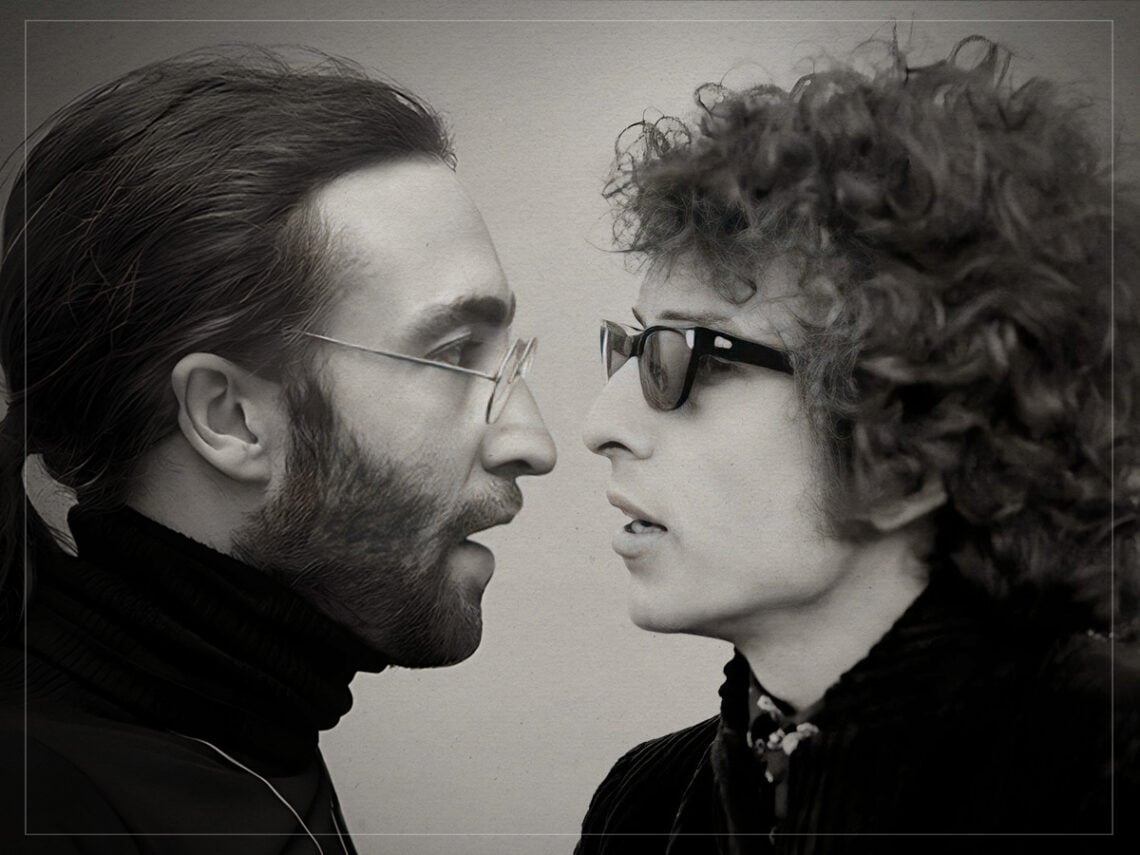
“Really pathetic”: The Bob Dylan song John Lennon couldn’t stomach

For a man who valued peace and love, John Lennon was also certainly prone to vitriol. He was more forthcoming with his opinion than a football pundit after a few pints.
Those opinions were often pretty far away from being prudish. However, that was also part of his lore—The Beatles would never have risen to such lofty heights if Lennon hadn’t been prepared to stick his head above the parapet.
It is a fact often forgotten that when the band ditched the hand-holding pop sentiments that had brought them to a precipice of fame known only to Jesus Christ, as Lennon would famously say, before them, they were only 21 to 23 years old. For working class kids, their search for something more profound at the possible expense of their promising careers was astounding.
However, Lennon had been inspired. The group had uncovered a Freewheelin’ Bob Dylan record while they were in France in 1964. When they later met him, Paul McCartney would say that he had uncovered the “meaning of life”. So, it goes without saying that they were rather moved by his music. None more so than Lennon. He would even admit that he was prone to imitating his hero on songs like ‘Norwegian Wood’.
By the same token, heroes were as questionable as everything else in the world in Lennon’s eyes, and the esteem in which he held Dylan did not exempt him from criticism. The Lennon of 1966 might’ve been the folk star’s biggest fan, but as he grew older and Bob Dylan became a born-again Christian, the original vagabond fell out of favour with the rock ‘n’ roll messiah he had helped to spawn.
“So here we sit, watching the mighty Dylan and the mighty McCartney and the mighty Jagger slide down the mountain… mud and blood in their nails”
John Lennon
Part of what frustrated Lennon so much was that he had always viewed Dylan as a symbol of rebellion and free thought. The Bob Dylan who inspired The Beatles to move beyond teenage love songs was the same artist who questioned authority and blurred the lines between poetry and protest music. To Lennon, seeing that same figure devote himself so publicly to religion likely felt like a betrayal of the restless spirit that had once made him such a cultural force.
At the same time, Lennon’s criticism also revealed how deeply he still cared about Dylan’s work. He rarely wasted this much energy attacking artists he considered irrelevant. Dylan had helped reshape Lennon’s understanding of songwriting during The Beatles’ most transformative years, so hearing him move into overtly religious territory clearly struck a nerve.
Even when mocking ‘Gotta Serve Somebody’, Lennon was still engaging with Dylan as though his music mattered enough to demand a response, which says almost as much as the insults themselves.
“So here we sit, watching the mighty Dylan and the mighty McCartney and the mighty Jagger slide down the mountain [with] mud and blood in their nails,” Lennon drawls into a dictaphone in 1979. “Well, I was listening to the radio,” he begins, “And Dylan’s new single or whatever the hell it is came on.” The track that he’s referring to is ‘Gotta Serve Somebody’, or as Lennon jokingly calls it ‘Everybody’s Gotta Get Served’, from Dylan’s 1979 record Slow Train Coming, the first in a series of born-again Christian records with heavy biblical overtones.
“He wants to be a waiter for Christ,” Lennon adds, laughing to himself. Thereafter, his critique becomes even more caustic. He adds,“The backing is mediocre […] the singing’s really pathetic and the words were just embarrassing.”

Later, he took this attack in a musical direction with his parody response to the demo ‘Serve Yourself’. Lennon sang: “You tell me you found Jesus/ Christ! Well, that’s great, and he’s the only one/ You say you just found Buddha?/, and he’s sittin’ on his arse in the sun?” The home-recorded satire, which you can listen to below, was first released in November 1998 as part of the John Lennon Anthology boxset.
As far as Lennon was concerned, Dylan had fallen from grace, and anything less than ridicule was tantamount to conspiracy. Around the time that the home recording was made in 1980, Lennon remarked to David Sheff: “Anybody who wants to hear Dylan just because of who he is isn’t gonna understand what Dylan is saying now or then. They’re just following some kind of image. They’re the sheep anyway.”
But was the song really that bad? Simply put, no. In fact, it is a bit of a gem amid an admittedly rather wayward period, and its message stretches far beyond pure religiosity. With a fair chunk of our readership being people at work, you may well be serving someone right now—particularly, if you work as a waiter for Christ.
As it happens, Dylan argues the exact inverse to Lennon, explaining that his derided Born-again phase was one of the strongest of his career, and people were just blinded by pious sentiment. He soldiered on with diminishing returns on all fronts. Saved reached a measly 24 in the US charts, and Shot of Love fared even worse, peaking at 33. For an icon of Dylan’s scope, these were disastrous figures. This was no 1960s comedown either, evidenced by the fact that at around the same time, Paul McCartney’s two releases, McCartney II and Tug of War, hit first and third in the charts. No, the prognosis was that Dylan had hit a major artistic downturn, and perhaps Jesus was to blame.
Nevertheless, the troubadour describes Shot of Love as his own finest work. “For me, I think it’s the most explosive album I’ve ever done,” he said in 1983. “I like Freewheelin’, and I like my first album. Shot of Love is my favourite, actually.” He wasn’t just after latent publicity either, because in 1985, he was still at it. “People didn’t listen to [Shot of Love] in a realistic way,” he told Cameron Crowe.
”The critics wouldn’t allow the people to make up their own minds,” he continued. ”All they talked about was Jesus this and Jesus that, like it was some kind of Methodist record. I don’t know what was happening, maybe Boy George or something, but Shot of Love didn’t fit into the current formula.”
Dylan explained that divergence as thus: ”People were always looking for some excuse to write me off and this was as good as any. I can’t say if being ‘non-commercial’ is a put-down or a compliment.” Lennon had found his excuse—but by the same token, it was that selfsame angling for iconoclasm that made Lennon the great artist he was.

Never Miss A Tale
The Far Out Bob Dylan Newsletter
All the latest stories about Bob Dylan from the independent voice of culture.
Straight to your inbox.