


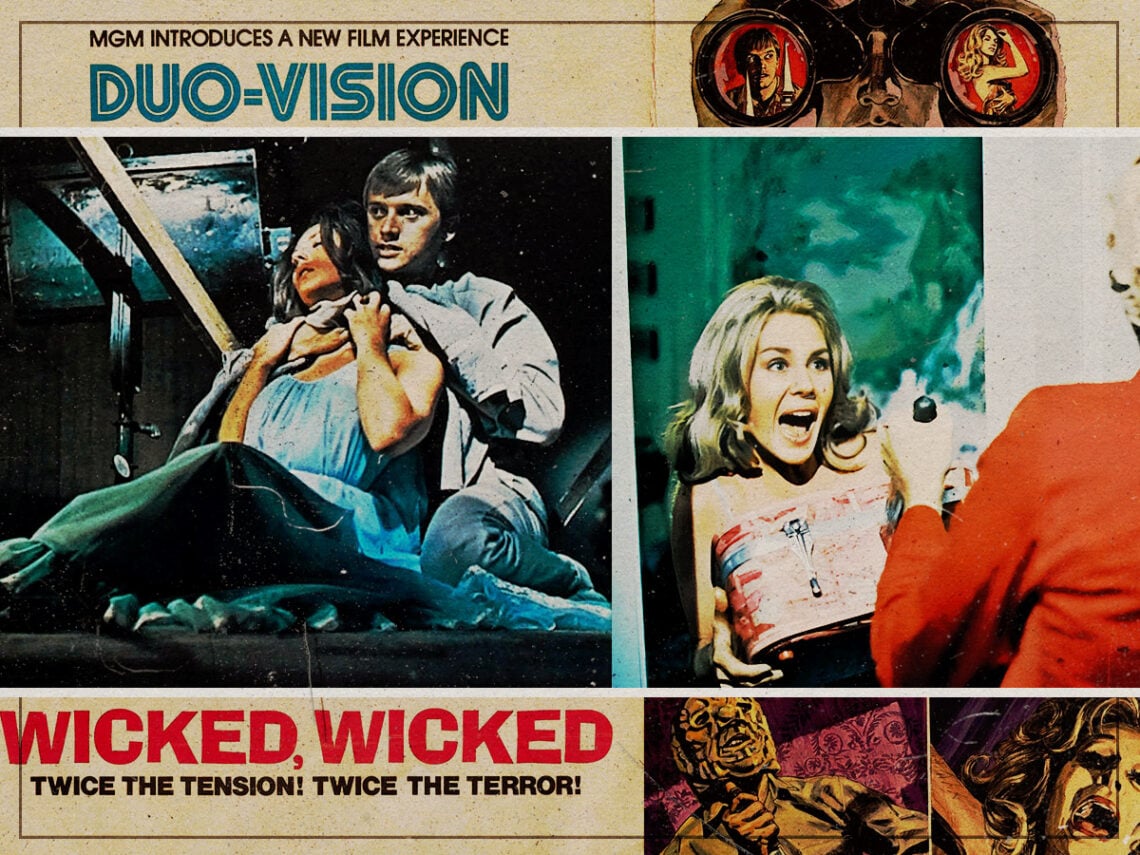
‘Wicked, Wicked’: the 1970s horror movie presented entirely in split screen

Sometimes, cinema gimmicks prove to be incredibly successful, such as 3D films, which had a good run in the 1950s and later in the 2000s. However, others remain more of a one-off, such as smell-o-vision, which never really caught on. It perhaps didn’t help that John Waters’ Polyester boasted a mixture of ‘flatulence’, ‘skunk’ and ‘dirty shoes’ scents to scratch and sniff in 1981.
However, in 1973, Richard L. Bare, who was a writer for The Twilight Zone and Green Acres, had the idea for his own movie gimmick, which he labelled ‘Duo-Vision’. The idea was essentially just split screen, a technique that had been around since the early days of cinema. However, it appears that Bare’s idea to create a movie entirely shot in split-screen, with two different perspectives on either side, was the first of its kind.
Wicked, Wicked was marketed by MGM as a “new film experience” with the tagline, “No glasses – all you need are your eyes”. The horror movie stars Tiffany Bolling as a singer at a hotel where blonde women are murdered. David Bailey plays her ex-husband, who happens to be investigating the disappearances of several blonde female guests. Thus, things get complicated when Bolling’s character, a brunette, begins wearing a blonde wig for her performances, making her a vulnerable target.
According to Bare, the idea for Duo-Vision came to him while driving. He explained to the Oakland Tribune, “As I glanced from one side of the freeway to the other, I noticed how my mind was taking a picture over here, then another over there.”
A year later, he expanded on his ideas with the publication. “Why not tell a film story with two simultaneous images?”
He added: “I had a script I had written called The Squirrel which had been on the market but hadn’t sold, so I just cut it up and patched scenes together here and there to make two parallel scripts.”
Bare continued: “My first problem was finding a typewriter with a carriage wide enough to take a legal-size piece of paper sideways, so I could type parallel scripts. Then I had to find a duplicating machine that would do the same thing.”
The director later had difficulties when it came to editing the movie, claiming that the process took 32 weeks to complete. Once the film was finally finished, Bare had to figure out how to project it, settling on utilising a unique 2.65:1 aspect ratio.
Despite Bare calling the film “high camp”, the movie was not particularly well-received by critics and faded into obscurity. However, Bare’s intentions for the movie remain impressive. He once detailed his ideas behind the technique, describing it as a way to show “truth and untruth”.
He added: “The Duo-Vision technique involves an active screen and a passive screen, meaning that dialogue comes from only one screen at a time while silent footage unreels on the other, so there is no dialogue confusion.”
