


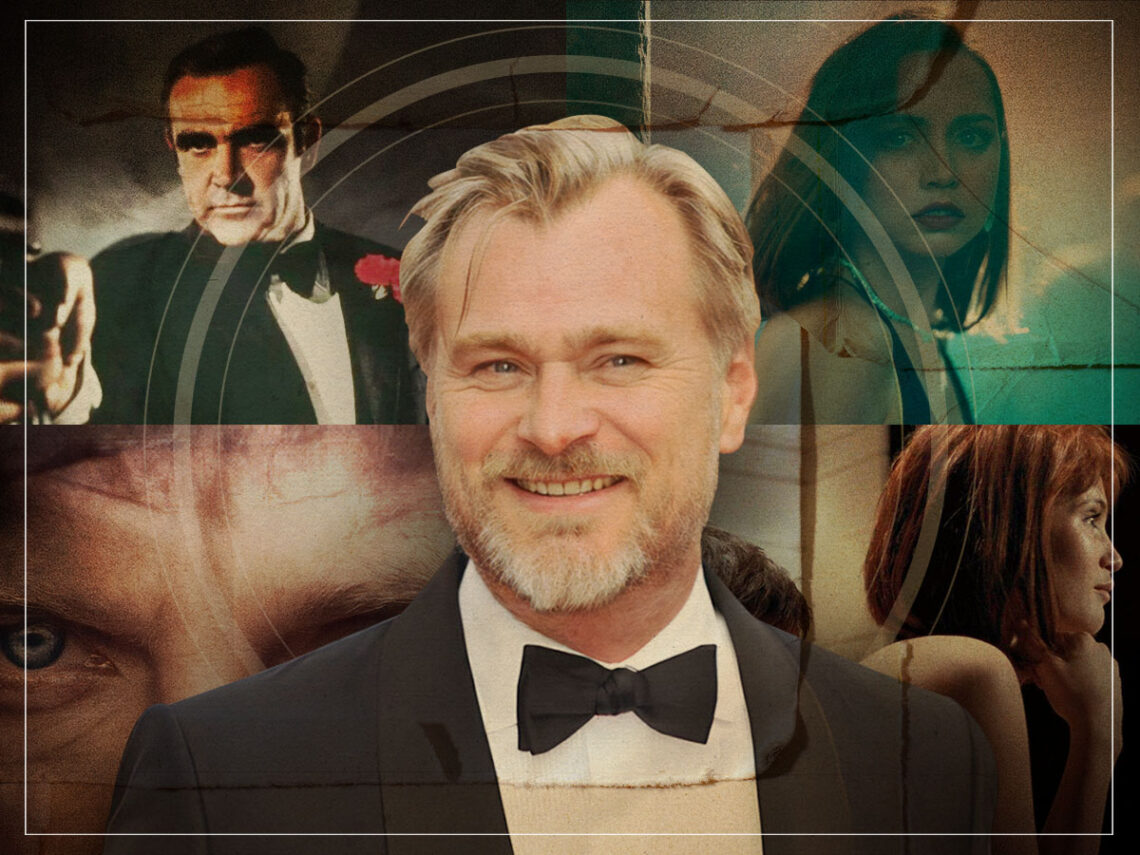
10 times Christopher Nolan ripped off James Bond

He couldn’t have known it at the time, but the worst thing Christopher Nolan ever did was let the world know he’d been a massive James Bond fan since he was an impressionable—and immaculately dressed, most likely—little nipper.
Ever since he hit the directorial big time 20 years ago, he’s never been able to escape the rumour mill. Every time a Bond film searches for a new director, Nolan’s name is always the one that rockets right to the top of both the wish list and the bookies’ odds.
At this stage, he’ll probably be happy if he retires without helming an official instalment in the ongoing adventures of 007 because he’s been spending a lot of that time liberally lifting from the iconic secret agent and repurposing them for his own cinematic agenda.
The only way people will stop demanding that Nolan helms a Bond movie is if he actually gets around to directing one, but as the following ten examples show, he may not need to when he’s been pilfering the back catalogue anyway.
So, how was Christopher Nolan inspired by James Bond?
10. Lucius Fox’s role in the Dark Knight trilogy
Obviously, the character of Lucius Fox comes directly from the comic books, but within the context of the Dark Knight trilogy, Morgan Freeman has much more in common with Desmond Llewelyn than he does with his counterpart on the printed page.
Much like 007’s trusted gadget maestro Q, Nolan used Freeman’s Fox as a kindly exposition machine who takes subtle digs at the protagonist’s extracurricular activities while kitting him out with his fancy toys and explaining to the audience what exactly it is they do, which inevitably comes in handy during an action scene.
Few actors deliver exposition with quite as much lyricism as Freeman, but Llewelyn wasn’t half bad at it, either. They’re too peas in a gadget-happy pod, and there are no prizes for guessing where Nolan drew his principal inspiration for Bruce Wayne’s world-weary outfitter.
9. The first act of Batman Begins
For more than 60 years, the Bond franchise has been characterised by villains who dwell in residences that don’t exactly seem fit for purpose, a sentiment that was applied liberally to the training sequences of Batman Begins.
Although it isn’t revealed until the third act that Liam Neeson’s Henri Ducard is actually Ra’s al Ghul, it should have been obvious from the start. After all, he trains Bruce Wayne on a frozen lake surrounded by glaciers, and the organisation he represents resides in an ominous mountaintop lair.
The bad guys occupying an isolated stronghold that nobody else can find despite the fact it’s the only looming structure for miles around it ripped right out of the 007 playbook, which was a warning sign that Neeson’s mentor wasn’t quite the stand-up guy he presented himself to be.
8. A suave, globetrotting protagonist
It goes without saying that every actor to play Bond, from Sean Connery to Daniel Craig, has needed to look the part. In order to do so, cinema’s favourite secret agent must be kitted out in the finest gear.
Another necessity is for the action to flit from one country to another as the narrative progresses, which Nolan has applied to several of his features. 007 may not have the monopoly on suave heroes who embark upon globetrotting escapades in a dapper ensemble, but few have replicated it as often as Nolan.
Bruce Wayne from the Dark Knight trilogy, Dom Cobb from Inception, Robert Angier from The Prestige, and Tenet‘s central pairing of John David Washington as the Protagonist and Robert Pattinson as Neil have all touched down in multiple countries while sporting the finest apparel, a Nolan hallmark that’s indebted to Bond.
7. Tenet, in general
Speaking of Tenet, it gave Nolan ample opportunity to put his own twist on a Bond flick while maintaining the type of ambitious narrative frameworks that have become synonymous with his work.
It’s a blockbuster espionage caper featuring twists, turns, subterfuge, and double-crosses, there’s a damsel in distress who needs rescued from the clutches of a nefarious villain, and that nefarious villain happens to be a foreign national with designs on world domination.
Throw in a MacGuffin that drives the story forward, the involvement of agencies both governmental and mysterious with their own agendas, and a central character plunged in at the deep end who ends the movie as the saviour of humanity having saved the day and the girl, and Tenet is positively Bondian.
6. The Dark Knight‘s skyhook
Making a detour from his usual haunt of Gotham City to swing by China and become a one-man extradition treaty, Bale’s Batman strongarms Chin Han’s criminal banker Lau back to the United States and escapes by hooking himself onto a passing aircraft.
It was an impressive sequence without a doubt, albeit one that looked awfully – some might even say suspiciously – familiar to the conclusion of 1965’s Thunderball, where Connery’s Bond makes a getaway of his own in very similar circumstances.
Not identical, though, if only because 007 would rather be doing something else with Claudine Auger’s Domino when he was lifted into the sky, which was definitely not the reason the ‘Dark Knight’ pitched up in Shanghai.
5. The plot of The Dark Knight Rises
This film features the main character being deserted by their veteran counsel, boasting a bald secondary villain known by a mononym that can’t feel pain, and a principal antagonist played by a French actor who beds the hero before revealing themselves to be the real brains behind the evil operation.
The scheme in question involves the detonation of a nuclear device, the protagonist suffers a serious injury at one stage that severely hampers their ability to pull off a daring act of heroism, and the aforementioned secondary villain hands their arse to them on a silver platter during their first encounter, before a confidant becomes the subject of a murder attempt.
In the third act, a tenuous alliance is formed between the hero and a character who’d previously made their lives miserable, only for the former enemy to heroically sacrifice themselves in the name of the greater good. The film, of course, is 1999’s The World Is Not Enough.
4. A knife in a shoe
Heath Ledger might have been playing a homicidal clown with green hair in The Dark Knight, but not even the ‘Jester of Genocide’ was immune from Nolan’s ongoing adoration of the Bond saga.
It’s only a minor moment in the grand scheme of Ledger’s iconic Academy Award-winning performance, but at one stage, the villain reveals that his DIY costume even extends to keeping a switchblade tucked away in his shoe for those moments where such a thing comes in handy.
Three decades previously, Rosa Klebb had adopted the exact same tactic in From Russia with Love as a last-ditch attempt to murder Connery’s operative. Neither of them strikes a killing blow, making it a rather useless accessory in hindsight.
3. The Dark Knight Rises opening scene
The Timothy Dalton era didn’t quite go to plan when his two-film stint as Bond coincided with a noticeable drop-off in box office earnings, but Nolan was evidently a fan of the actor’s work.
As spectacular as it is in isolation, the fingerprints of Licence to Kill‘s climactic airborne action scene are all over the opening of The Dark Knight Rises, which even earns bonus 007 points for doubling as a high-octane cold opening before the story properly kicks into gear.
Of course, Nolan put his own stamp on depicting a pulse-pounding midair ordeal that leaves plenty of debris and bodies by the wayside, but Dalton’s 007 still did it first.
2. Inception‘s snowcapped finale
No worthwhile Bond villain is complete without a lair, something Nolan took to heart when he staged his own expansive escapade during the grandstanding third act of Inception.
The filmmaker has never been shy about admitting that 007 was the biggest inspiration behind the extended set piece, but even if he hadn’t gone on the record acknowledging where his influences came from, they were pretty clear anyway.
It’s arguably Nolan’s most overt and intentional homage to the franchises he’s loved since his youngest days, but the downside is that it only reinforced many viewers’ desire to see him take that final step and take the reins on the genuine article.
1. Underwritten female characters
The Daniel Craig era did put in the work to ensure its female characters were more than the one-note archetypes of the previous six decades, but it’s something Nolan still hasn’t been able to shake.
He’s unquestionably one of the finest filmmakers working today, but the single biggest recurring criticism of his career is that his filmography remains sorely lacking in well-rounded women. For anyone who wants to pull out Emily Blunt’s Oscar-nominated Kitty Oppenheimer card, don’t forget she’s a real person who was exhaustively researched in the name of accuracy and authenticity before the script was written.
When Nolan has to craft female characters from the ground up, the evidence has been steadily mounting for years that it’s the weakest weapon in his arsenal. In his defence, it took the Bond series the better part of half a century before that particular conundrum was solved, so there’s still plenty of time to right the ship.
