


10 songs given a second life by movies

Music and film go together like strawberries and cream, macaroni and cheese, or David Lynch and Harry Dean Stanton. Soundtracks have always been a pivotal aspect of filmmaking, from back in the days of silent films in which orchestral accompaniment was vital to the production of the final movies. In the modern age of filmmaking, soundtracks can often make a lasting impact on audiences, with some songs spawning a second life after their inclusion in a film.
There are countless examples of tracks which were first created for film and then went on to be smash hits in their own right, the likes of Whitney Houston’s ‘I Will Always Love You’ from Bodyguard or Berlin’s ‘Take My Breath Away’ from Top Gun springing to mind. However, there are further instances of movies repopularising already successful songs after including them within their soundtrack.
Back in 2022, ‘Running Up That Hill’ reached number one in eight different countries almost four decades after its original release due to its use in the Netflix series Stranger Things. Elsewhere, John Cooper Clarke has spoken about his gratitude for his single ‘Evidently Chickentown’ being used in The Sopranos, as it helped to endear his work to a new generation. Being included in film and television soundtracks often has the ability to re-energise tracks and expose them to a new audience after their initial release.
Film and television soundtracks can give hit songs a second run in the charts – as was the case with ‘Running Up That Hill’ – whereas sometimes those soundtracks can help to drag up an obscure track from the past and give it a new life, allowing audiences to appreciate the track in ways which they had not previously. So, with that in mind, let us count down some of the greatest examples of tracks which had new life breathed into them by their inclusion in film soundtracks.
10 songs given a second life by movies:
‘Stuck In the Middle With You’ by Stealers Wheel – Reservoir Dogs (1992)
Quentin Tarantino is often lauded for the soundtracks of his films. From Pulp Fiction to Once Upon A Time in Hollywood, the director seems to place a great deal of importance on the music which accompanies his work. Throughout his filmography, though, the stand-out musical moment would have to be his use of Stealers Wheel’s ‘Stuck In the Middle With You’ in Reservoir Dogs.
Accompanying the iconic torture scene in Tarantino’s movie, the track was first released back in 1973. The Gerry Rafferty-penned song became a top ten hit for Stealers Wheel in both the US and UK, in addition to four other countries worldwide. Even from the audition stages of the film, Tarantino had his heart set on using ‘Stuck In the Middle With You’. For many people who first heard the track by watching Tarantino’s film, it is now forever linked to the sight of Michael Madsen cutting Kirk Baltz’s ear off with a razor.
‘Twist and Shout’ by The Beatles – Ferris Bueller’s Day Off (1986)
As one of the biggest bands of all time, The Beatles certainly did not need film soundtracks to help them get hits. Nevertheless, they found their second charting single of the 1980s after ‘Twist and Shout’ was used in a popular scene from the John Hughes classic Ferris Bueller’s Day Off. During the scene, Ferris lip-syncs along to the track during a parade through Chicago as the rest of the city becomes infected by a temporary bout of Beatlemania.
Originally released in 1963, The Beatles cover track was famously recorded in a single take. Reaching number two in the US singles chart, at a time in which the entire top five was composed of Beatles tracks, the song re-entered the charts in 1986 after its inclusion in Hughes’ film.
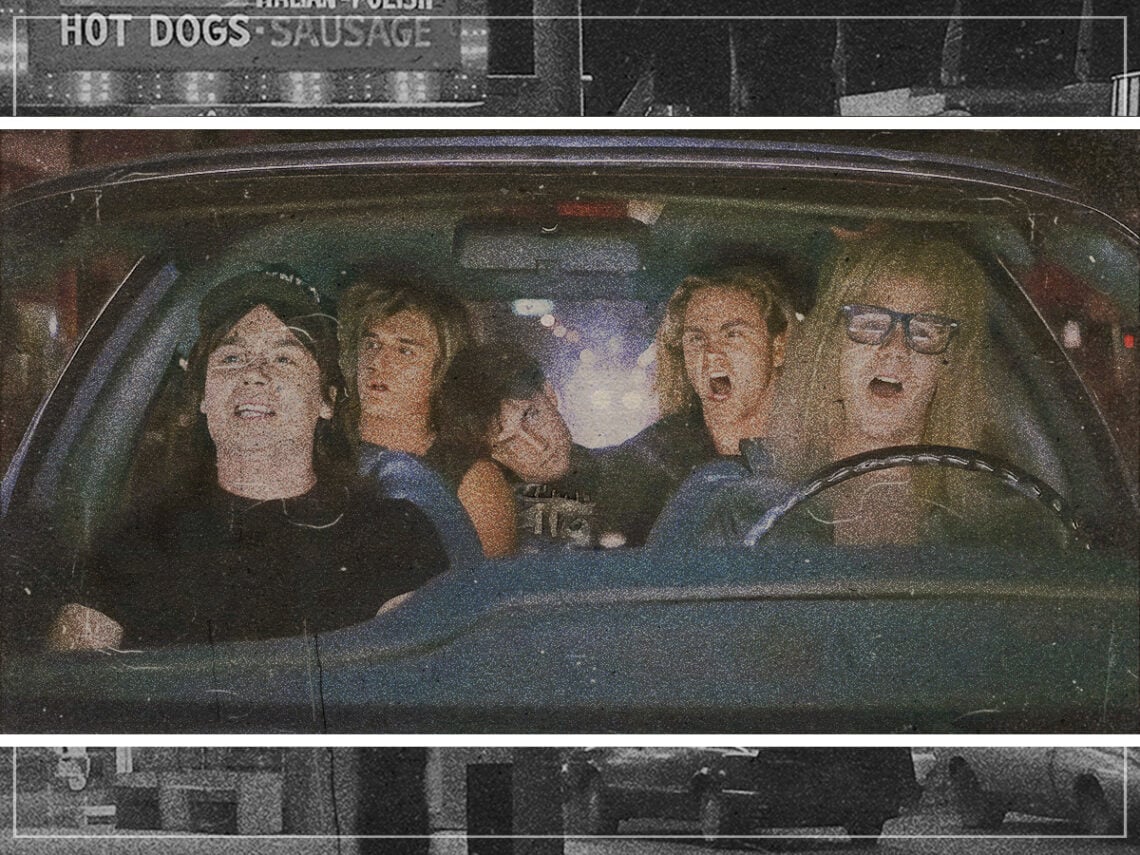
‘Bohemian Rhapsody’ by Queen – Wayne’s World (1992)
When ‘Bohemian Rhapsody’ was first released in 1975, there were very few expectations for it to do well. At nearly six minutes long, it was deemed too long for radio play, and record executives reportedly thought it was too complex a song to be a hit. Despite this, the Queen track quickly became a number one single and Queen’s defining track.
The opening scene of the Mike Myers comedy flick Wayne’s World features the song, setting the tone for the entire film. Wayne and the other main characters perform a kind of proto-carpool karaoke to ‘Bohemian Rhapsody’ in their baby blue AMC Pacer. Released shortly after the passing of Freddie Mercury, the film is credited with getting the single to reach a new peak in the US singles charts in 1992.
‘Unchained Melody’ by The Righteous Brothers – Ghost (1990)
The highest-grossing film of 1990, Ghost, gripped the world. Following a murdered banker’s ghost and his quest to save his girlfriend from the killer, the film had a huge impact on audiences in the early 1990s. During one of the most recognisable scenes from the film, Patrick Swayze can be seen sharing an intimate pottery wheel with Demi Moore as ‘Unchained Melody’ plays in the background.
The Righteous Brothers track was a modest success upon its initial release in 1965, reaching number 14 in the UK singles chart. However, after its inclusion in Ghost, a newly rerecorded version of the song spent four weeks at the top of the singles chart in 1990.
‘White Rabbit’ by Jefferson Airplane – Platoon (1986)
Of all horrific conflicts, the war in Vietnam was probably the best soundtracked. The counterculture and anti-war movement spawned a generation of peace-loving hippies, popularising artists like The Byrds, Bob Dylan and Jefferson Airplane. Jefferson’s seminal track ‘White Rabbit’ was featured in the 1986 Vietnam War film Platoon, which introduced its LSD-influenced imagery and built tension to a new audience.
‘White Rabbit’ is no stranger to cinema, being included in various soundtrack albums over the years, notable for the bathtub suicide scene in Fear and Loathing in Las Vegas. However, it was in Platoon that the track was given a new life. The song plays as Charlie Sheen’s character smokes dope for the first time in the barracks of Vietnam. ‘White Rabbit’, which features the iconography of Alice in Wonderland, reaches its peak as Sheen’s character inhales smoke from the end of a rifle. After the film’s release in the UK in 1987, the track entered the singles chart for the first time.
‘Green Onions’ by Booker T. and the MGs – Quadrophenia (1979)
One of the most well-known instrumental tracks of all time, ‘Green Onions’ is a fantastic soul floor-filler. Released in 1962 by then-17-year-old Booker T Jones, the song arose from a simple twelve-bar blues rhythm played on a Hammond organ. Although its simplicity has been credited with its success, Jones claims the track is a lot more complex than it seems.
‘Green Onions’ topped the US R&B charts in 1962, establishing Booker T and the MGs as talented musical forces in their own right, as opposed to the Stax session musicians they had started out as. However, it was not until the song was included in the 1979 classic film Quadrophenia that it became a hit in the UK. In the film, the song is played during a Mod all-nighter in Brighton, with Sting busting some questionable moves to the signature sound of Booker T’s organ.
‘Le Temps De L’Amour’ by Françoise Hardy – Moonrise Kingdom (2012)
The films of Wes Anderson have always enjoyed fantastic soundtracks, from the beautiful Seu Jorge David Bowie covers of The Life Aquatic to the West Coast Pop Art Experimental Band theme of Isle of Dogs. His 2012 coming-of-age film Moonrise Kingdom is no exception. The incredibly endearing tale of two disenfranchised kids who run away together features tracks by the likes of Hank Williams, Frank Schubert and Leonard Bernstein.
In one of the most pivotal scenes in the film, the young couple sets up camp on a beach and occupies their time by reading, swimming, and dancing to Françoise Hardy’s ‘Le Temps De L’Amour’. The song provides the backdrop to the couple’s first kiss as they listen to the classic song through a Barrington portable turntable. Françoise Hardy is undoubtedly among the biggest musical exports of France, but the use of her song on this soundtrack definitely hooked a lot of the younger generation onto her music.
‘Where is My Mind?’ by Pixies – Fight Club (1999)
Giants of alternative rock, Pixies influenced a vast range of future artists, from Nirvana to Weezer. Although the groups were tremendous in their respective scene, Pixies were always reasonably underground. When ‘Where Is My Mind?’, arguably their biggest track, first came out in 1988, it did not receive much attention outside of Pixies’ fanbase.
However, the song made a big cultural impact after being used for the grand finale of the 1999 classic Fight Club. As the surrounding city explodes, with Edward Norton watching on, smiling, ‘Where Is My Mind?’ fills the airwaves. The cultural impact of the film itself was massive, so it stands to reason that the song used in its final moments would have a renaissance as a result.
‘Pretty in Pink’ by The Psychedelic Furs – Pretty in Pink (1986)
Many songs on this list have been pivotal to the films they feature in, but none have been so important as to provide the film’s actual title. Pretty in Pink took its name from the The Psychedelic Furs track, and the band graciously re-recorded the song for inclusion on the soundtrack. The score itself is notable in its own right, often hailed as one of the greatest in all cinema, but the Furs track is certainly the defining song of the film.
The second John Hughes film to feature on this list, the writer and director was famed for his use of up-to-date music in his films, embracing new wave and current pop trends. Although ‘Pretty in Pink’ was a fairly successful track for the Furs on its 1981 release, their re-recorded version for the film was a much bigger commercial hit, peaking at number 18 in the singles charts.
‘Lust For Life’ by Iggy Pop – Trainspotting (1996)
When it comes to soundtrack albums, Trainspotting is often held up as the gold standard. As an album, it really captured the zeitgeist of the time. Featuring the likes of Lou Reed, New Order and rising Britpop groups Sleeper, Blur and Pulp, it is easy to see why people talk about how great the Trainspotting soundtrack is. Of all the songs on the album, though, ‘Lust for Life’ is perhaps the most synonymous with the film.
Playing during the iconic ‘Choose Life’ opening of the film, as Renton and Spud run through Edinburgh evading police, ‘Lust for Life’ was used heavily in the promotion of Trainspotting. The track failed to chart upon its initial release in 1977, but such was the cultural phenomenon of Trainspotting that it reached number 26 in the UK singles chart in 1996. Its success was likely helped along by the fact that Iggy Pop is mentioned multiple times throughout the film itself. Not only did Trainspotting repopularise ‘Lust for Life’, but it forever tied itself to that track.

Never Miss A Beat
The Far Out Beatles Newsletter
All the latest stories about The Beatles from the independent voice of culture.
Straight to your inbox.