


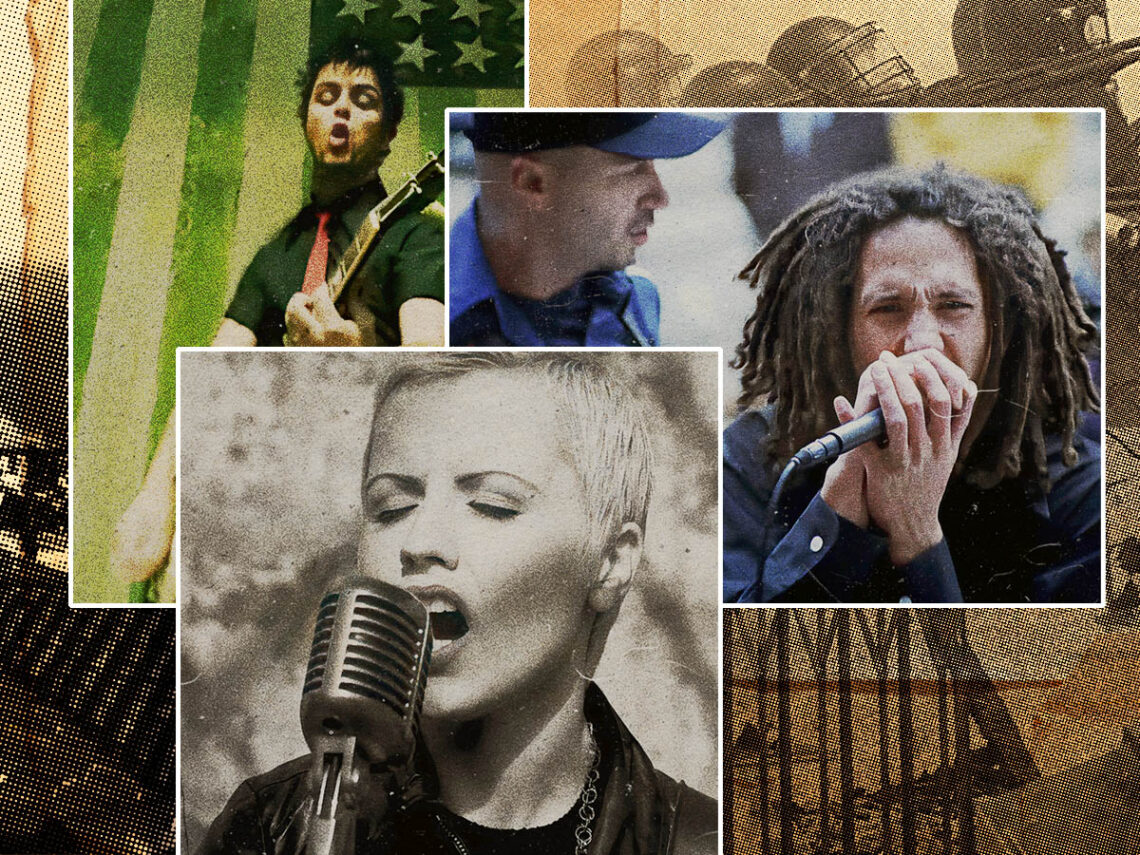
10 rock songs inspired by political events

The best rock anthems tend to come from a place of passion. Although a handful of decent tracks have been written as a work job by world-class songwriters, a tune tends to connect with the public more when there are singers who believe in what they’re singing. While that enthusiasm usually comes from emotions like love and heartache, acts like Rage Against the Machine and The Beatles looked to current events as their muse.
When each song was brought to the hit parade, the world was going through its fair share of turbulence, whether it was the abuse of power in politics or a massive change of the guard. Rather than idly stand by, the premier artists of their time decided to voice their confusion, either showing support for the marginalised or throwing a middle finger in the face of the corrupt.
Rather than strictly political events, a handful of political tracks deal with the pain and strife that have come with politically motivated violence. From chaos and disorder overseas to the threat of terrorist attacks in the modern age, fans saw their favourite artists’ bleeding hearts as they prayed for a better world.
While some political tirades may genuinely disdain political movements, they never feel like they are brow-beating their audience with their ideologies. Each song is meant to be a unique take on how the times were in the moment and to inspire people to take initiative in what was going on outside of their everyday lives.
10 rock songs inspired by political events:
10. ‘The Lonesome Death of Hattie Carroll’ – Bob Dylan
For the first half of the 1960s, Bob Dylan practically made his living by writing political songs. As a folk singer, Dylan’s tunes felt more like reporting through music, discussing the problems in the modern landscape in ‘The Times They Are A-Changin’ and ‘Blowin’ In the Wind’. Though Dylan could paint with a broad brush, ‘The Lonesome Death of Hattie Carroll’ had a specific target in mind.
Tracing back to a race-related murder, Dylan tells the tale of Hattie Caroll, a black woman who worked in a bar and died after suffering a blow to the head by patron William Zanzinger. Although Zanzinger did face legal action for his crime, the verdict was far less than expected, getting out on bail and not having to spend a day in jail for his gruesome actions.
Although Dylan doesn’t leave anything to the imagination in the song, the chorus is the main draw, reminding everyone that now is not the time for them to cry. Injustices like this can only happen when the public accepts it, and by protesting the death of this innocent woman, Dylan knows that politicians will never forget the tale of a woman who died for nothing. Hattie Carroll’s life may have been cut short, but her memory lives on in Dylan’s immortal words.
9. ‘BYOB’ – System of a Down
As the 2000s was dawning, America was getting ready to head off to war. In light of the terrorist attacks of 2001, the Bush administration had started enacting plans to invade Iraq and Afghanistan over suspicion of targeted terrorism, which was transparently flimsy throughout congressional hearings. System of a Down were never one to shy away from politics on albums like Toxicity, and they weren’t about to stop with a country in shambles.
Painting the war as a dystopian fever dream, the kickoff to the band’s album Mezmerize, ‘BYOB’, was a heavy metal assault on the senses, with Daron Malakian’s guitar practically sounding like a machine gun throughout the song. While most of the song is at full blast, the terrifying section of the track is the most mellow portion, as if Serj Tankian is playing the role of media propagandist, making the thought of going off to war sound intriguing and fun.
By the time the song hits its final breakdown, Tankian is playing the role of a political radical, thinking that patriotism can only be earned by coming to the party and supporting the war no matter the cost. A handful of politicians may have been trying to sway public opinion, but the sad truth is that the poor are the ones who truly suffer in the equation.
8. ‘Ohio’ – Crosby, Stills, Nash and Young
Once the psychedelic movement began, politicians saw the youth start to decay. Rather than the cosy jobs lined up for the next generation, kids were taking to the counterculture, trying hallucinogens and protesting the Vietnam War, which never sat well with those who started the fighting in the first place. While peaceful protesting was happening across the US, Neil Young pulled none of his punches once the other side decided to turn violent.
During a peaceful protest at Kent State University, authorities turned their guns on the protesters, leaving many participating students dead in the Ohio sun. Looking to document his experience seeing the coverage on the news, Young’s greatest offering to CSNY turned into ‘Ohio’, offering a scathing indictment for the heartless policemen that took children’s lives that day.
Although the ‘Summer of Love’ may seem like an idyllic place to be through rose-coloured glasses, ‘Ohio’ is a look at what the dark side of Flower Power was all about. Whereas most people were walking around with flowers in their hair, Young could only remember the site of men with badges who decided to shoot first and ask questions later.
7. ‘My City Of Ruins’ – Bruce Springsteen
The entire US seemed to come to a standstill on the morning of September 11th, 2001. In just hours, the two planes that crashed into the World Trade Center in New York City left everyone shellshocked and glued to their televisions as they mourned those innocent citizens who lost their lives. Although many New York musicians reached out to show their support, it took a guy from Jersey to write the most poignant song about the tragedy.
Debuting on TV just a few weeks after the tragedy, Bruce Springsteen paints a grim picture of what he saw in ‘My City of Ruins’, taking inventory of the lives lost and what an attack like this means for the rest of the world. While most would respond in anger, Springsteen is just genuinely hurt by the tragedy, reacting to the millions of people who never knew that their loved ones would not be coming home that day and feeling helpless.
That mentality would go on to fuel The Boss’s songwriting on his next album, The Rising, which detailed the many different stories that came along with the tragedy, like the sad sounds of ‘You’re Missing’ or paying tribute to those who tried to help in whatever way they could on ‘Into the Fire’. There’s no way to truly recover from a tragedy like 9/11, but Springsteen showed millions how to process their grief.
6. ‘Sunday Bloody Sunday’ – U2
The thought of U2 using their music to enact change feels like a long-forgotten memory these days. Before the ‘grandma-sunglasses’ era of Bono’s development, he decided to use his lyrics to cover the heaviest topics he could, whether it was finding the meaning of love on Achtung Baby or discovering his faith again on October. As Ireland went through one of its darkest days, Bono knew he couldn’t hold anything back on ‘Sunday Bloody Sunday’.
Documenting the horrific violence that went down on January 30th, 1972, the lion’s share of the lyrics feels like they could have been written by anyone seeing the coverage of the events at home. Regardless of how much Bono might try to make the images of the dead disappear, the carnage is practically tattooed on his mind.
Rather than sit around and wait, Bono uses his platform as a call to arms, calling for the millions who saw the events to protest their right to live how they want to live, regardless of what the authorities might think of them. U2 might have sold their souls to big business more than a few times over the years, but whenever Bono sings, “How long must we sing this song?” it always feels like it’s coming from the depths of his broken heart.
5. ‘War Pigs’ – Black Sabbath
As rock made its way out of the 1960s, the same old problems persisted. No matter how much Flower Power may have dominated the culture, the Vietnam War still raged overseas, with millions of soldiers coming back twisted and seeing carnage that was never meant for human eyes. While Black Sabbath was already becoming known as a sinister band, ‘War Pigs’ was a warning that the greatest evil is man-made.
Set to a plodding blues groove, Ozzy Osbourne sings lyrics about the corrupt generals who are leading poor soldiers off to a war that they don’t want to fight. Although Osbourne condones those in power for making the poor fight their wars for them, he knows that that kind of corrupt ideology comes at a price.
Imagining what the world will be like when judgement day comes, the final verses detail an apocalypse where the world stops turning and is reduced to darkness. Rather than have the poor fight against anything, Satan gets vengeance on those politicians, spreading his wings across the land and reducing the corrupt to rubble. The Vietnam War may have been a misguided display of carnage, but ‘War Pigs’ is why people should stand up against greedy politicians who only want to see the bodies burn.
4. ‘Zombie’ – The Cranberries
For an entire generation of people, The Cranberries tends to be that one band that every mothr has jammed to at least once, whether it’s blasting ‘Dreams’ in the car or crying their eyes out to ‘Linger’. Although The Cranberries have earned a reputation as one of the rulers of adult contemporary music, ‘Zombie’ is a reminder of what they could sound like when they got nasty.
Reminiscing on the aftermath of The Troubles in their native Ireland, Dolores O’Riordan shakes with anger throughout the song, talking about the senseless violence that happened when the bomb attacks began. Keeping with the title of the song, O’Riordan can only see someone who would enact such despicable behaviour as a mindless zombie, only looking to serve the bottom line rather than think about the destruction that they’re causing every time one of the bombs drops.
The instrumentation follows O’Riordan’s lead throughout the song, constantly swelling with intensity before slamming into the chorus. Even without knowing the lyrics, listening to the backing track gives the listener a sense of unease, as if they’re caught in the chaos right before detonation.
3. ‘American Idiot’ – Green Day
Punk rock has always been a staple genre for protest songs. From the Sex Pistols first bursting onto the scene with ‘God Save the Queen’ to pretty much any Clash song, there’s usually a target in mind when going through certain punk rock anthems. Although every band of punk’s golden age had an agenda in mind, Green Day stepped up to the plate with a firm condemnation of war on ‘American Idiot’.
As a visceral reaction to the Iraq War, Billie Joe Armstrong wrote ‘Idiot’ as a scathing critique about those who give in to blind patriotism. Although he acknowledges in the song that people would be criticised for disagreeing with war practices, Armstrong proudly claims to not be a part of a “redneck agenda”, pointing the finger squarely at George W. Bush for his dimwitted choice for waging war overseas.
Then again, Armstrong is also looking to wage war against the media, always trying to beat US citizens into submission by showing war propaganda on TV while still grieving tragedies like 9/11. The world was on the precipice of the information age in the early 2000s, and Armstrong created a firm reminder not to let go of one’s moral ideals.
2. ‘Killing in the Name’ – Rage Against the Machine
There aren’t too many songs by Rage Against the Machine that didn’t have to do with politics in some form. The entire mentality of the band was to give a voice to the disenfranchised, so there was no way they would write meatheaded songs about sex and drugs. As America watched in horror at the LA riots in the early 1990s, Rage had a different outlook on the assault that inspired them.
When reacting to the verdict of the Rodney King trial, LA dwellers were livid when the cops charged with his murder got off with no questions asked. Rather than talk about the trial specifically, ‘Killing in the Name’ spotlights a problem that Zack de la Rocha knew all too well, looking at the racism in law enforcement. Although there may be no firm confirmation, Rocha is convinced in the song that police officers were members of the Ku Klux Klan, willing to beat black men into submission because of their racist beliefs.
Considering the horrors that have gone on in recent years as a result of corrupt policemen, Rage’s words seem more relevant now than ever, especially when Rocha erupts in anger towards the end of the song by screaming, “Fuck you, I won’t do what you tell me.” Rage may have gotten a lot of flak for getting too political in the aftermath of the George Floyd protests, but anyone dogging them for airing their opinion wasn’t listening hard enough back in the day.
1. ‘Revolution’ – The Beatles
For the first half of their career, The Beatles had practically made a point not to talk about politics. Since they were one of the biggest bands of all time, it would have been divisive amongst their fans to air their opinion about hot-button issues like The Civil Rights Movement or the Vietnam War. With their manager, Brian Epstein, passing away, John Lennon had no tolerance for stifling himself anymore.
Being the first overtly political track the band would create, Lennon imagined ‘Revolution’ as his ultimate statement on protests in America. Although there are clear signs that he is in favour of standing up against the corrupt, Lennon offers a look at what people are fighting for in the first place, wondering what the world will look like after everything is burned to the ground.
Recording it in several versions on The White Album, each interpretation offers its own take on what Lennon saw as revolution, from the raucous energy of the single version to painting a picture of what revolution would look like in one’s mind on ‘Revolution 9′. Although the tune may have been full of the same Beatles whimsy most would expect, Lennon was inching closer to the political doctrine of his solo career.

Never Miss A Beat
The Far Out Beatles Newsletter
All the latest stories about The Beatles from the independent voice of culture.
Straight to your inbox.