


The politics of Rage Against the Machine in five pivotal moments

Rage Against the Machine is truly one of the most influential and important bands of all time. Not only does the Los Angeles outfit effortlessly combine the genres of rap, rock, funk and metal, but they are also one of the most politically engaged bands in recent history, with lyrics leaning vehemently in the direction of freedom and justice.
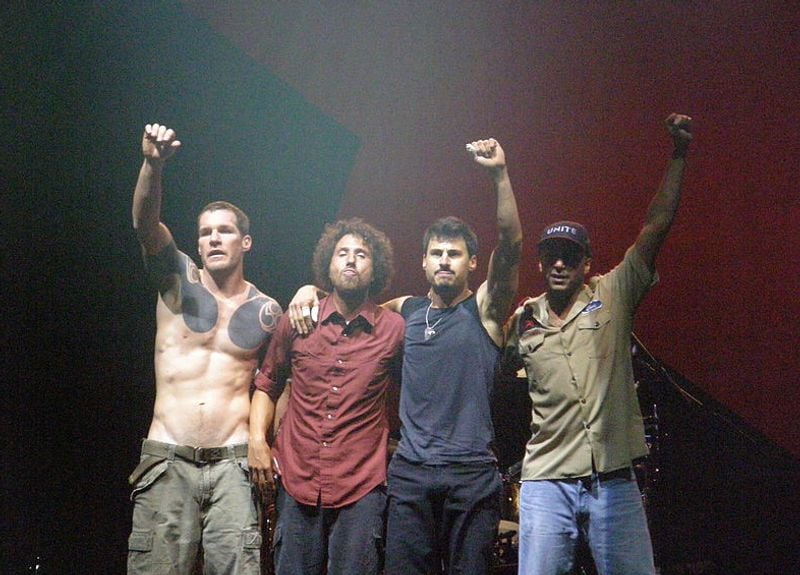
The band was formed in 1991 by guitarist Tom Morello, vocalist Zach de la Rocha, bass player Tim Commerford and drummer Brad Wilk, with Wilk having previously unsuccessfully auditioned for the band that would later become Pearl Jam.
The release of the band’s self-titled debut album in 1992 established the group as the most vitriolic group of the decade, with songs such as ‘Bullet in the Head’, ‘Take the Power Back’ and ‘Killing in the Name’ expressing the most vital political issues of the 20th century, including education, censorship, class injustice and military conscription.
The primary target of Zach de la Rocha was the American government, and across the self-titled record as well as through its follow-up releases, 1996’s Evil Empire and 1999’s Battle for Los Angeles, de la Rocha persistently called out the powers that be for the way in which they had treated their subjects with injustice and utter disinterest for their well-being.
Over the years, the band frequently took part in several domestic and international protests and activism campaigns that sought to enlighten society’s global political consciousness. Through being signed to one of the biggest record labels in the world, Sony (via Epic), de la Rocha felt that the platform enabled the band to disseminate their message to a broader audience.
As for using music as a means of political awakening, de la Rocha once said: “I’m interested in spreading those ideas through art, because music has the power to cross borders, to break military sieges and to establish real dialogue.” Amongst those beliefs is the freedom of civilians in countries with authoritarian political regimes, primarily in Central and South America.
To celebrate de la Rocha’s birthday, we’re going to take a closer look at five pivotal moments that define the politics of Rage Against the Machine. From campaigns in the indigenous communities of Mexico to several polemic outbursts in the United States via a truly angered appearance on Saturday Night Live, prepare yourself for political enlightenment.
The politics of Rage Against the Machine:
Saturday Night Live Steve Forbes incident
When Rage Against the Machine appeared on Saturday Night Live in April 1996, the show was hosted by ex-Republican presidential candidate and multi-millionaire Steve Forbes: a mix bound to end in tears. According to Tom Morello, the band “wanted to stand in sharp juxtaposition to a billionaire by making [their] own statement.”
To do that, the band suspended two inverted American flags on stage. “America’s freedom of expression is inverted when you’re free to say anything you want to say until it upsets a corporate sponsor,” Morello said. However, the flags were quickly removed mid-set, prompting outrage in which the band were asked to leave the building, at which point Tim Commerford stormed into Forbes’ dressing room and threw shredded pieces of the flag at him.
Supporting the Zapatista Army of National Liberation
Rage have offered their support to the Zapatista Army of National Liberation, which Morello describes as “a guerrilla army who represent the poor indigenous communities in southern Mexico who, for hundreds of years, have been trodden upon and sort of cast aside and which really are the lowest form on the economic-social ladder in Mexico.”
De la Rocha has made several trips to the Mexican state of Chiapas to help their efforts of rebellion. At the core of the band’s politics is the emancipation of downtrodden groups and the EZLN utterly represents this. “[The US and Mexican governments] will never be able to isolate the Zapatista communities from the people in the United States,” de la Rocha said.
Hosting Radio Free L.A.
Rage hosted a radio show on January 20th, 1997, the night on which Bill Clinton was inaugurated as the United States president for the second time. The band played a number of tracks from their catalogue and featured segments from the likes of Michael Moore, Public Enemy’s Chuck D and Noam Chomsky. The reason for hosting the show was that the band wanted to highlight the fact that people had lost faith in politics.
They stated: “That election had resulted in one of the lowest voter turnouts in the history of the country, as more and more Americans came to realize that their government was not in their hands, but in the hands of big business. Radio Free L.A. provided a musical and political gathering point for the majority of Americans who rightly felt left out of the ‘democratic process.'”
Playing the 2008 Republican National Convention
The year after the band reformed in 2007, they were set to play a free show on the State Capital lawn in St. Paul, Minnesota, in protest against what de la Rocha called “the power-abusing party”. However, when the band arrived, they were swarmed by riot police who told them that they would be arrested if they approached the stage.
However, Morello noted: “This is a band that has made a living singing a song that goes ‘Fuck you, I won’t do what you tell me,’ so we weren’t about to go back to the hotel with our tails between our legs. So we out-flanked the police line and went into the middle of the crowd, and played a couple of songs passing a bull horn back and forth, and it seemed to go over pretty well.”
Response to the Fox News Iraq War controversy
When Rage played at Coachella in 2007, de la Rocha told the crowd that if the same laws that were applied to the Nazis after World War II today, then all the United States presidents after Truman would be executed. Shortly after, a clip of the speech appeared on Fox News in which the headline read, “Rock group Rage Against the Machine says Bush admin should be shot.”
The was a great uproar surrounding de la Rocha’s comments, but rather than be shamed by the public, he simply stated during another show, “we don’t back away from the position because the real assassinator is Bush, and Cheney and the whole administration for the lives they have destroyed here and in Iraq. They’re the ones. That’s what we said. And we refuse not to stand up, we refuse to back down from that position.”
